
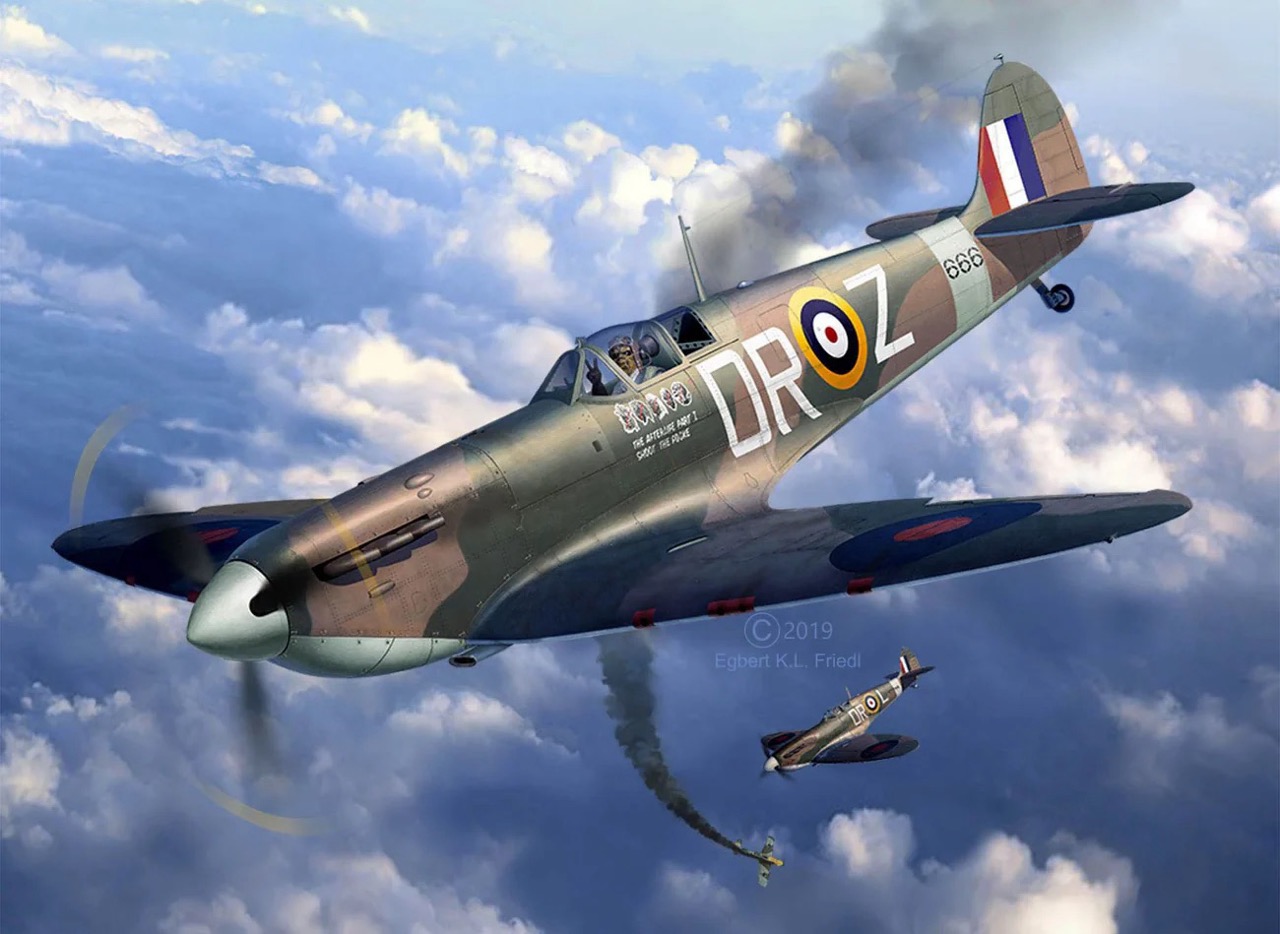
In 2026, Iron Maiden are celebrating their 50th anniversary with their Run for Your Lives World Tour, filling stadiums all over the world. For the encore, “Aces High” rings out every single time, introduced by Churchill’s famous speech, a Spitfire built to almost full scale flies over the stage, and the crowd goes wild. For everyone who wants to experience this energy off the stage too, we at Revell have two very special models in our range: the Spitfire Mk.II “Aces High” Iron Maiden as a classic plastic model kit gift set and the Iron Maiden Spitfire MK.II Aces High as a brick model in the Revell Brick System. Both sets combine aviation history, iconic music and ambitious model building in a way that has never existed before.
Reginald Mitchell and the Birth of a Legend
The story of the Supermarine Spitfire doesn’t begin in a cockpit, but at the drawing board of a man from the Potteries, the ceramics heartland of the English Midlands. Reginald Joseph Mitchell, born in 1895 in Butt Lane, Staffordshire, joined the Supermarine Aviation Works in Southampton as a young engineer. During the 1920s and 1930s, he designed a series of groundbreaking racing seaplanes for the prestigious Schneider Trophy competition. His Supermarine S.6B won the trophy outright for Great Britain in 1931, setting a new world air speed record of 407.5 mph along the way.
Drawing on the aerodynamic insights from these racing machines, Mitchell began developing the “Type 300” in 1934, a revolutionary fighter aircraft with elliptical wings and the legendary Rolls-Royce Merlin engine. On 5 March 1936, the prototype K5054 took off from Eastleigh Aerodrome, flown by test pilot Joseph “Mutt” Summers. His terse verdict after landing went down in aviation history: “Don’t change a thing.” The tragic part of this story: Mitchell was diagnosed with cancer in 1933 and worked tirelessly to finish the prototype despite his illness. He died on 11 June 1937 at the age of just 42 and never lived to see his creation in combat. His successor, Joseph “Joe” Smith, took over the further development of the Spitfire and carried it through the entirety of the Second World War.
“Achtung, Spitfire!” and the Battle of Britain
The moment that turned the Spitfire into a legend came in the summer of 1940. After the fall of France, the German Luftwaffe was preparing to invade Great Britain, and the Royal Air Force had its back against the wall. In August 1940, the improved Spitfire Mk II entered frontline service, reinforcing the 18 Spitfire squadrons already fighting in the Battle of Britain. The Spitfires primarily took on the task of engaging the German escort fighters, the Messerschmitt Bf 109s, while the sturdier Hawker Hurricanes focused on the bomber formations.
Although the Hurricanes were superior in numbers and accounted for roughly seven out of every ten German aircraft shot down, the Spitfire became the symbol of British resistance. This was due in no small part to the so-called “Spitfire Fund” campaign, launched by Lord Beaverbrook, the Minister of Aircraft Production, which called on the British public to donate money toward building new Spitfires. Entire communities, school classes and clubs raised funds to pay for “their” Spitfire. On the German side, the cry “Achtung, Spitfire!” had become a dreaded warning call.
One particular anecdote deserves mention: the early Spitfires had a problem with their carburettor system, which caused the engine to cut out under negative G forces. Pilots had to perform a half roll before they could go into a dive. It was engineer Beatrice “Tilly” Shilling who developed a simple but ingenious fuel flow restrictor, which pilots, with typically British humour, nicknamed “Miss Shilling’s Orifice” and which elegantly solved the problem.
The Spitfire on the Big Screen
Hardly any other aircraft has shaped film and television history quite like the Spitfire. As early as 1942, in the middle of the war, Leslie Howard directed “The First of the Few” (released in the US under the title “Spitfire”), a dramatised biopic of R.J. Mitchell with a stirring score by William Walton. Howard himself, known as Ashley Wilkes from “Gone with the Wind”, was tragically shot down by the Luftwaffe just a year after the premiere, when his civilian aircraft was attacked over the Bay of Biscay.
In 1969, Guy Hamilton set new standards for aerial combat scenes on film with “Battle of Britain.” The production assembled over 100 historic aircraft, including 27 Spitfires, 12 of which were still airworthy. Michael Caine, Christopher Plummer and Robert Shaw played RAF pilots. Almost five decades later, Christopher Nolan continued this tradition with “Dunkirk” (2017): Tom Hardy played a Spitfire pilot fighting over the beaches of Dunkirk, and the final scene, in which his Spitfire glides along the beach with its propeller stopped before finally going up in flames, ranks among the most striking film images of the 21st century. The landing was filmed using a real Spitfire at the original location, and it was the first time since 1940 that an aircraft had touched down on that beach. Afterwards, however, the aircraft got stuck in the sand and had to be rescued before the incoming tide could reach it.
The Spitfire also has a firm place in the world of documentary film. “Spitfire: The Plane That Saved the World” (2018, available on Netflix) tells the story of the aircraft through the eyes of the last surviving veterans and features breathtaking aerial footage. To this day, the RAF maintains the Battle of Britain Memorial Flight with five airworthy Spitfires, which regularly appear at ceremonies and flying displays. At the wedding of Prince William and Kate Middleton in 2011, a Spitfire accompanied a Hurricane on the ceremonial flypast over London.
“Aces High”: How Iron Maiden Built a Musical Monument to the Spitfire
In 1984, bassist Steve Harris wrote a song that translated the intensity of an aerial dogfight into sound. “Aces High” was released as the second single from the album “Powerslave” and tells the story from the perspective of an RAF pilot during the Battle of Britain. The racing guitar harmonies of Dave Murray and Adrian Smith, Harris’s galloping bassline, and Bruce Dickinson’s vocals, which earned him the nickname “Air Raid Siren”, combine into one of the most intense songs in heavy metal history. The single reached number 20 on the British charts, though its true significance goes far beyond any chart position.
Band artist Derek Riggs created an iconic image for the cover: Eddie, the band’s mascot, in the cockpit of a Spitfire, in the middle of a dogfight. The back of the cover shows Eddie’s kill markings, depicted as various earlier Eddie incarnations from previous albums. One particular piece of background deserves special mention: the band had set up base on the Channel Island of Jersey to work on “Powerslave”, a place that had been under German occupation from 1940 to 1945 and where the scars of war were still felt decades later. Drummer Nicko McBrain also claimed that he had inspired Harris to write the song, since he was learning to fly on Jersey at the time.
Live, “Aces High” has always been introduced by Winston Churchill’s famous “We shall fight on the beaches” speech. On the Legacy of the Beast Tour in 2018/2019, the band had a scale replica of a Spitfire fly over the stage, a 90 percent scale replica of an actual Supermarine Spitfire Mk Vb with the registration number AA 853 from the Polish 302 Squadron, which had been in active service in 1941. Bruce Dickinson, a licensed commercial pilot himself, commented that they would have loved to build it full size, but had to scale it down by ten percent so it would fit on the festival stages.
On the current Run for Your Lives World Tour 2026, with which the band is celebrating its 50th anniversary, “Aces High” is also a fixed part of the programme as the encore opener. The tour kicked off on 23 May 2026 in Athens and takes the band through Europe, North America and South America, all the way to Australia and Japan by November. “Aces High” remains one of the most emotional moments of every show.
Two Models, One Legend: Build Your Own Spitfire “Aces High”
For everyone who wants to bring a piece of this fascination home, we at Revell offer two fundamentally different ways to build your own Iron Maiden Spitfire.
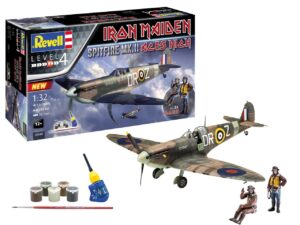
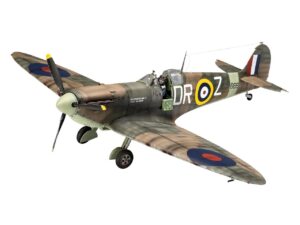
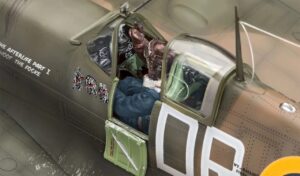
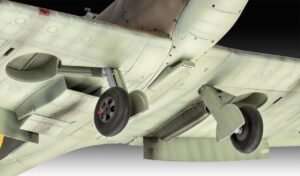
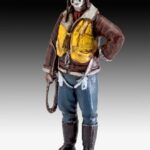
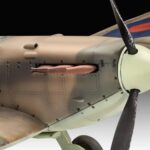
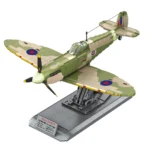
The Spitfire Mk.II “Aces High” Iron Maiden gift set is a classic plastic model kit in 1:32 scale with 134 individual parts, reaching impressive dimensions with a length of 28.6 cm and a wingspan of 35.1 cm. As a gift set, it already includes glue, paints and a brush, so you can get started right away without having to buy any extra accessories. The model scores points with a detailed cockpit complete with instrument panel, a movable propeller, detailed landing gear and a split canopy glazing. You get authentic decals for both the historic Aces High version and Iron Maiden’s stage version, so you can choose your preferred variant. The absolute highlight for fans: the set includes two Eddie pilot figures, one seated and one standing, so Eddie can be displayed either in the cockpit or next to the aircraft. At 40.99 euros, this set, recommended from age 12, is an ideal entry point into the world of model building with genuine Iron Maiden flair.
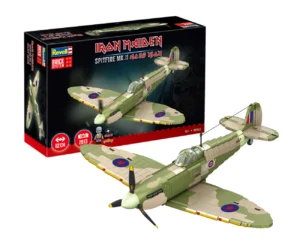
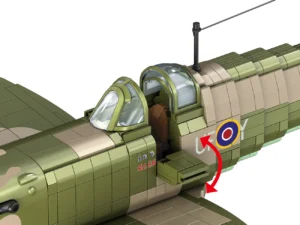
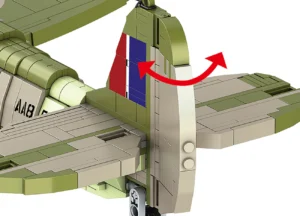
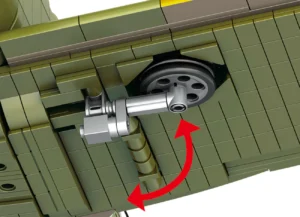
For anyone looking for more space on the build table and a longer build experience, the Iron Maiden Spitfire MK.II Aces High in the Revell Brick System is the right large-scale project. This brick model in 1:18 scale consists of more than 2,800 parts and achieves an impressive wingspan of over 60 centimetres. The build is divided into several construction stages, starting with the aircraft’s inner skeleton, moving on to a detailed recreation of the Rolls-Royce Merlin engine, and finally to the characteristic elliptical wings. The Spitfire’s camouflage pattern is not created using stickers, but through the colour interplay of the individual bricks. Clever SNOT techniques (Studs Not On Top) and ingenious angled constructions make it possible to recreate the round, aerodynamic shape of the original. Here too, an exclusive Eddie figure sits enthroned in the cockpit, in full flying gear. The set is recommended from age 18 and is aimed at experienced model builders and collectors looking for a genuine statement piece for their shelf.


From the Workbench to the Shelf: Why the Spitfire’s Fascination Never Fades
Of the more than 20,300 Spitfires built in total, an estimated 50 to 70 examples are still airworthy worldwide today. Around 70 more are on static display in museums, and over 100 are being actively restored. In 2026, exactly 90 years after the prototype’s first flight, a restored two-seat Spitfire completed an anniversary tour across the whole of Great Britain, during which members of the public could bid for a seat in the cockpit. The RAF provided escort aircraft for the occasion, including Typhoons and possibly even F-35 Lightnings.
This vibrant enthusiasm for a 90 year old aircraft shows that the Spitfire is far more than a piece of technical hardware. It stands for engineering excellence, for courage, and for a turning point in history. When Iron Maiden turn this symbolic power into music, and we at Revell translate it into precise model kits, something emerges that adds up to more than the sum of its parts.
Whether you choose the classic plastic model kit or the brick model, in the end you’ll be holding a piece of aviation and music history in your hands, one that shouldn’t be missing from any collection.
Get the Spitfire Mk.II “Aces High” Iron Maiden gift set (item no. 056889090) for 40.99 euros, or the Iron Maiden Spitfire MK.II Aces High in the Brick System (item no. 009629090) for 205.00 euros, directly from our shop.
Technical Specifications at a Glance
Spitfire Mk.II “Aces High” Iron Maiden gift set (item no. 056889090)
Scale 1:32, 134 individual parts, length 28.6 cm, wingspan 35.1 cm, recommended age 12+, includes glue, paints, brush and two Eddie pilot figures (seated and standing), authentic decals for the Aces High version and Iron Maiden’s stage version, price 40.99 euros.
Iron Maiden Spitfire MK.II Aces High in the Brick System (item no. 009629090)
Scale 1:18, over 2,815 individual parts, wingspan over 60 cm, recommended age 18+, includes exclusive Eddie pilot figure in full flying gear, authentic camouflage pattern made of coloured bricks, official Iron Maiden licensing, price 205.00 euros.
Inspiration for Your Build
A great walkaround of a Spitfire at the Imperial War Museum
And here’s a first unboxing from German brick model YouTuber Johnny