
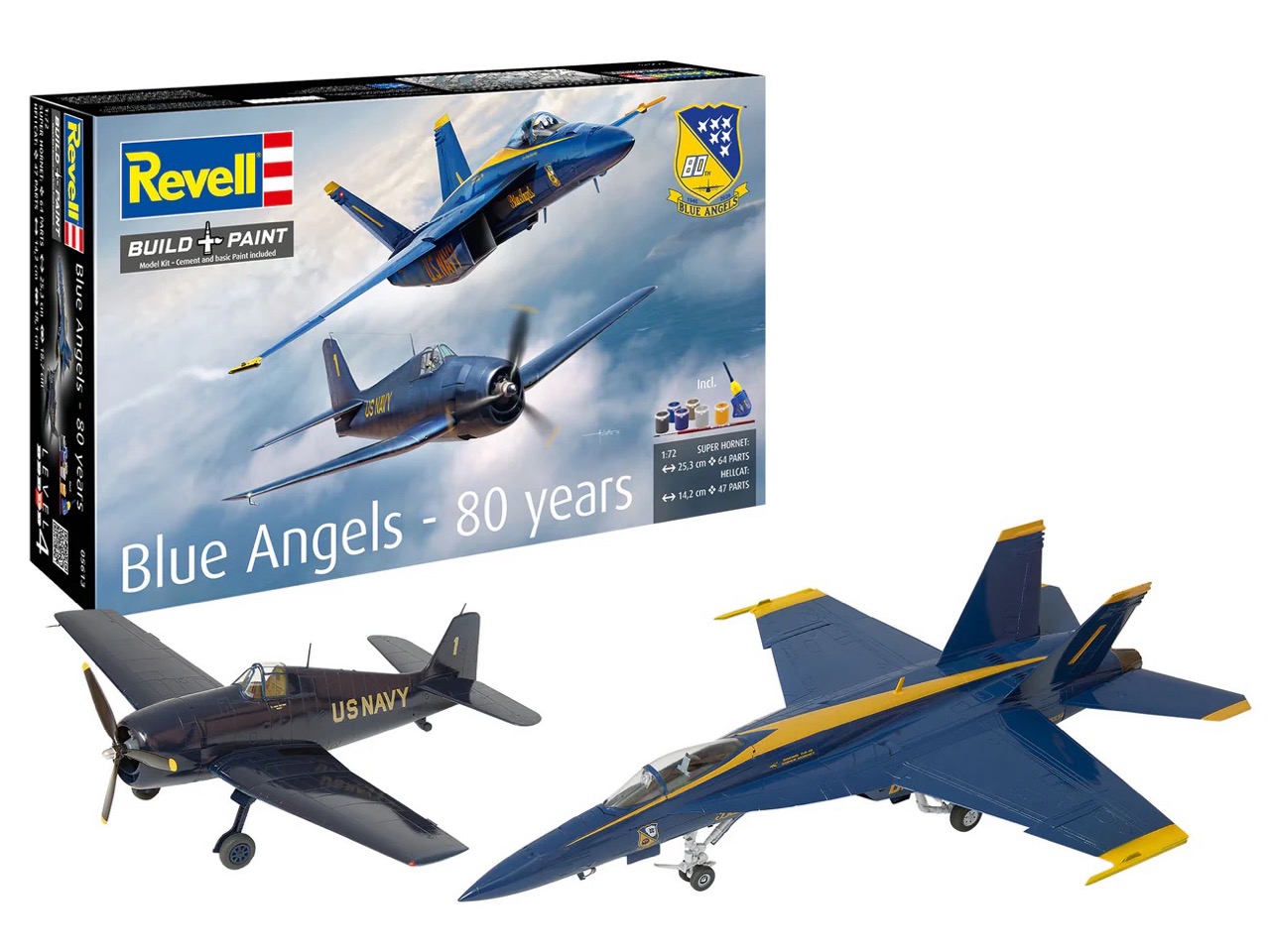
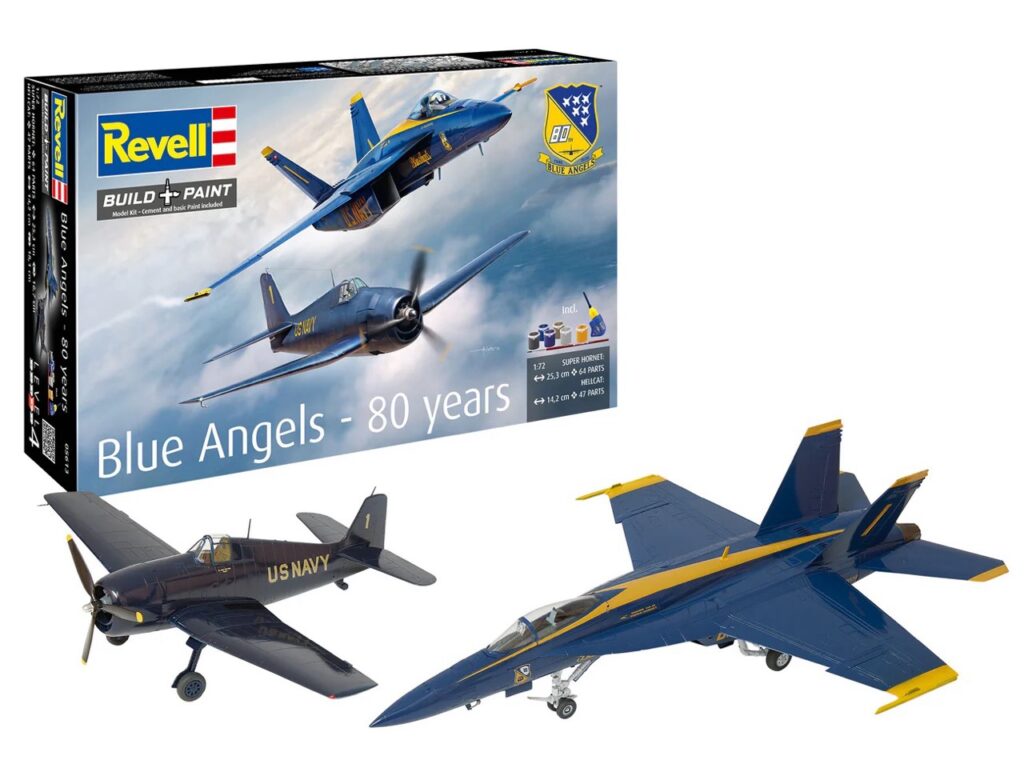
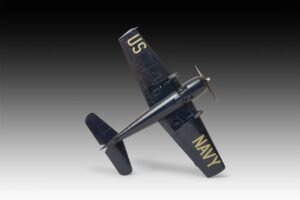
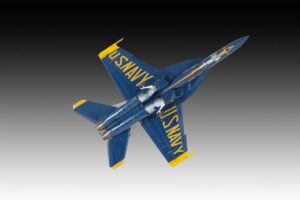
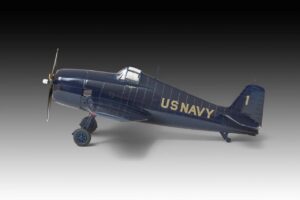
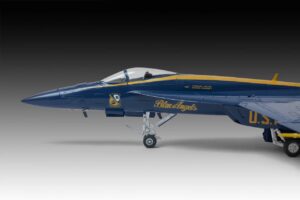
In April 2026, the Blue Angels, the world’s most famous aerobatic team, are celebrating their 80th anniversary. Eight decades of flying precision at the highest level, eleven different aircraft types and over 10 million spectators per year make the US Navy squadron a legend of aviation. We at Revell are celebrating this anniversary with a very special set: the “Blue Angels – 80 Years” gift set, which brings together the team’s beginnings and its present day in a single box. You build the combat-proven Grumman F6F Hellcat, with which it all started in 1946, and the modern F/A-18 Hornet, which carried the team through the skies for over three decades. The set already includes paints, glue and a brush, so you can get started right away.
How a Nightclub Gave an Aerobatic Team Its Name
The story of the Blue Angels begins on 24 April 1946, just months after the end of World War II. Fleet Admiral Chester W. Nimitz, who as Commander in Chief of the US Pacific Fleet had led the decisive naval battles of the war and accepted the Japanese surrender aboard the USS Missouri, gave the order to establish a flight demonstration squadron. His calculation was cool and strategic: the US Army Air Forces were in the process of separating from the Army to become an independent branch of the military (the future Air Force), and naval aviation was in danger of being sidelined in the fight over shrinking peacetime budgets. A spectacular flight demonstration was to draw public attention to the Navy and secure political support.
Nimitz chose Lieutenant Commander Roy “Butch” Voris to build the team, a World War II fighter ace with eight confirmed aerial victories. Voris recruited two more pilots, and the trio began training at Naval Air Station Jacksonville in Florida, initially flying the Grumman F6F-5 Hellcat. On 15 June 1946, the squadron performed its first public demonstration at the Southeastern Air Show in Jacksonville. The show lasted just 17 minutes and consisted of a few formation flights, but the audience was thrilled.
The team still bore the somewhat stiff official name “Navy Flight Exhibition Team.” An attempt to christen them the “Blue Lancers” had come to nothing. The solution arrived in the most unconventional way imaginable: during a stay in New York ahead of a show, pilot Lieutenant Maurice “Wick” Wickendoll was leafing through The New Yorker magazine and spotted an advertisement for the “Blue Angel,” a legendary nightclub in Manhattan. “I’ve got it! I’ve got it!” he called out to his flight leader Voris, who replied: “That sounds great!” From that moment on, the Blue Angels have been the Blue Angels, named not after a military tradition, but after a nightclub that promised “Continuous Entertainment from 10 P.M.”
The F6F Hellcat: From the Pacific War to the Show Stage
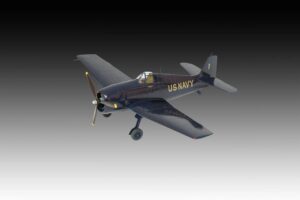
The Grumman F6F Hellcat, the first aircraft flown by the Blue Angels and one of the two models in our gift set, was anything but a show plane. As the US Navy’s primary fighter in the Pacific War, the Hellcat achieved over 5,000 confirmed kills and dominated the air war against the Japanese forces like no other Allied aircraft. Powered by a 2,200 hp Pratt & Whitney R-2800 Double Wasp radial engine, it reached a top speed of over 630 km/h. Pilots particularly valued its legendary ruggedness, which earned Grumman the nickname “Grumman Iron Works”: a Hellcat could absorb astonishing amounts of combat damage and still bring its crew safely home.
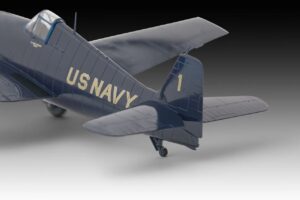
For service with the Blue Angels, the F6F-5s were specially modified. The armament was removed to save weight, and the aircraft received their characteristic dark navy blue paint scheme with gold lettering. From June to August 1946, the Hellcats completed a total of ten demonstrations. A particular feature of the early shows was a staged dogfight: an SNJ Texan trainer painted to resemble a Japanese Zero would “attack” the formation, get “shot down” after a theatrical pursuit, and release smoke while the rear-seat occupant dropped a small parachute simulating the pilot bailing out. Shortly afterwards, the Blue Angels switched to the Grumman F8F Bearcat, which served as the squadron’s last propeller-driven aircraft and with which the famous diamond formation was introduced.
From the Korean War to the Jet Era: The Blue Angels Through the Decades
The history of the Blue Angels has not always run smoothly. When the Korean War broke out in 1950, the Navy made a decision that is unique in the history of military aerobatic teams: it disbanded the Blue Angels and sent its pilots into combat. The pilots formed the core of Fighter Squadron VF-191, better known by its nickname “Satan’s Kittens,” and flew combat missions from the aircraft carrier USS Princeton. On 8 March 1951, former Blue Angels flight leader Lieutenant Commander John Magda was hit during a low-level attack on North Korean and Chinese positions. His F9F-2B Panther was engulfed in flames, and Magda, just 33 years old, lost his life. The Navy posthumously awarded him the Navy Cross, the second-highest decoration for valour in the United States.
On 25 October 1951, the Blue Angels were reactivated and now entered the jet age for good. Over the following decades, they flew an impressive series of aircraft types: the F9F Panther, the F9F Cougar as their first swept-wing aircraft, the F11F Tiger, the F-4J Phantom II, and the A-4 Skyhawk. The Phantom was responsible for one of the most amusing anecdotes in the team’s history: during a practice session over British Columbia, a pilot accidentally broke the sound barrier and destroyed hundreds of windows within an eight-block radius in the town of Kelowna. The US Government paid for the damage, and the next day the show went on.
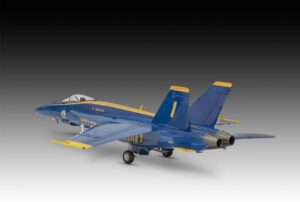
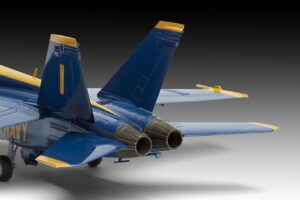
In 1986, for their 40th anniversary, the Blue Angels transitioned to the McDonnell Douglas F/A-18 Hornet, the aircraft included as the second model in our “Blue Angels – 80 Years” gift set. For 34 years, the Hornet defined the look of the team. In 2021, they switched to their current aircraft, the F/A-18E/F Super Hornet, which the Blue Angels fly today.
Inches Apart at 650 km/h: What Makes the Blue Angels Unique
What sets the Blue Angels apart from other aerobatic teams is the extreme proximity at which their pilots fly. In the diamond formation, the wingtips of the jets are often just inches apart, at speeds exceeding 650 km/h. The pilots do not wear G-suits, which are otherwise standard in fighter jets. The reason: the inflatable pressure bladders of a G-suit would interfere with the fine control inputs needed for formation flying at this level of precision. Instead, the pilots use special breathing techniques to withstand the extreme G-forces.
The Blue Angels’ aircraft are largely identical to the standard fleet aircraft of the Navy. The nose cannon is removed and replaced by a smoke-oil tank that creates the characteristic smoke trails. In addition, a spring is mounted on the control stick that adds resistance, enabling the ultra-fine control movements required for formation flying. In an emergency, the aircraft can be made combat-ready again within 72 hours.
Since their founding in 1946, a total of 272 pilots have worn the coveted blue flight suit, which was first introduced in 1954. 28 members of the team have lost their lives in accidents, including Captain Jeff Kuss, who was killed during a training flight in 2016. Every new pilot undergoes an extreme selection process and must have logged at least 1,250 flight hours as a carrier-qualified tactical jet pilot. The training phase begins each year in El Centro, California, and is considered one of the most demanding training programmes in the entire US military.
The Blue Angels in Film and Television
The Blue Angels have had a remarkable presence in film and television history. As early as 1996, they were a central feature of the IMAX film “The Magic of Flight,” which documented the story of flight from its beginnings to the modern jet era and was celebrated for its cockpit footage. In 2024, a new IMAX documentary followed, simply titled “The Blue Angels,” produced by J.J. Abrams and Glen Powell, who had previously appeared as Lieutenant Jake “Hangman” Seresin in “Top Gun: Maverick.” Powell flew with the Blue Angels himself during filming, and the film was the first in which a civilian aircraft was permitted to enter the “box,” the team’s designated performance airspace. The camera crews used the same filming techniques that had been employed on “Top Gun: Maverick.” The film is available on Amazon Prime Video and documents, among other things, the selection of the first female pilot in the history of the Blue Angels, Lieutenant Commander Amanda Lee.
The cultural influence of the Blue Angels extends far beyond documentaries. They are an integral part of the American self-image and have been immortalised in countless television documentaries, commercials and print media. The unique combination of military precision, aesthetic perfection and the thrill of pushing boundaries makes them one of the most powerful visual symbols of the US military.
Two Eras in One Box: The Gift Set in Detail
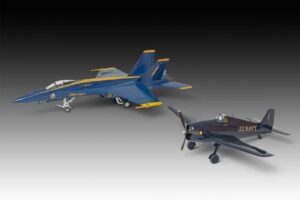
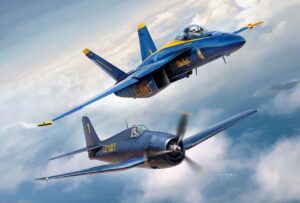
Our “Blue Angels – 80 Years” gift set brings two fundamentally different aircraft to your workbench, which together represent 80 years of aviation development. The Grumman F6F Hellcat, with which it all started in 1946, stands for the era of piston engines and propeller drives, for the angular ruggedness of wartime fighters and for a time when flying was still pure craft. The F/A-18 Hornet, by contrast, embodies the jet era with supersonic speed, computer-assisted flight controls and aerodynamic shapes optimised for maximum performance.
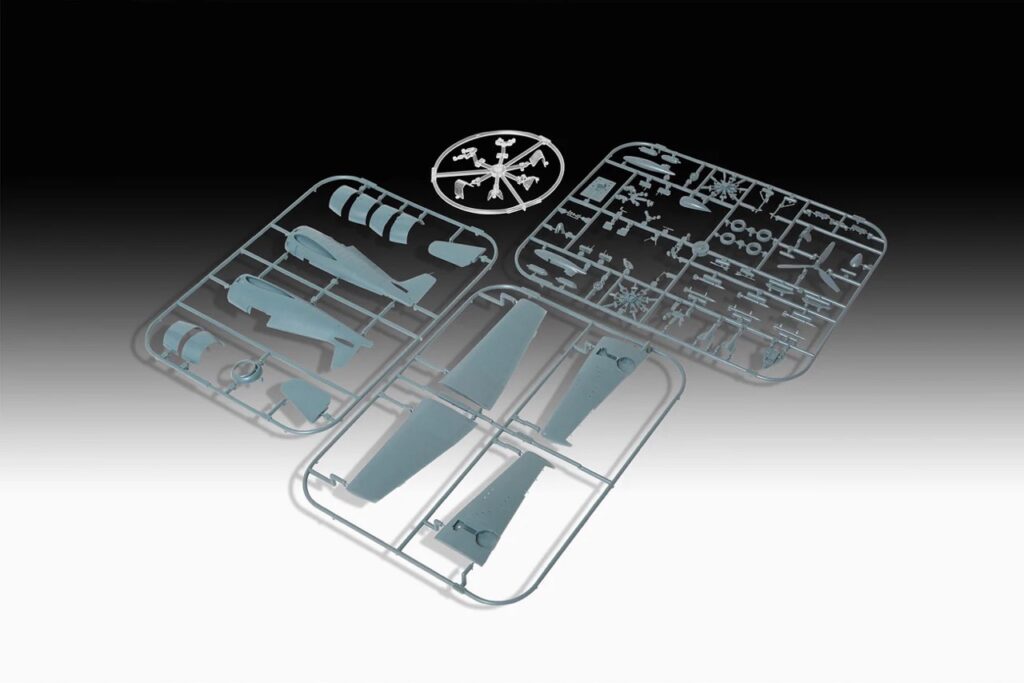
Both models are in 1:72 scale and comprise a total of 91 individual parts. The set is rated as challenging at Level 4 and is suitable for experienced model builders and ambitious beginners aged 12 and up. As a gift set, the box already includes a brush, the matching Revell Aqua Color paints for the iconic navy blue and gold of the Blue Angels, and Contacta Professional Mini glue. You don’t need to buy any additional accessories to start building. The included anniversary edition decals allow you to create an authentic representation of both aircraft in the squadron’s historic and current colour scheme.
The special appeal of this set lies in the direct comparison: when the stocky Hellcat stands next to the sleek Hornet in your display case, this duo tells the story of eight decades of progress in aviation technology, design and flying skill. A display piece that not only impresses technically, but also tells a story.
Get the “Blue Angels – 80 Years” gift set, item no. 056139090 directly from our shop.
Technical Specifications at a Glance
“Blue Angels – 80 Years” gift set, item no. 056139090
Scale 1:72, 91 individual parts (F6F Hellcat and F/A-18 Hornet), Level 4 (advanced), recommended age 12+, gift set including brush, Revell Aqua Color base colours and Contacta Professional Mini glue, anniversary edition decals for both models.