
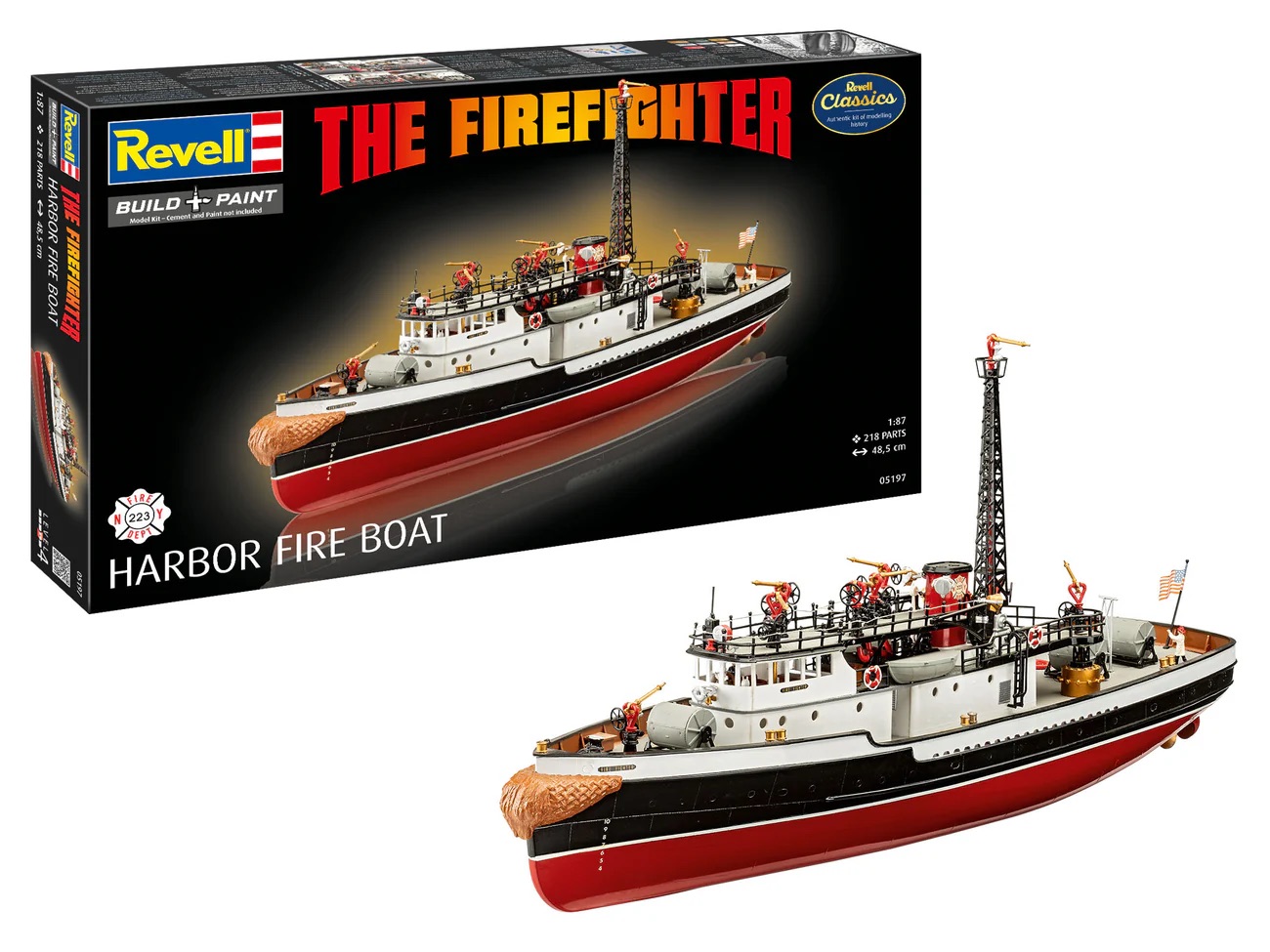
A fireboat that survived the greatest maritime disaster in New York Harbor and the September 11 attacks. That launched in 1938 and wasn’t retired until 2010. That remains the only fireboat in the world ever to receive the Gallant Ship Award. And that today is a National Historic Landmark. The Fire Fighter of the New York City Fire Department was no ordinary vessel – and our model kit “The Firefighter” is no ordinary kit.
If you’re wondering why a fireboat deserves that status, read on. The story of this ship is a piece of New York City history but also firefighting history, reflected in the harbour waters of the Hudson River.
The model directly in the Revell Shop: The Firefighter at Revell
A Ship is Born: New York, 1938
It was Mayor Fiorello LaGuardia himself who commissioned the construction of a new fireboat for New York City in 1937. The design plans came from William Francis Gibbs and his renowned firm Gibbs & Cox, the same architect who would later design the legendary SS United States. The keel was laid at United Shipyards as Hull Number 856, and on August 28, 1938, the ship was launched as Fire Fighter, christened by Miss Eleanor Grace Flanagan.
On November 16, 1938, at 9:00 a.m., the Fire Fighter entered service with the New York City Fire Department, stationed with Engine 57 at Pier 1 in the Battery, later reorganised as Marine Unit 1. What no one suspected at the time: this ship would not leave its post in New York for another 72 years.
The technical specifications of the new vessel were sensational for the era. With a pumping capacity of 20,000 gallons (approximately 75,000 litres) per minute, the Fire Fighter was the most powerful diesel-electric fireboat in the world. Two 16-cylinder General Motors Winton diesel engines developing 1,500 hp each drove a pair of 1,000 hp Westinghouse electric motors, propelling the 134-foot vessel to speeds of up to 14 knots. This propulsion technology was so advanced that the Fire Fighter’s drivetrain was among the very first diesel-electric marine propulsion systems ever fitted to a ship. The design proved so successful that the vessel completed its entire active career without fundamental technical modifications, outlasting most of the younger boats in the fleet.
Fire Over the Hudson: The SS Normandie, 1942
Barely three years after entering service, the Fire Fighter faced its first major test and one of the most dramatic moments in New York’s maritime history. On February 9, 1942, fire broke out aboard the SS Normandie at Pier 88 on the Hudson. The Normandie was at the time the largest passenger liner in the world, seized by the US Navy after America’s entry into the war and being converted into a troopship.
Thousands of spectators gathered along the waterfront as one of the most spectacular fires in the city’s history unfolded. The Fire Fighter responded alongside the fireboat John J. Harvey and fought the flames for five and a half hours. The fire was eventually brought under control, but then something happened that no one had foreseen: the water pumped into the burning ship by the fireboats caused the Normandie to develop a dangerous list. Five hours after the flames were extinguished, the ship rolled onto its side and settled on the bottom of the Hudson.
The former flagship of the French Atlantic service now lay as a vast rusting hulk in the riverbed and would not be salvaged for years.
For the crew of the Fire Fighter, the Normandie fire was a defining experience that showed just how fine the line between victory and defeat in fighting ship fires could be.
Ammunition on the Line: The SS El Estero, 1943
A year after the Normandie, New York City stood on the brink of a catastrophe that would have dwarfed all others. The SS El Estero, a munitions ship loaded with shells and explosives bound for the front in Europe, caught fire in New York Harbor in 1943. Had the ship blown up, the detonation would have been comparable to a small atomic bomb, and large parts of Manhattan and Brooklyn would have been destroyed.
The Fire Fighter was on the scene. Its crew fought for hours to save the ship and prevented the worst. New York did not learn the full extent of the threat until decades later, when documents were declassified. This operation made the Fire Fighter a quiet hero of the Second World War.
Engine 223: The Brooklyn Chapter
In 1956 the Fire Fighter was reassigned and given the designation Engine 223, under which it served from 1956 to 1967 at the 37th Street Pier in Brooklyn. Visitors to the museum ship today still find this designation on board – a living piece of city history.
It was on the very first day of its service as Engine 223 that the Fire Fighter experienced a moment that nearly brought it to an end.
The Lukenbach Pier, December 3, 1956: The Miracle in Brooklyn
On December 3, 1956, the Fire Fighter responded to a fire at the Lukenbach Steamship Co. pier at 35th Street. The boat tied up alongside the burning pier house, and its monitors had just begun sending water through an open freight door when a battalion chief ordered the boat to move forward 60 metres.
The moment the bow line was made fast, a tremendous explosion erupted at the exact spot where the Fire Fighter had been lying just seconds before. The blast threw the crew to the deck, blew out all the pilothouse windows, knocked the port engine out of action, and turned three city blocks into a field of rubble without an intact window pane. Ten bystanders were killed and more than 250 people were injured.
The Fire Fighter itself was heavily damaged but remained afloat. And despite the destruction, the crew stayed on scene and kept fighting until the fire was under control, before the vessel was taken to the shipyard for repairs that lasted well into 1957. This episode later became a symbol of the almost superhuman resilience of Fire Fighter crews.
“We Don’t Fight Fires – We Knock Them Down!”
During the 1960s and 1970s, the piers and terminals of New York Harbor became a serious problem. Ageing wooden piers fell victim to vandalism, arson, and the ravages of time, and entire pier buildings regularly went up in flames. The Fire Fighter and its crews developed a technique without equal: they directed the 5-inch bow monitor at maximum pressure and physically brought burning structures crashing down into the water.
From this practice grew the crew’s unofficial motto, which describes the spirit of the ship better than any official title ever could: “We don’t fight fires – we knock them down!” This motto became part of the identity of the Fire Fighter and reflects the uncompromising directness with which generations of FDNY firefighters carried out their duty on board.
Build yourself a piece of that history: The Firefighter – directly in the Revell Shop
1973: The Esso Brussels, the Sea Witch, and the Gallant Ship Award
The Fire Fighter’s greatest single operation came in June 1973, when the tanker SS Esso Brussels collided with the container ship SS Sea Witch beneath the Verrazano-Narrows Bridge. Both vessels caught fire, and the explosion was felt miles away.
The Fire Fighter fought the blaze virtually single-handedly and rescued 28 surviving crew members from the burning Sea Witch. For this operation it received the Gallant Ship Award in 1974, the highest civilian decoration for gallantry awarded to ships in the United States. To this day, the Fire Fighter remains the only fireboat ever to have received this award since it was established in 1944.
9/11: Three Weeks of Continuous Operations
On the morning of September 11, 2001, New York and the world changed forever. As the towers of the World Trade Center burned and eventually collapsed, the city’s water mains were buried beneath the rubble and the hydrants in the surrounding area were destroyed. The water for firefighters at Ground Zero had to come from somewhere else.
The Fire Fighter and the other boats of the FDNY Marine Units became the sole reliable water supply for firefighting operations at Ground Zero. The Fire Fighter pumped at maximum capacity from New York Harbor into the fire department’s supply lines for three full weeks. Three weeks of uninterrupted operations – which at the same time became its longest single deployment in 72 years of active service.
The vessel had already been designated a National Historic Landmark in 1989. After September 11, that status took on an entirely new meaning.
The Farewell: 2010 and 2012
On July 17, 2010, the Fire Fighter was decommissioned after 72 years of active service and replaced by the new fireboat Fire Fighter II at Marine Unit 9. At that point it was the second-oldest fireboat still in active frontline service worldwide and the longest-serving vessel in the entire FDNY Marine Unit Fleet.
In 2012 it was officially designated a museum ship. Thanks to grants from various foundations and donations totalling more than one million dollars, it was completely overhauled and restored to its original condition. Since 2021 it has been berthed at Mystic Seaport Museum in Connecticut, where it has been visited by thousands of people. With that arrangement concluding in 2026, the non-profit organisation operating the museum is currently seeking a new permanent home for the vessel.
The boat that generations of FDNY firefighters regarded as a dream posting, known simply among its crews as “The Fighter”, is waiting for its next chapter. As a national landmark, the Fire Fighter cannot be sold. But you have the opportunity to build it.
The Kit: 485 Parts, a Piece of Naval History
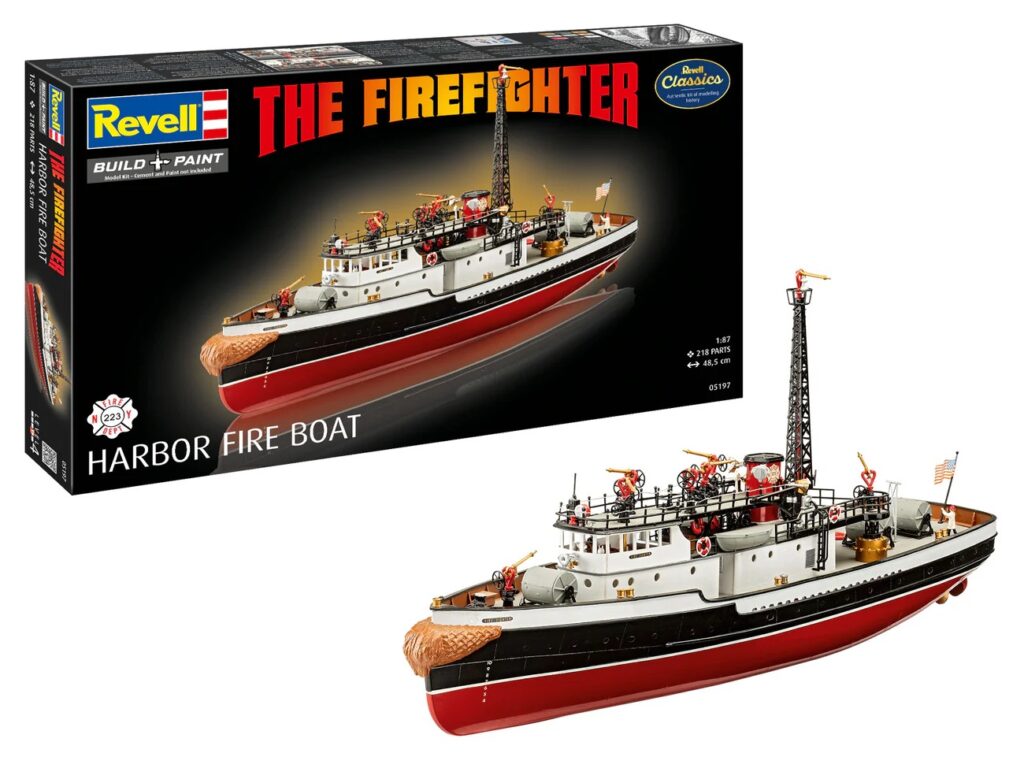
Our “The Firefighter” kit in 1:87 scale brings this extraordinary vessel to your workbench. With 485 individual parts it is rated Level 4 and is aimed at experienced modellers looking for a demanding project.
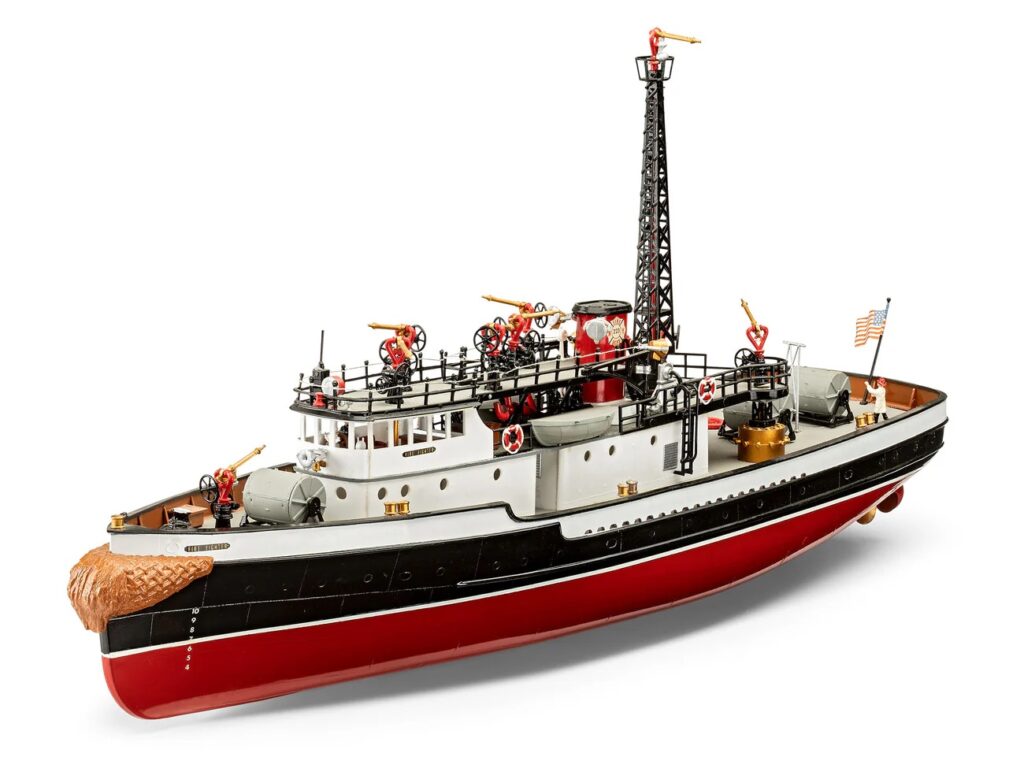
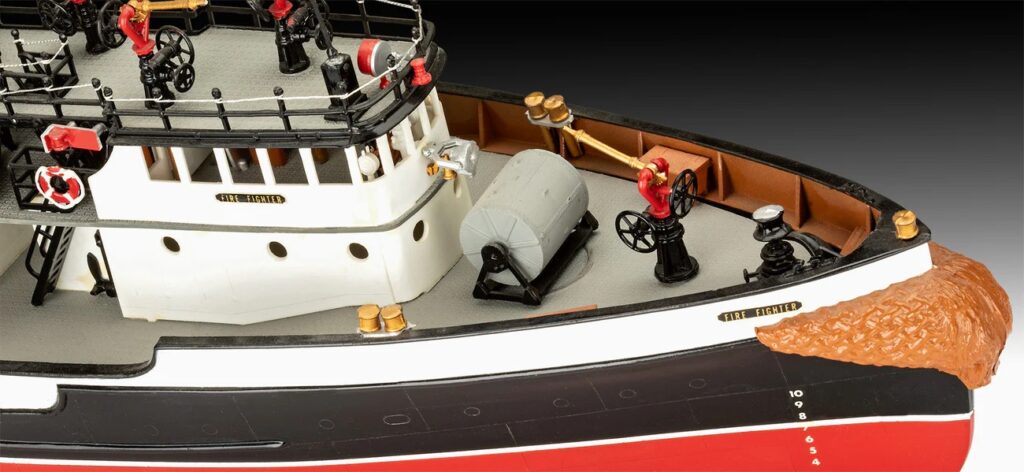
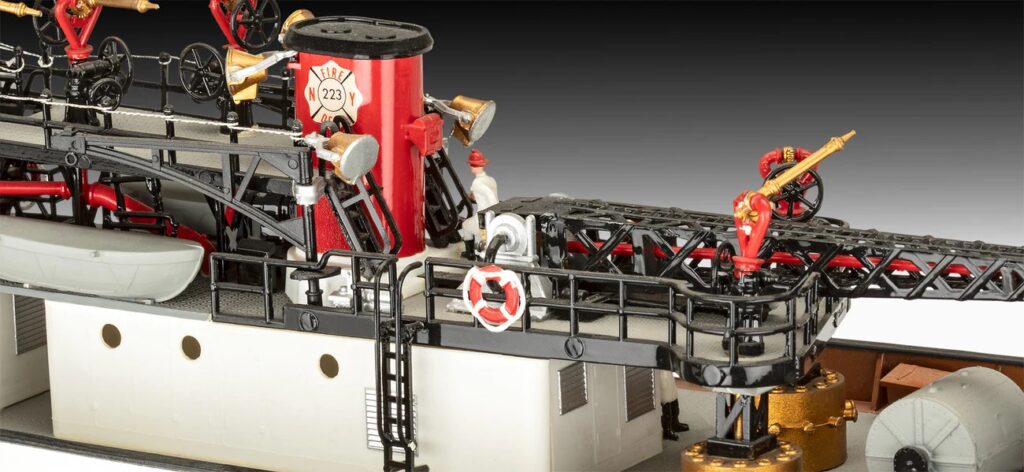
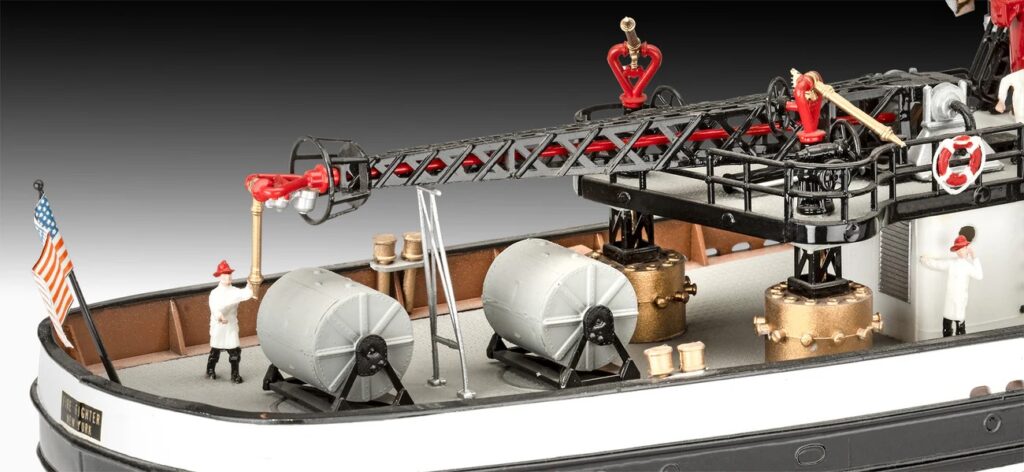
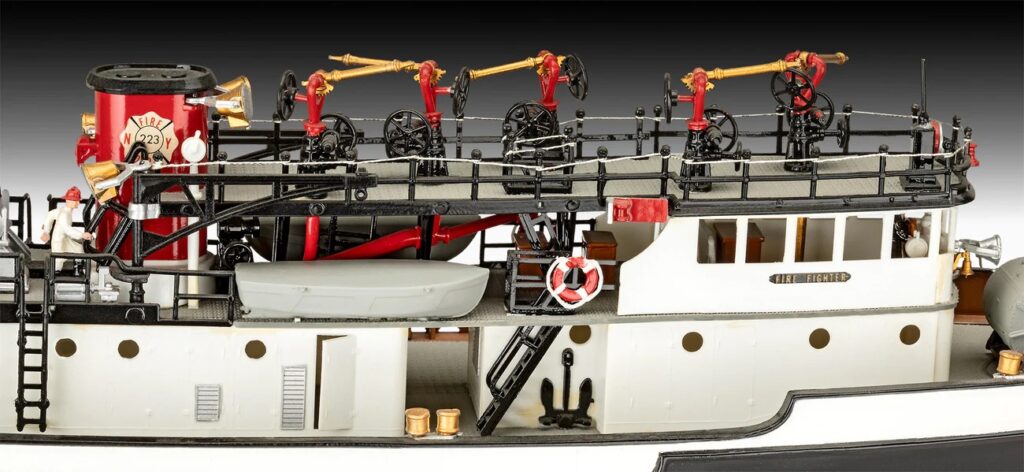
When the kit was developed, we placed particular emphasis on the accurate reproduction of the distinctive features that make the Fire Fighter so unmistakable: the large monitor mast with its nozzle, the powerful bow monitor, the seven decks with their finely detailed fire monitors, the detailed pilothouse, and the radar antennas. Figures are also included in the kit and bring the crew to life.
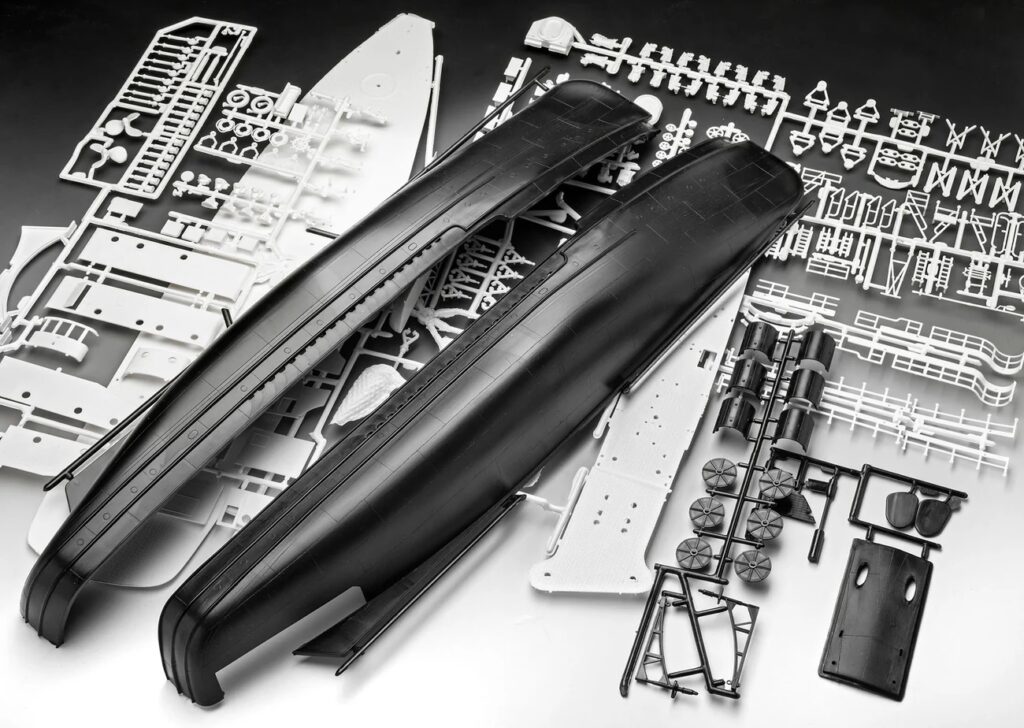
The illustrated, multilingual instruction sheet guides you step by step through the assembly process, and the included decal sheet provides the authentic markings. Everything you need to get started is in the box.
The recommended age is 12 and above, though for a kit of this complexity we recommend prior experience with plastic cement and a steady hand. The kit is expected to be available in June 2026 and can already be pre-ordered at a price of €39.99.
Pre-order now: The Firefighter in the Revell Shop
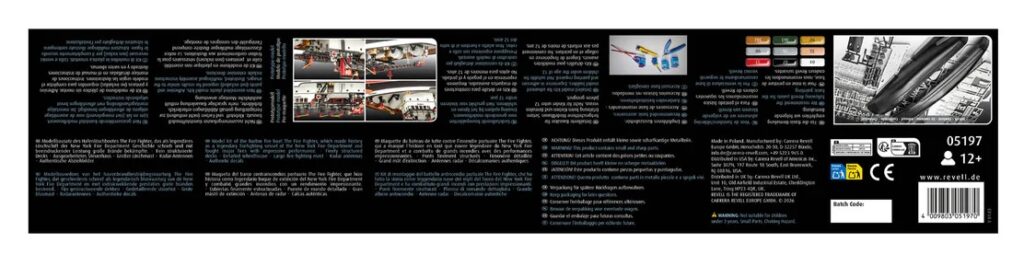 Kit at a Glance
Scale: 1:87
Parts: 485
Skill Level: Level 4
Recommended Age: 12 and above