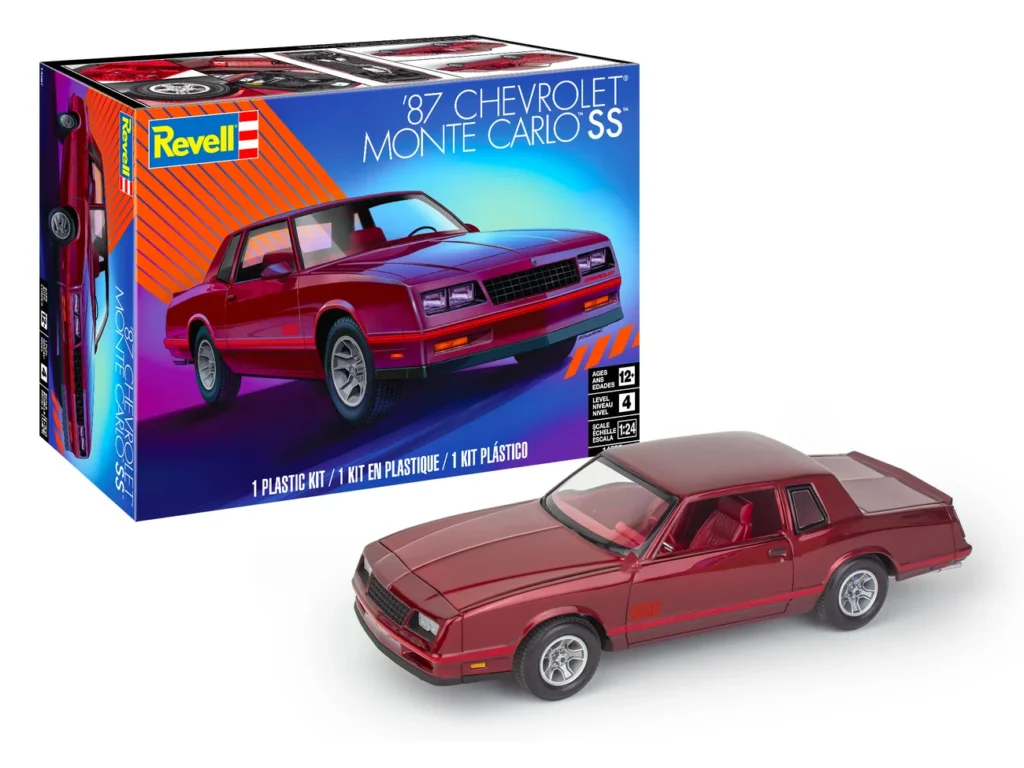
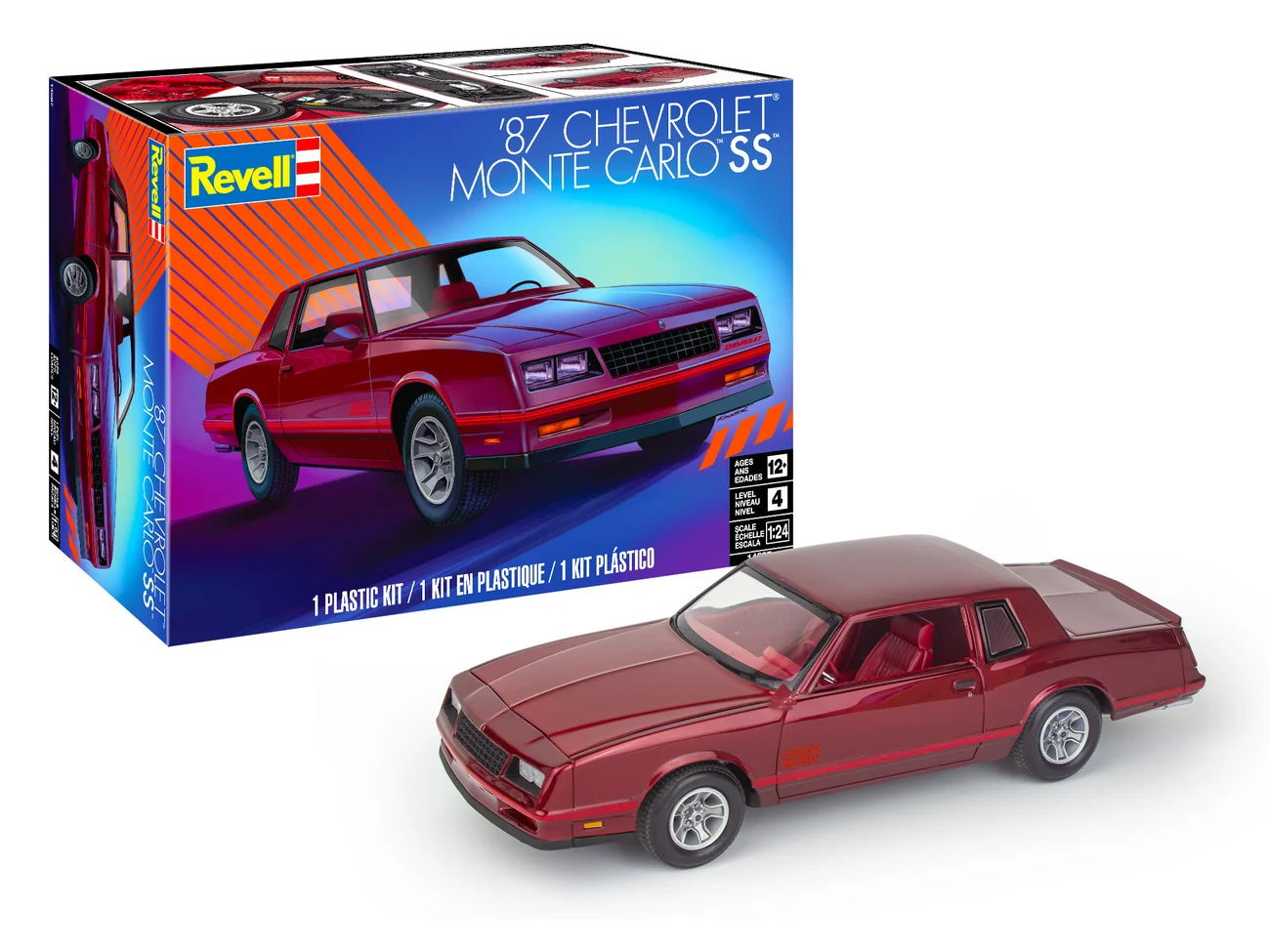
Some cars tell the story of their era better than any history lesson ever could. The Chevrolet Monte Carlo SS of the 1987 model year falls squarely into that category. It is a coupe from a time when American manufacturers were rediscovering their muscle without giving up on comfort, and at the same time it is the street car behind one of the most exciting NASCAR seasons ever. With our new kit in 1:24 scale you can bring this piece of the eighties to your workbench.
You can find the kit directly in our shop:
From personal luxury coupe to street fighter
The Monte Carlo arrived in 1970 as Chevrolet’s first personal luxury coupe and took its name from the city in Monaco. It stayed in the range across six generations and right through to the 2007 model year, interrupted by a break between 1989 and 1994. For the fourth generation, the one we are interested in here, General Motors downsized its mid size coupes considerably in the wake of the oil crisis years. Rear wheel drive remained, output dropped noticeably. In 1982 the original A platform with rear wheel drive became the so called G platform, because GM needed the letter A for its new front wheel drive cars. These G bodys are still a cult item today, whether as a Monte Carlo, as a Buick Grand National or as an Oldsmobile Cutlass.
In 1983 the SS badge returned, and with it the idea that a Chevrolet coupe is allowed to look fast again. The striking wedge shaped nose with its deeply drawn front air dam was exclusive to the Super Sport, joined by a rear spoiler, sport suspension and its own graphics. It is exactly this mix of suburban cruiser and race track looks that makes this car so appealing to this day. Across the entire run from 1983 to 1988 around 154,800 Monte Carlo SS were built, and 39,251 cars in the 1987 model year alone.
What makes the 1987 car special
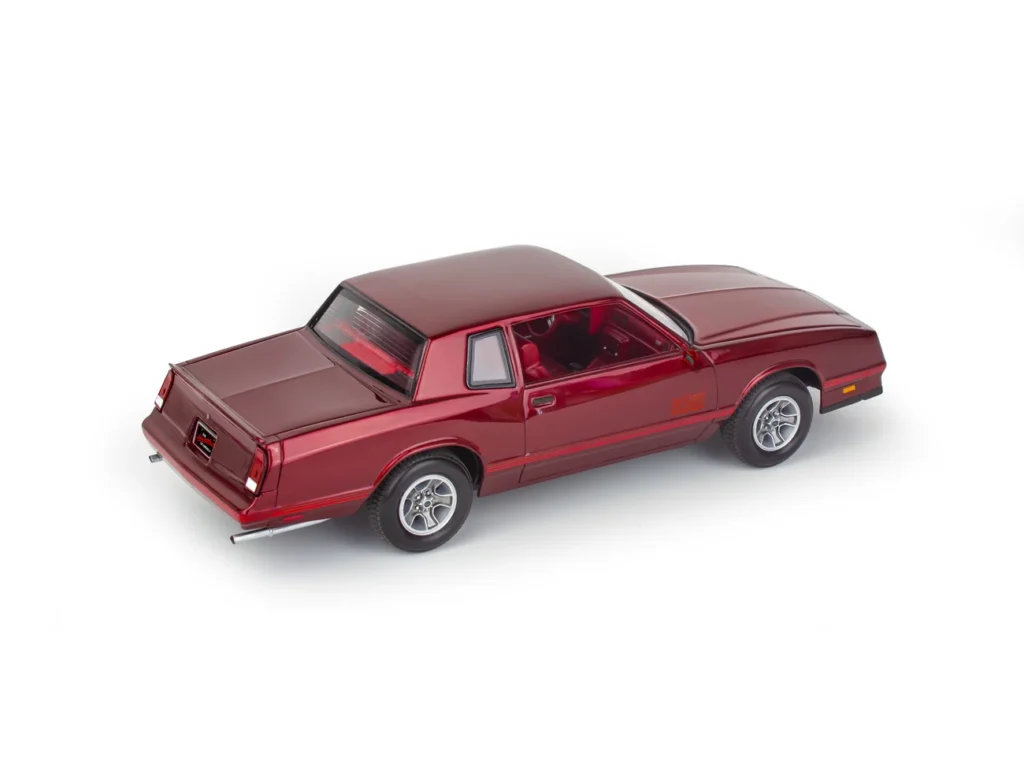
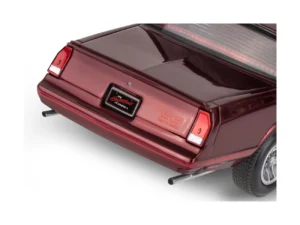
For the 1987 model year the Monte Carlo SS received a whole series of small but visible changes, and that is exactly the state the kit depicts. The rear end was drawn rounder and more closed off, with new tail lights and a newly shaped bumper cover. A revised logo appeared on the door, with a large SS above the Monte Carlo lettering, and the side stripes switched to a three colour version. Inside, the notorious speedometer that ended at 85 miles per hour finally bowed out. From 1987 the instrument was allowed to read up to 120 miles, which sounds trivial by today’s standards but was a small statement back then. The Super Sport models were built in Arlington in Texas, and from 1987 additionally in Pontiac in Michigan.
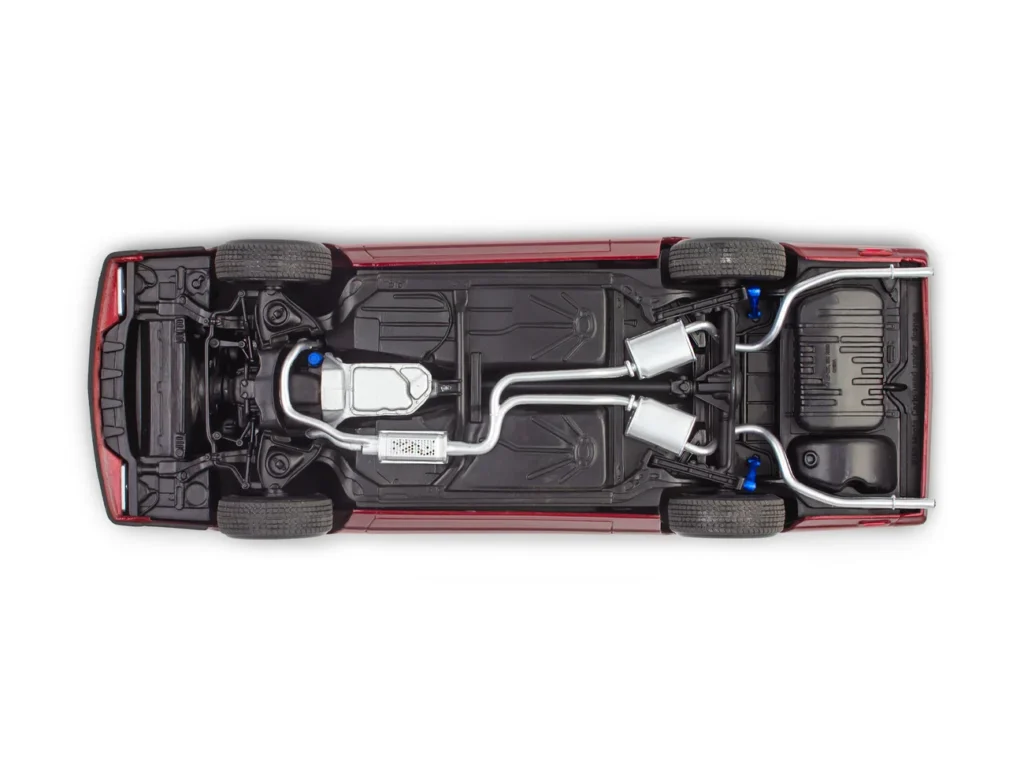
Under the hood sat the 5.0 litre small block with 305 cubic inches in its High Output version, known internally as the L69. A Rochester Quadrajet four barrel carburettor, HEI ignition and a hotter camshaft brought output up to around 180 hp. From 1984 it was joined by the 200 4R four speed automatic with overdrive, usually combined with a rear axle with a 3.73 ratio and a limited slip differential. The standard F41 sport suspension with stiffer springs and thicker anti roll bars rounded out the package. In practice that meant a good eight to nine seconds to highway speed and quarter mile times of around 16 seconds. By today’s standards that is leisurely, but in the context of the eighties it was a serious offering, especially since the car was anything but a lightweight at roughly 1,600 kilograms.
The NASCAR story: Aerocoupe, Earnhardt and the Pass in the Grass
Without motorsport this Monte Carlo would never have existed in this form. In the middle of the eighties a full blown aerodynamic arms race was raging in the NASCAR Winston Cup series, and Ford’s Thunderbird simply had the better shape on the long ovals. Chevrolet answered with the Aerocoupe, a homologation variant with a steeply raked rear window, revised C pillars, a shorter decklid and a flatter spoiler. In 1986 exactly the 200 examples that NASCAR demanded as a minimum were built, all of them in white with a burgundy interior. They were assembled as ordinary Monte Carlo SS in Arlington and then converted by the conversion specialist Cars and Concepts in Brighton, Michigan. In 1987 a further 6,052 Aerocoupes followed, even though Chevrolet had originally reckoned with up to 20,000 units. The last one left the line on 11 December 1987.
On track the effort paid off immediately. In 1986 Dale Earnhardt won five races and his second title in the Wrangler Monte Carlo run by Richard Childress Racing, the first for the team. In 1987 he went one better: eleven wins over the season, five victories in the first seven races, a record of four wins in a row and, in the end, a 489 point margin over Bill Elliott.
The most famous scene of that season took place on 17 May 1987 at the all star race The Winston at Charlotte Motor Speedway. Elliott took pole and led 121 of the 135 laps, yet the decisive laps belonged to Earnhardt. Eight laps from the end Elliott nudged him at the exit of turn four, Earnhardt ended up in the infield grass, stayed on the throttle, kept the car straight and came back onto the track without losing the lead. That excursion went down in history as the Pass in the Grass, even though strictly speaking it was not a pass at all. What remained was 200,000 dollars in prize money, plenty of bent sheet metal and the nickname The Intimidator. So anyone who builds this kit is building the road going version of a car that played a part in one of the most talked about scenes in American motorsport.
If you want to get started right away, here is the Monte Carlo in the Revell shop
Appearances in film, television and popular culture
Because the Monte Carlo was on the road in the United States in the hundreds of thousands, it keeps turning up in film and television, usually as a vehicle with character rather than as a polished star. The best known role is probably the one in Breaking Bad. In the first episodes Jesse Pinkman drives a red Monte Carlo with hydraulic suspension and the licence plate THE CAPN, and it is exactly that detail that puts Walter White on his trail in the first place. Later in the series a 1987 Monte Carlo appears on camera as the car of the rival dealers. The late G body coupes also show up in the series Third Watch, in The Devil’s Own with Harrison Ford and Brad Pitt, in Ride Along 2 and with the Trailer Park Boys.
At least as important is the second career these cars have had in the custom scene. The fourth generation Monte Carlo is one of the most popular base vehicles for lowriders and cruisers anywhere, with huge wire wheels, candy paint jobs and hydraulics. For you as a modeller that means one thing above all: the kit can be built in two completely different directions, as a clean production car in factory condition or as an interpretation from the street scene.
The kit on the workbench
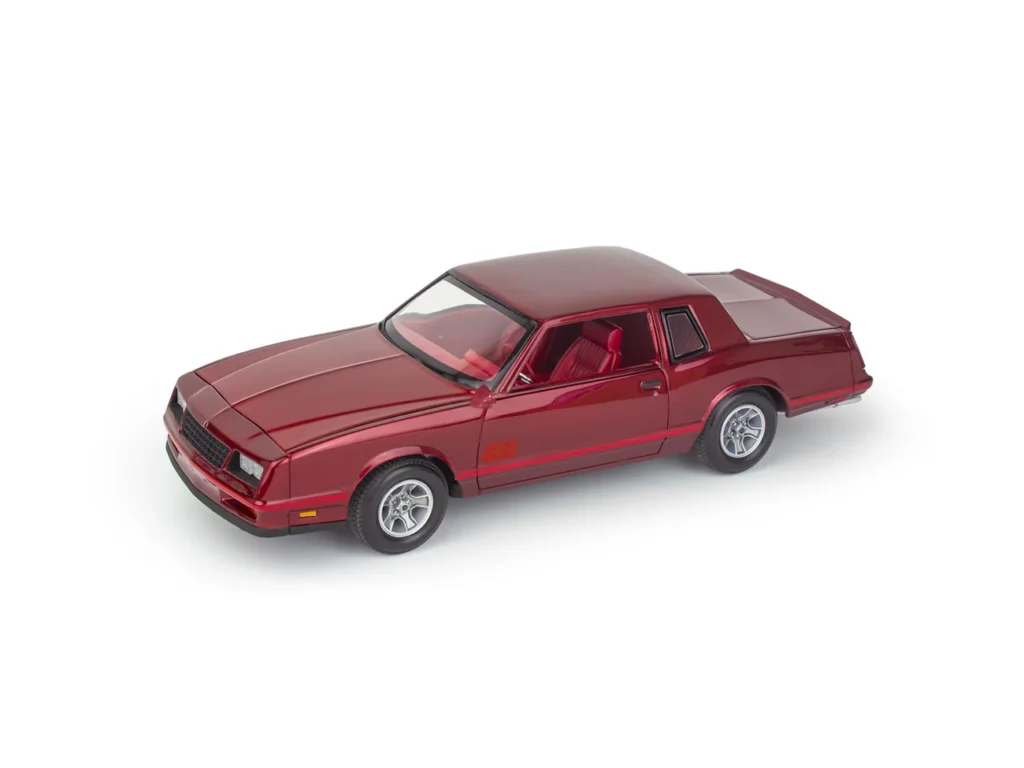
We are offering the 1987 Monte Carlo SS here with the classic notchback roofline in 1:24, in other words with the stepped rear end and not with the flat Aerocoupe glass. So if you have the Aerocoupe version from earlier years on the shelf, you now get the matching counterpart and can put both body shapes side by side.
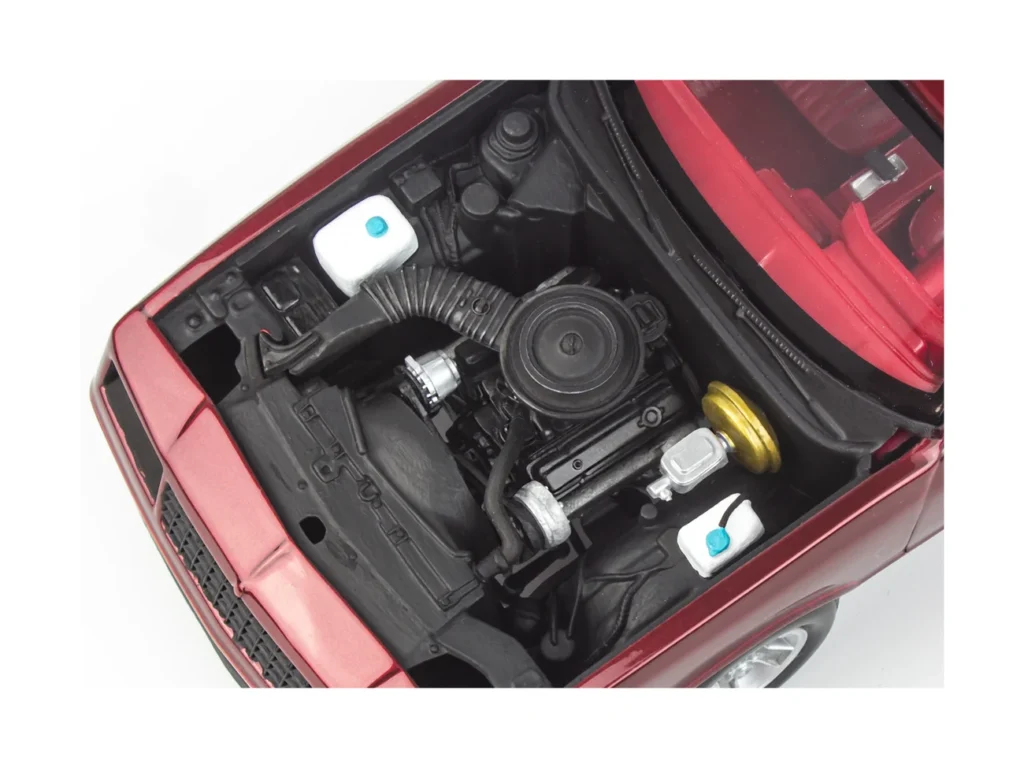
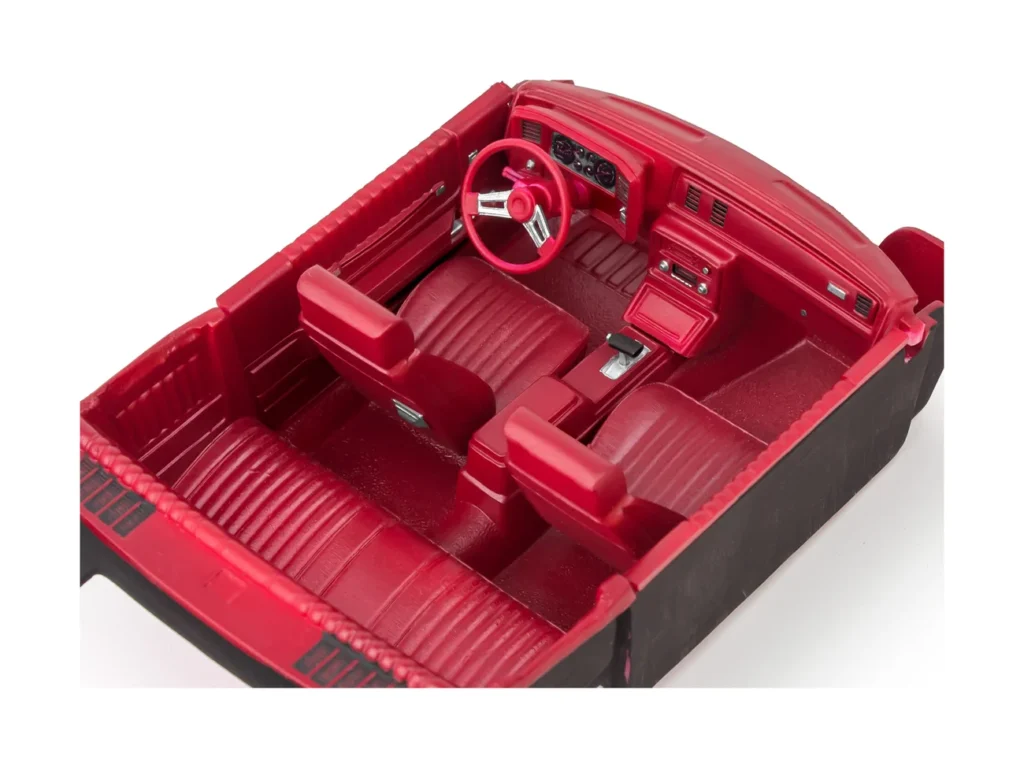
The kit comprises 89 parts and is rated as level 4, so it is aimed at modellers with a little experience. The 305 small block is reproduced with the correct four barrel carburettor, the interior is built up from several parts and comes with bucket seats and the shift lever on the centre console. It is moulded in white, joined by clear parts, transparent red parts for the tail lights and soft black tyres. Paint and glue are not included.
The body of this car lives on large, calm surfaces, and those are exactly the ones that forgive no sloppiness. It pays off to clean up the mould seams thoroughly and to work with primer and several thin coats of paint before the clear coat goes on. If you want to follow the original, the factory colour charts of the eighties offer plenty of inspiration, from black and white to a strong red and silver metallic. Picking out the black window frames and trim strips cleanly is very effective, because that detail is what really brings out the angular silhouette. In the engine bay it is worth spending time on wiring and hoses, because a small block with a carburettor quickly looks technical and alive once a few extra lines find their way in. And if you like things dirty once the build is done, subtle washes around the wheel arches and the exhaust system turn a brand new car into one that has already seen a few summers.
The kit data at a glance
The kit is released under article number 145879090 in 1:24 scale and consists of 89 parts. It is rated as level 4 and recommended for modellers aged twelve and up.
The finished model measures roughly 21.3 centimetres in length, 7.7 centimetres in width and 6.0 centimetres in height. Included are the body in white, clear parts, transparent red parts, soft black tyres as well as a decal sheet and illustrated instructions. Paint, brushes and glue are not included. In the shop the kit currently sells for 34.99 euros.
Here is the direct link to the model: https://revell.com/products/145879090-87-monte-carlo-ss