
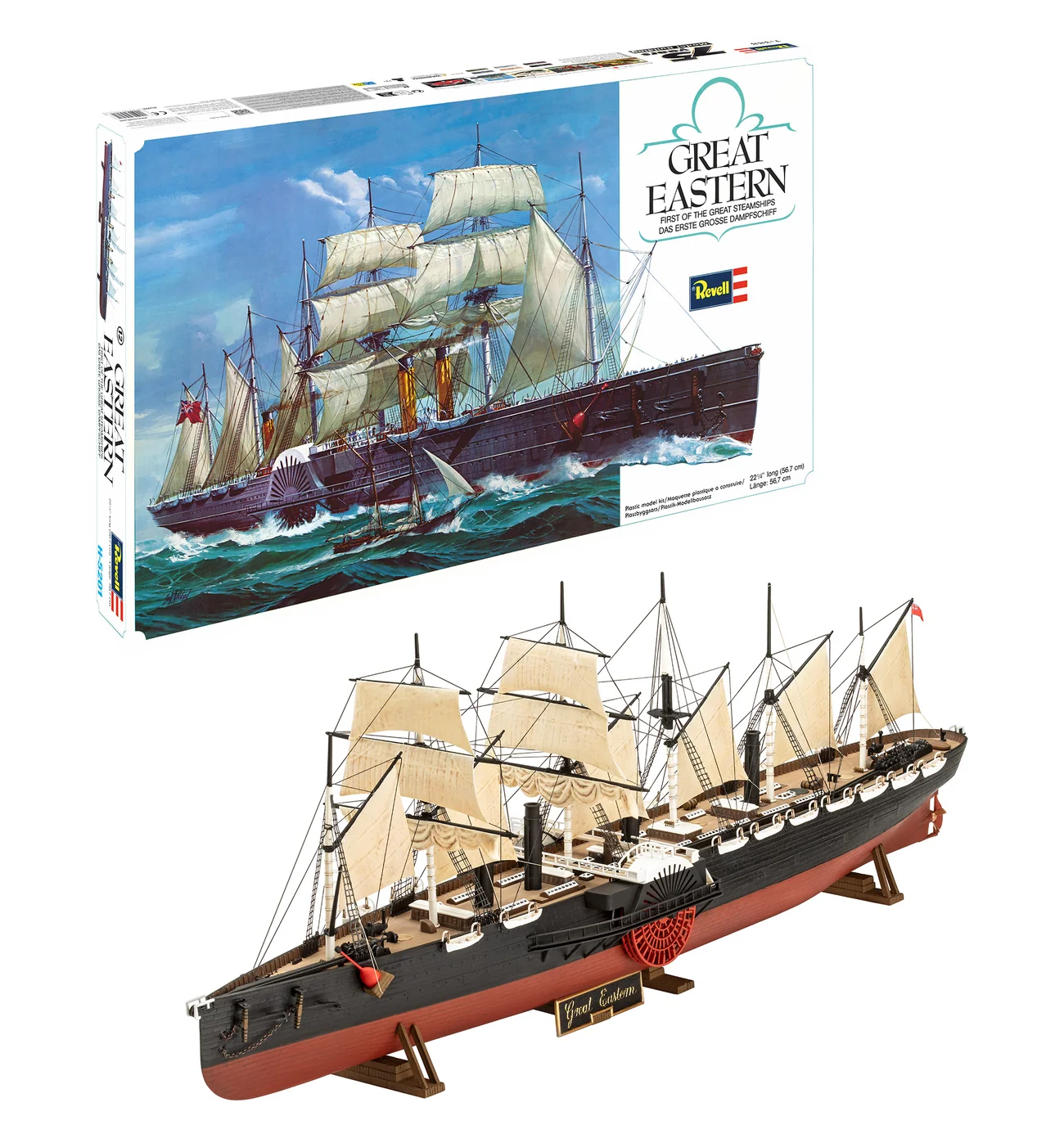
There are ships that were ahead of their time, and then there is the Great Eastern. She was the largest ship in the world for forty years, she ruined her builders, she connected Europe and America by telegraph, and she ended her days as a floating advertising hoarding. Our kit in 1:388 scale comes out of the original tooling of 1963 and is therefore one of the classics in our new Vintage Modelkits series. You will find it in our shop here: Great Eastern.
 A ship that burst every scale
The Great Eastern was designed by Isambard Kingdom Brunel, probably the most famous engineer of Victorian Britain, together with the shipbuilder John Scott Russell. She was built from 1854 at the yard of J. Scott Russell and Co. in Millwall on the Thames, initially under the name Leviathan. Brunel himself affectionately called her the Great Babe.
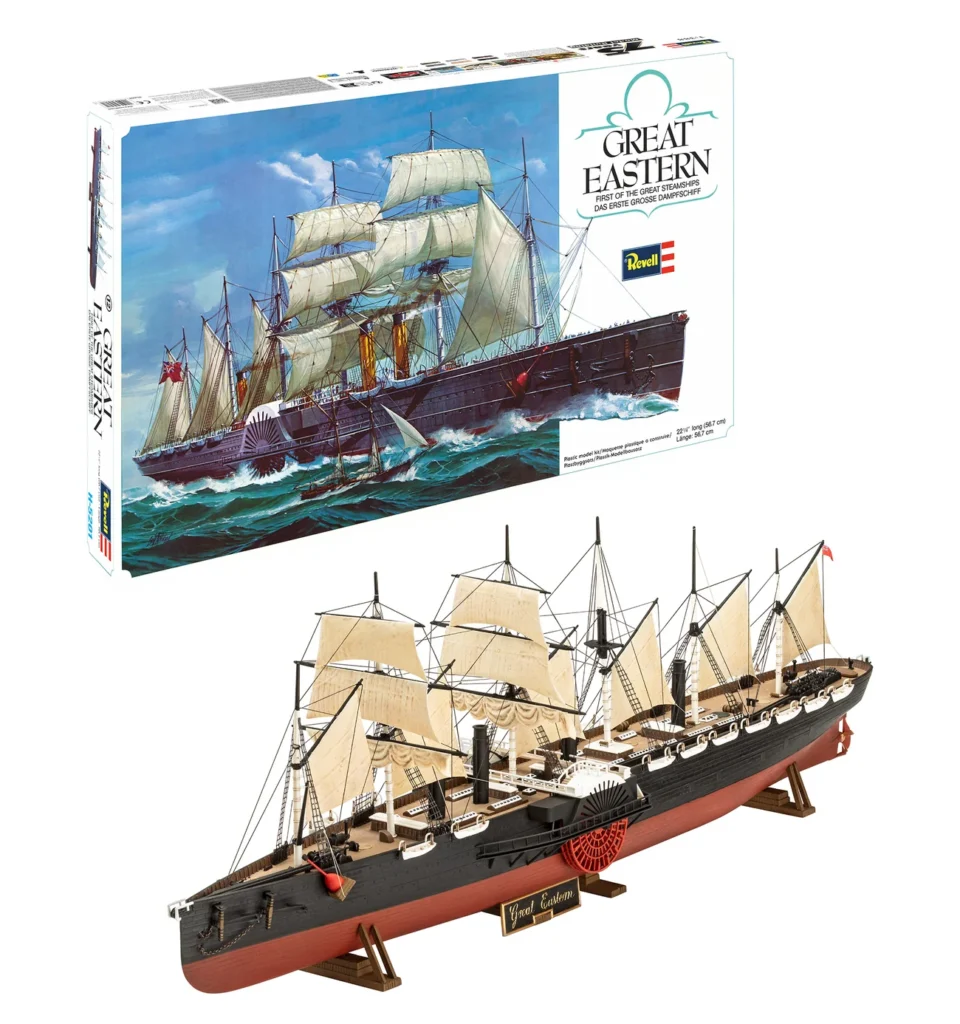
The figures still seem unreal today. 211 metres in length, around 32,000 tonnes displacement, room for 4,000 passengers and enough coal on board to reach Australia without a bunkering stop. The hull was double-skinned and made of iron, held together by millions of rivets, and Brunel brought his experience from bridge building to bear on it. The ship was driven in no fewer than three ways, namely by enormous paddle wheels on the sides, by a screw propeller and by sails on six masts. On top of that came five funnels. No other ship of the 19th century looked like this, and it is precisely this silhouette that makes the model so unmistakable on the shelf. Not until around the turn of the century were ships of this order of magnitude built again.
The launch that took three months
Because the hull was longer than the Thames was wide at that point, the Great Eastern had to be built broadside to the river and launched sideways as well. Nobody had ever attempted anything like it on this scale. At the first attempt on 3 November 1857 the colossus moved a full 120 centimetres and then came to a stop. There followed weeks of hauling, pressing and calculating, workers were killed in accidents, costs exploded, and Brunel wore himself down on the project. Only on 31 January 1858, with hydraulic rams and the help of the tide, did they manage to get the ship free. The failed launch alone swallowed around 120,000 pounds and drove the shipping company into insolvency, so that a new company had to be founded, which also gave the ship its final name.
Brunel’s last voyage
The maiden voyage in September 1859 turned into a tragedy. On 5 September Brunel suffered a stroke on board, and a few days later a feedwater heater exploded off Hastings, a funnel was torn out of the ship and several stokers died. Brunel died on 15 September 1859, without ever learning that his greatest work would make history after all. One of the most famous photographs of the 19th century also comes from the building site, namely Robert Howlett’s shot of Brunel with a cigar in front of the huge checking chains of the launching gear. Anyone who knows that picture knows the Great Eastern, even without knowing her name.
Here is the kit to go with it: Great Eastern in the Revell shop.
From costly failure to hero of communications
As a passenger ship the Great Eastern remained a loss-maker, because she was simply too big for the Atlantic route and the travellers stayed away. In 1862 an uncharted rock off Long Island tore a long gash in the outer hull, which the ship survived thanks to her double skin, but which weighed on the balance sheet still further.
It was her second career that made her immortal. Converted into a cable layer, she took thousands of kilometres of telegraph cable into her holds, and the loading alone took months. The attempt of 1865 ended with the cable parting in the middle of the Atlantic, but in 1866 it worked: the first permanently functioning transatlantic cable was laid and brought ashore at Heart’s Content in Newfoundland. The crew then even fished the previous year’s lost cable up from the seabed and completed that connection too. Weeks of carrying messages by ship became minutes. Anyone talking today about submarine cables and global data flows is talking about a development that began with this ship.
Verne, Zweig and the legend of the entombed riveter
No wonder literature took up the Great Eastern. Jules Verne sailed on her to New York himself in 1867 and worked the voyage into his novel Une ville flottante, in English A Floating City, which appeared in 1871. Stefan Zweig devoted one of his historical miniatures in Decisive Moments in History to the first word across the ocean, describing how the mammoth ship left the Thames in 1865 with a new cable. And in 2019 the author Howard A. Rodman placed Brunel between two literary captains in his novel The Great Eastern, namely Verne’s Nemo and Melville’s Ahab.
On top of that comes the most gruesome story of them all. During the breaking up, the skeletons of a riveter and his helper are said to have been found in the double hull, having been sealed in during construction. The tale persists stubbornly to this day, it supposedly explains the ship’s reputation for bad luck, and it is in all probability invented. The historian of technology L. T. C. Rolt searched the Liverpool newspapers of those months and found not a single reference to any such discovery. As an anecdote at the workbench it remains unbeatable all the same.
The end as a floating advertising hoarding
The final act fits the rest of her career. After the end of the cable voyages the Great Eastern served as an attraction, as a floating music hall and finally as an advertising vehicle for the Lewis’s department store in Liverpool, whose name was emblazoned in huge letters along her side. In 1889 she was sold and broken up on the Mersey, her hull resisting the demolition contractors so stubbornly that the work took a year and a half to two years and one of the early wrecking balls was brought into play. Even in dying, this ship was out of the ordinary.
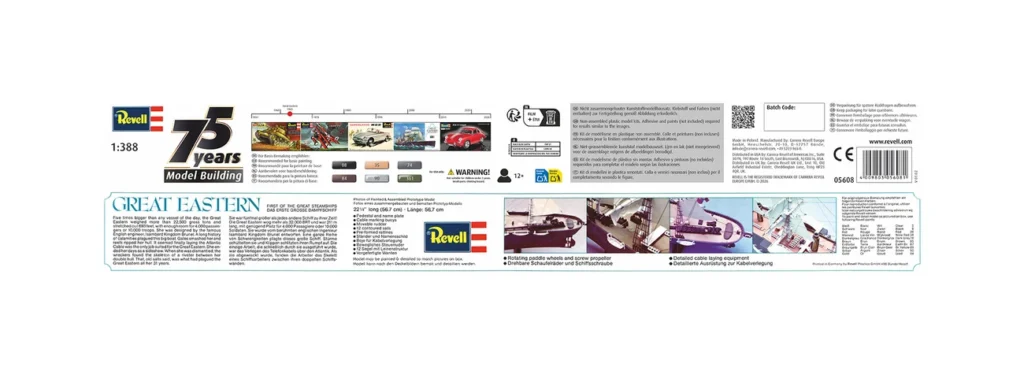 Our kit from 1963: 222 parts of model making history
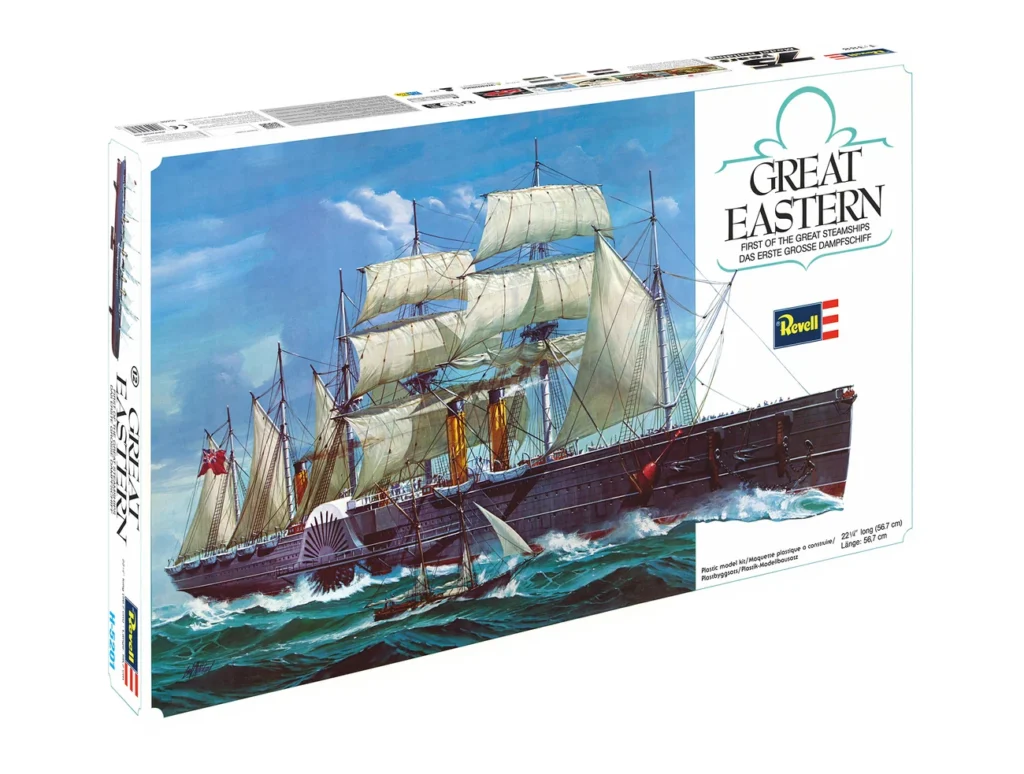
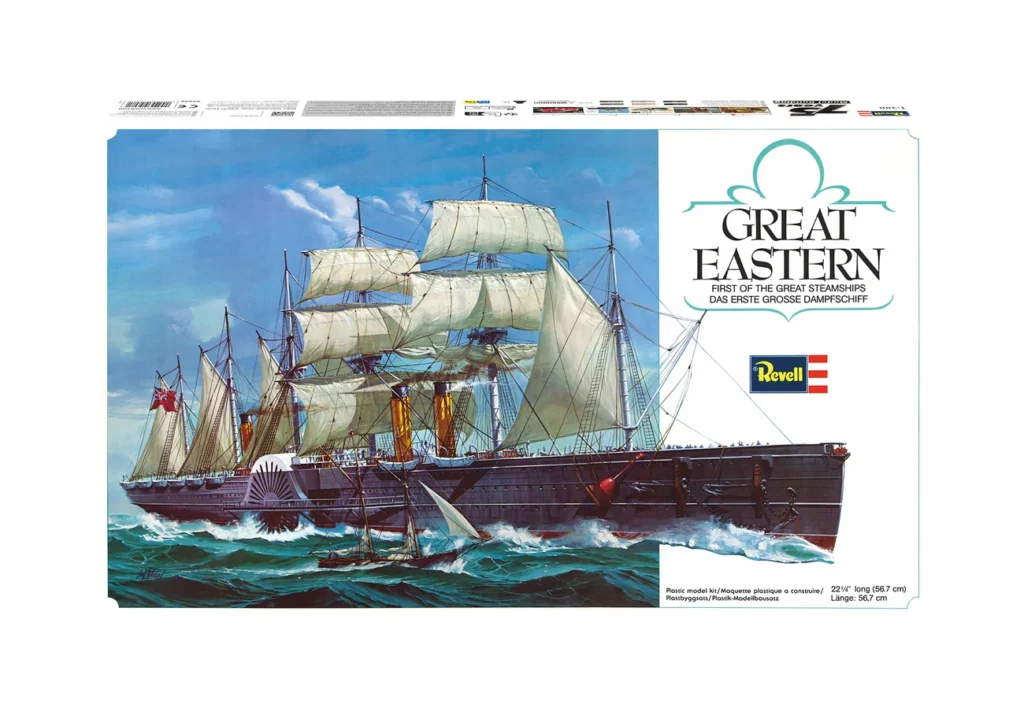
The moulds for this kit date from 1963, from a time when plastic model making was just coming of age. At 222 parts the Great Eastern is not an afternoon project, and at 56.7 centimetres long the finished model needs serious shelf space. You reconstruct the riveted hull, fit the mighty paddle boxes, align five funnels and rig six masts. The packaging comes in the classic design of the sixties, and the edition is strictly limited.
Three tips from experience. First, it pays to dry-fit all the parts beforehand, because historic tooling works with larger tolerances than today’s moulds, and flash comes with the territory. Second, you should fit the masts only after painting the deck, because otherwise every brush stroke becomes a test of patience. Third, fine rigging made from dark thread or stretched sprue achieves more than any additional part, especially at this small scale. If you like, you can suggest the rows of rivets with a thin wash that emphasises the structure of the hull without overstating it.
The package contains the unassembled plastic model kit from the historic moulds of 1963, illustrated multilingual assembly instructions and a decal sheet.
Bring the Leviathan to life while the limited edition lasts: Great Eastern now in the Revell shop.
Build inspiration
Megaprojects takes you around the ship here and introduces you to its impressive history