
On September 8, 1966, the very first episode of Star Trek aired on television in the USA. Sixty years later, a small series with cardboard sets and colorful uniforms has grown into an entire universe that has shaped generations of fans. Of all years, it is in this anniversary year that we have to say goodbye to a member of the original bridge crew. Walter Koenig, who sat at the helm console of the Enterprise as the young navigator Pavel Chekov, passed away on October 25, 2026, at the age of 90 at his home in North Hollywood. His daughter and his niece were with him in his final hours.
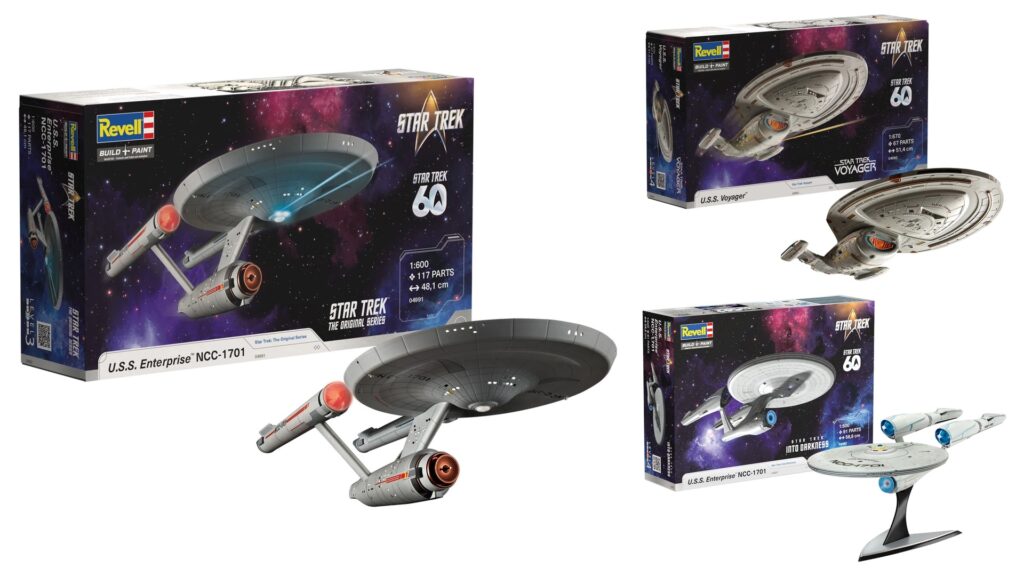
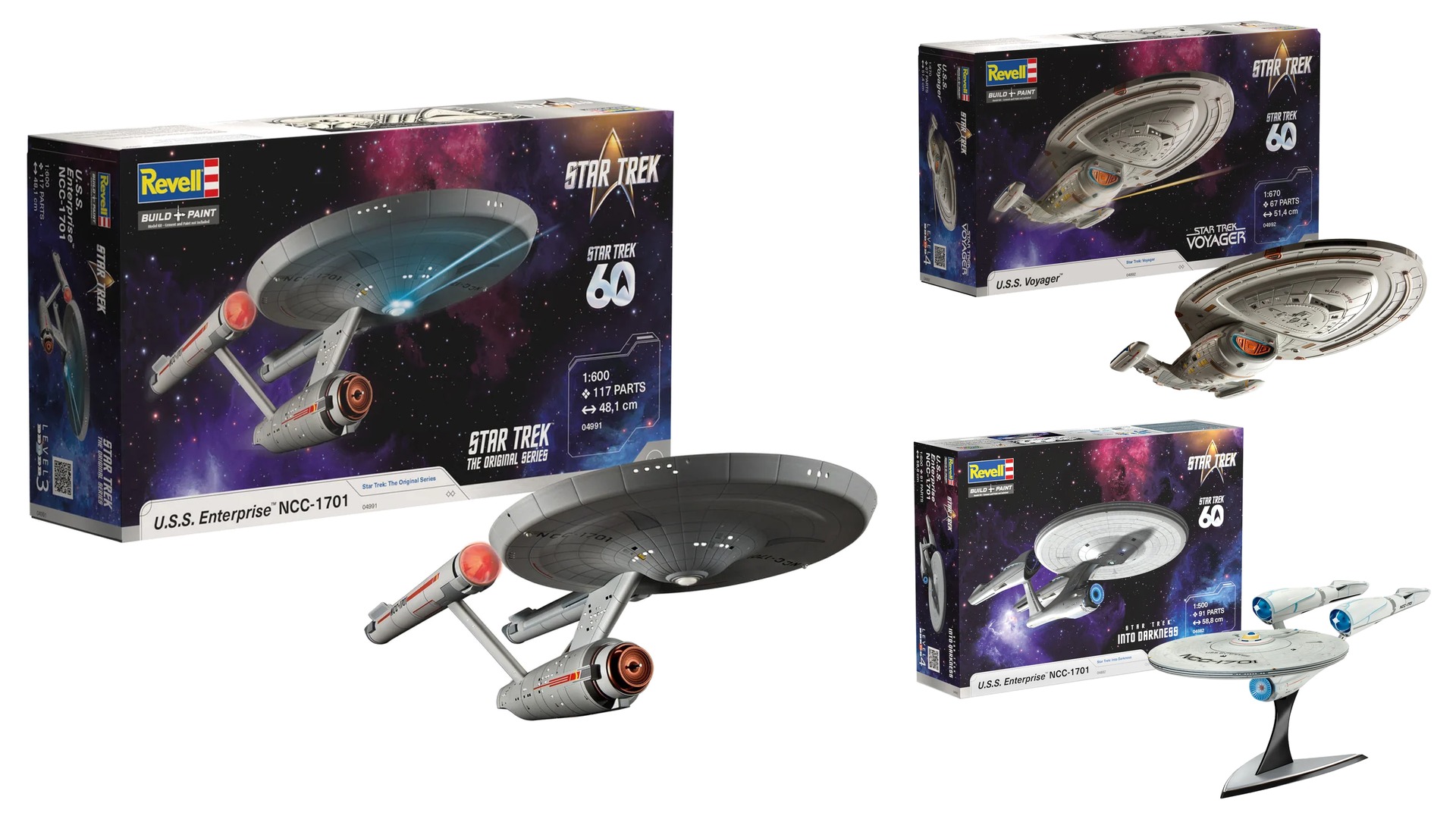
For us, the anniversary is a great occasion to look back with you on six decades of Star Trek and to introduce three starships that let you bring your passion for the final frontier to your workbench:
- the classic U.S.S. Enterprise NCC-1701 (TOS) from The Old Series
- the U.S.S. Voyager and
- the U.S.S. Enterprise NCC-1701 from Into Darkness.
Especially if you have loved Star Trek for years but have never dared to try a model kit, the NCC-1701 TOS is just the thing for you.
Walter Koenig: The navigator who was never actually part of the plan
Walter Koenig was not part of the original cast. It was only in 1967, at the start of the second season, that he joined the crew of the Enterprise. The producers wanted to bring a younger character on board that younger viewers could identify with. That is why Koenig even wore a wig in his first episodes, because they wanted to give him a hairstyle like the then popular pop band The Monkees. Even so, with his distinctive Russian accent and his dry humor, Chekov very quickly became a fan favorite.
Koenig played the role not only in the series but, from 1979 onwards, in seven feature films as well. Later, he thrilled science fiction fans once again as the enigmatic telepath Alfred Bester in Babylon 5, and in 2012 he received a star on the Hollywood Walk of Fame. His longtime colleague George Takei, who played Sulu, reminded everyone after Koenig’s death that his friend was far more than Chekov, namely also an author, a teacher and a thoughtful, loyal person. So if you like, over the coming weeks you can transport yourself back to Chekov’s station with a classic episode and a kit of the original Enterprise.
Six decades of Star Trek: From cancelled series to cult phenomenon
When Gene Roddenberry developed his idea of a peaceful exploration starship, nobody could have guessed how big it would one day become. The original series ran from 1966 to 1969 on the American network NBC and struggled with modest ratings from the very beginning. Cancellation loomed after the second season, but an unprecedented letter-writing campaign by the fans saved the series for a third season. After that, it was over for the time being.
Star Trek only became truly big in the years that followed. Reruns on television and the first fan conventions turned the crew around Captain Kirk, Spock and Doctor McCoy into icons. In Germany, the series aired on ZDF from 1972 under the title Raumschiff Enterprise, and many of you probably grew up with it. In 1979, the Enterprise came to cinemas for the first time with Star Trek: The Motion Picture, followed by further films with the original crew.
From 1987, The Next Generation launched a new era under Captain Picard, followed by Deep Space Nine, Voyager and Enterprise. In 2009, J. J. Abrams brought the classic crew back to life in an alternate timeline with young actors, and since 2017, series such as Discovery, Picard, Strange New Worlds and Lower Decks have continued telling stories of the universe on streaming platforms. What connects all of these stories is the hope for a future in which curiosity, diversity and cooperation matter more than conquest. And of course the starships, which for many fans are just as much main characters as the crew.
Why Star Trek and model building go so well together
When the autumn rain is pattering against the windows outside and it is already getting dark in the afternoon, there is hardly anything better than a project you can build a little further on evening after evening. This is exactly where Star Trek and model building meet. You know every line of these ships from countless episodes, and while building them you discover them all over again. Suddenly you understand how the saucer section is connected to the secondary hull, why the warp nacelles extend so far back and how much detail goes into the Bussard collectors.
Many beginners are wary of glue, paints and small parts. We can put that worry to rest. Our kits are divided into levels that show you what to expect. A Level 3 kit requires clean gluing and a bit of painting, but is straightforward enough that you can manage it well without any prior experience. As basic equipment, plastic cement, a pair of side cutters, a few brushes, the right paints and a good lamp are all you need. You will learn everything else as you build, and with each completed construction stage, not only does the starship grow, but so does your self-confidence. That is why our tip for getting started is clearly the U.S.S. Enterprise NCC-1701 (TOS), which you can find directly in our shop. If you are keen for more afterwards, take on the U.S.S. Voyager or the Enterprise from Into Darkness.
U.S.S. Enterprise NCC-1701 (TOS): The original for getting started
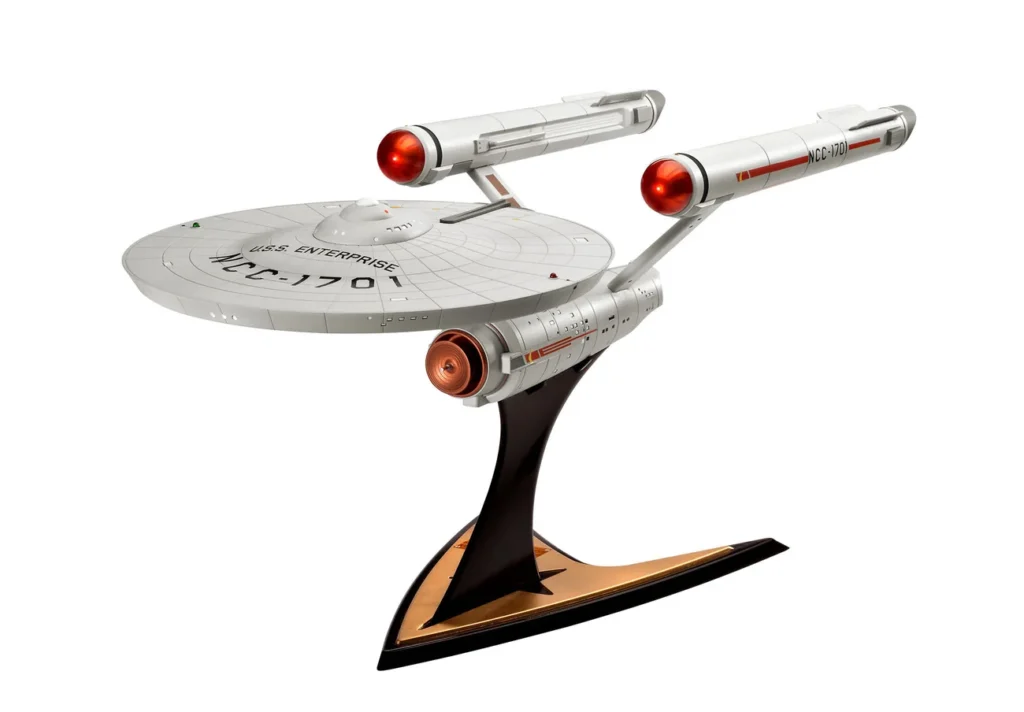
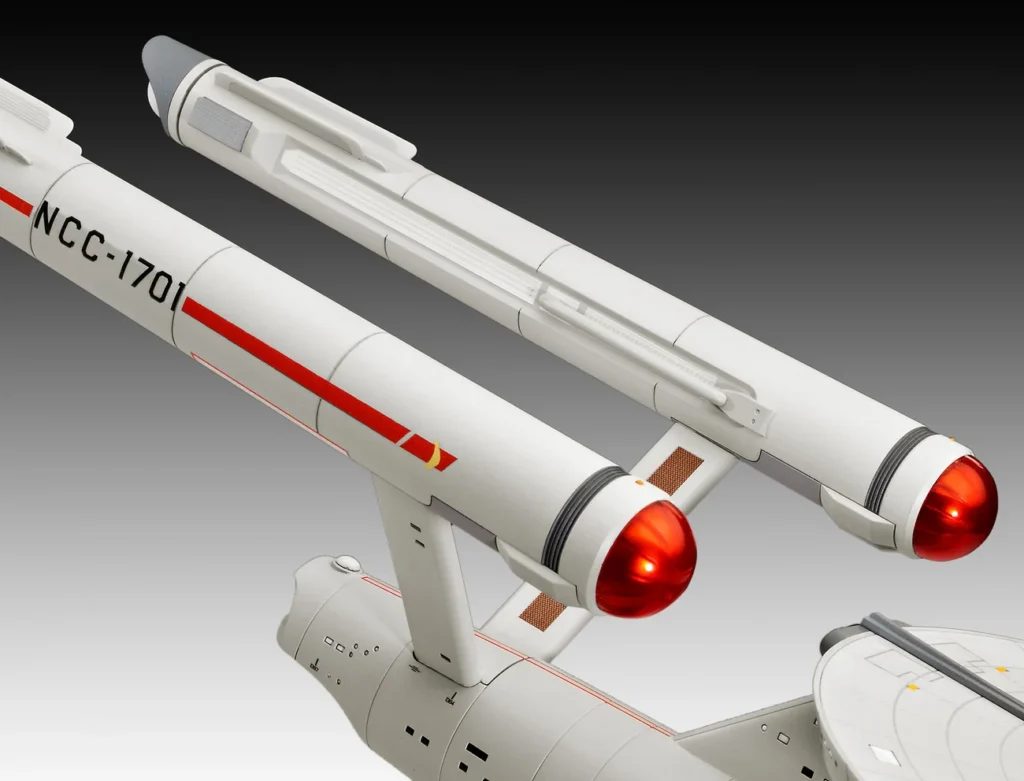
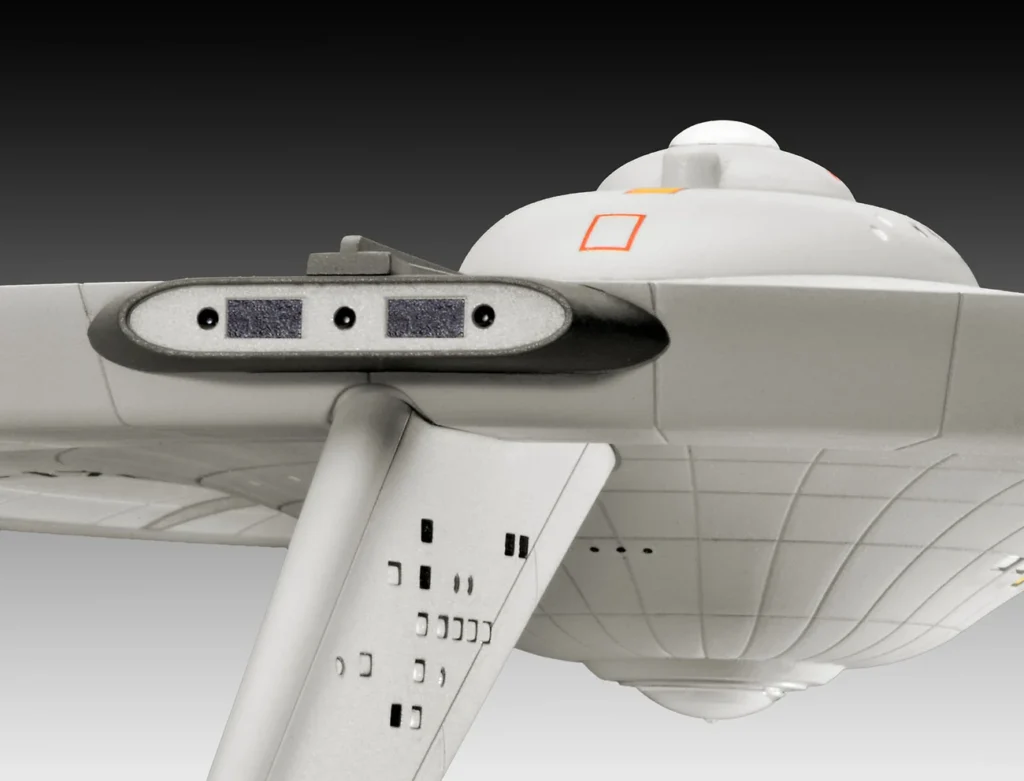
Our Enterprise from the original series is built in 1:600 scale from 117 parts and measures an impressive 48 centimeters when completed. Large parts for the saucer section, a multi-part deflector and numerous clear parts for the Bussard collectors and warp nacelles ensure that you make visible progress quickly and still end up with a richly detailed model on the display stand. Because the kit is rated Level 3, it is ideally suited as a first project.
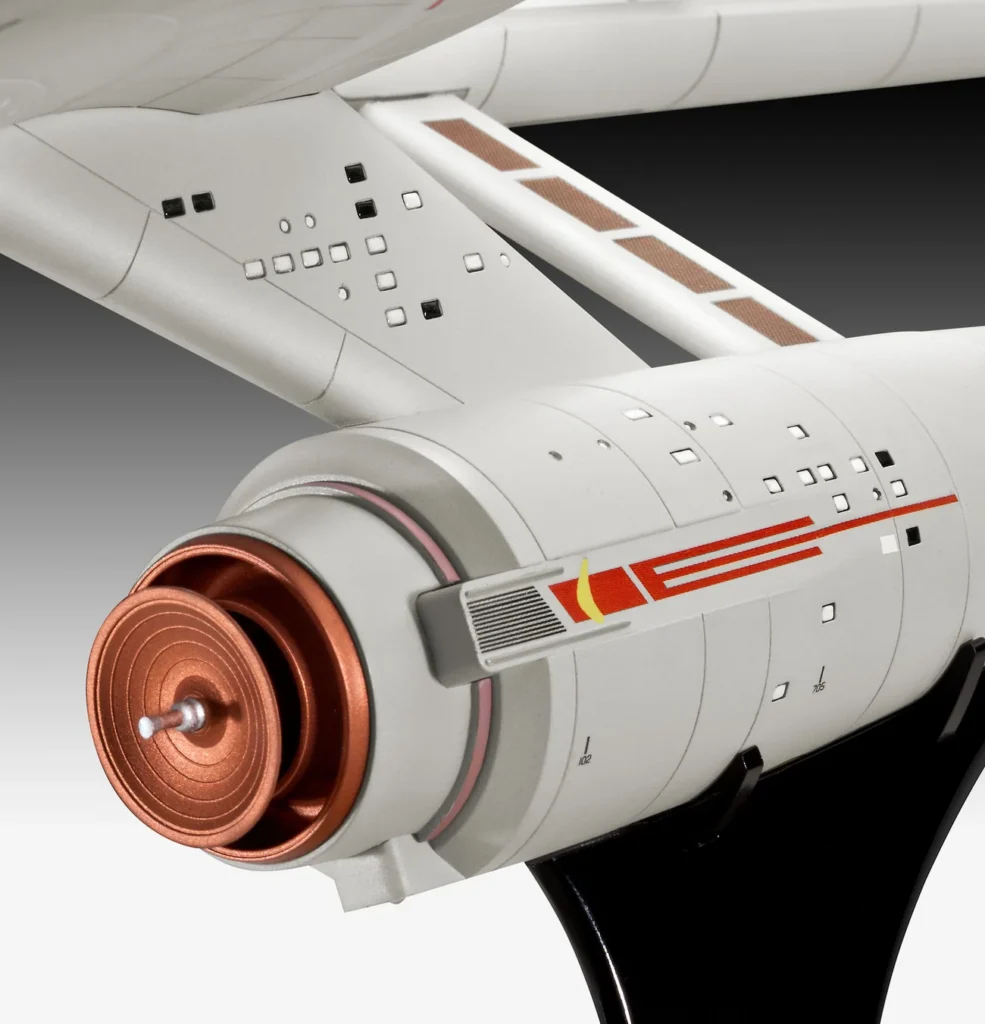
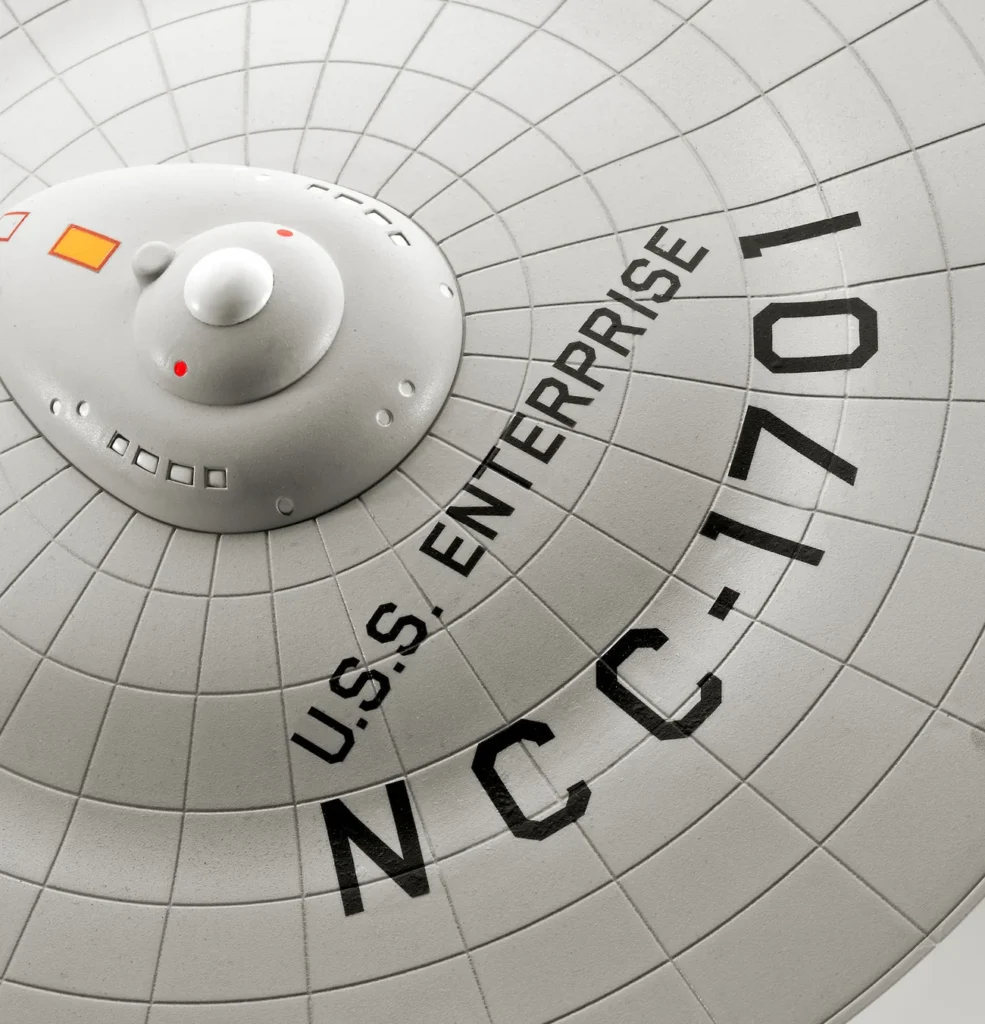
Designer Matt Jefferies designed the Enterprise in the mid-sixties and chose the NCC registry based on the registrations of American aircraft. The number 1701 stood for the seventeenth project and the first ship of this series, and it was meant to be easy to read on screen.
The original studio model from the series is a good three meters long and today belongs to the collection of the Smithsonian Institution’s National Air and Space Museum. Just in time for Star Trek’s fiftieth anniversary, it was extensively restored in 2016 and has been on display ever since in a place usually reserved for real aviation and space history.
In the episode The Doomsday Machine, the Enterprise encounters its badly damaged sister ship, the U.S.S. Constellation. The filming model for it was a perfectly ordinary model kit of the Enterprise, which the effects team had renumbered and given burn marks. So model building has been part of Star Trek history since as far back as 1967. Incidentally, our kit includes decals for the Constellation and the Potemkin, so you can decide for yourselves which Constitution class ship stands on your shelf.
U.S.S. Voyager: The long journey home
The U.S.S. Voyager under Captain Kathryn Janeway is flung into the Delta Quadrant on her very first mission, some 70,000 light years away from Earth. Our kit in 1:670 scale consists of 67 parts and reaches a length of just over 51 centimeters. At Level 4, it is the logical next step once you have mastered your first Enterprise and want to try your hand at somewhat finer work.
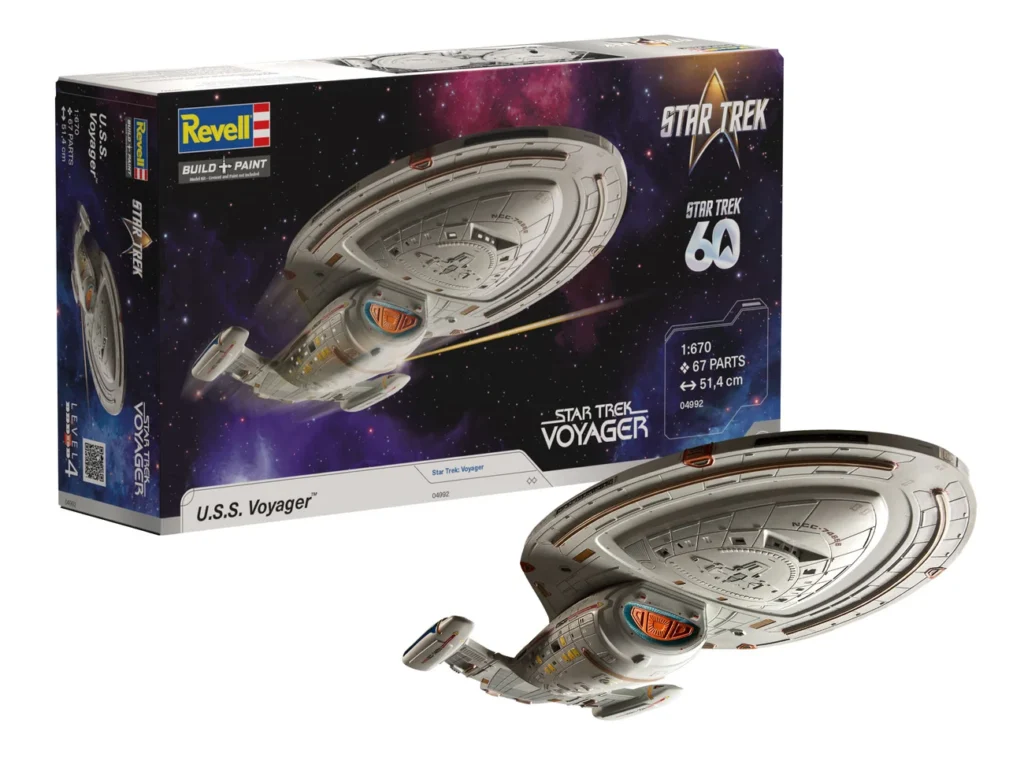
You can spot the first special feature right on the model. The Voyager’s pylons can be swiveled, just like in the original. The designers explained these movable warp nacelles by saying that ships of this generation were meant to protect subspace during warp flight, a problem that the series The Next Generation had previously addressed. So when building, you can decide whether your Voyager sits on the shelf in cruise mode or ready to jump to warp.
The Voyager was able to land on planets. Fans saw this for the first time at the start of the second season in the episode The 37’s, when the ship gently touched down on an alien world with its landing struts extended.
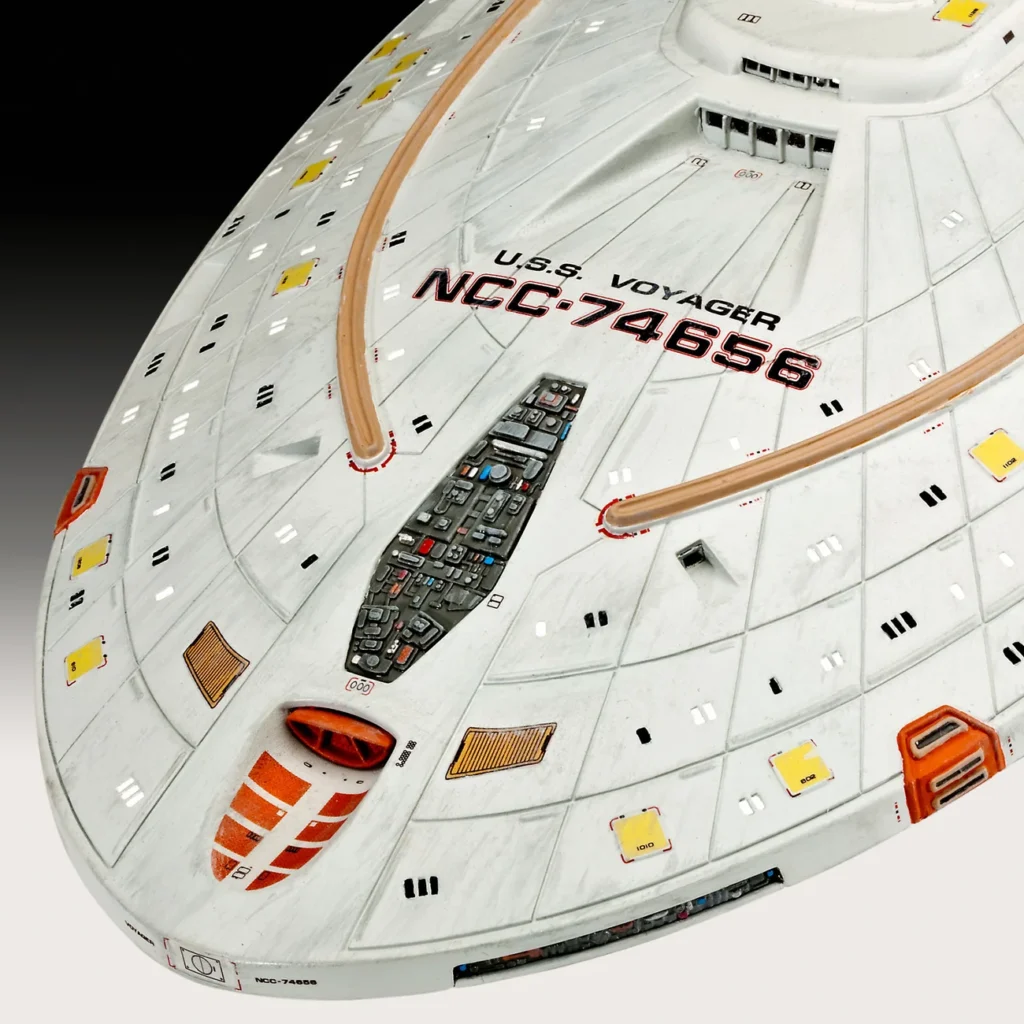
Originally, French Canadian actress Geneviève Bujold was supposed to play the captain, but she left after just a few days of filming. Kate Mulgrew took over the role and made Janeway the first woman to lead a Star Trek series as captain. For many fans, she remains one of the strongest characters in the entire universe to this day.
U.S.S. Enterprise NCC-1701 from Into Darkness: The Enterprise of the new generation
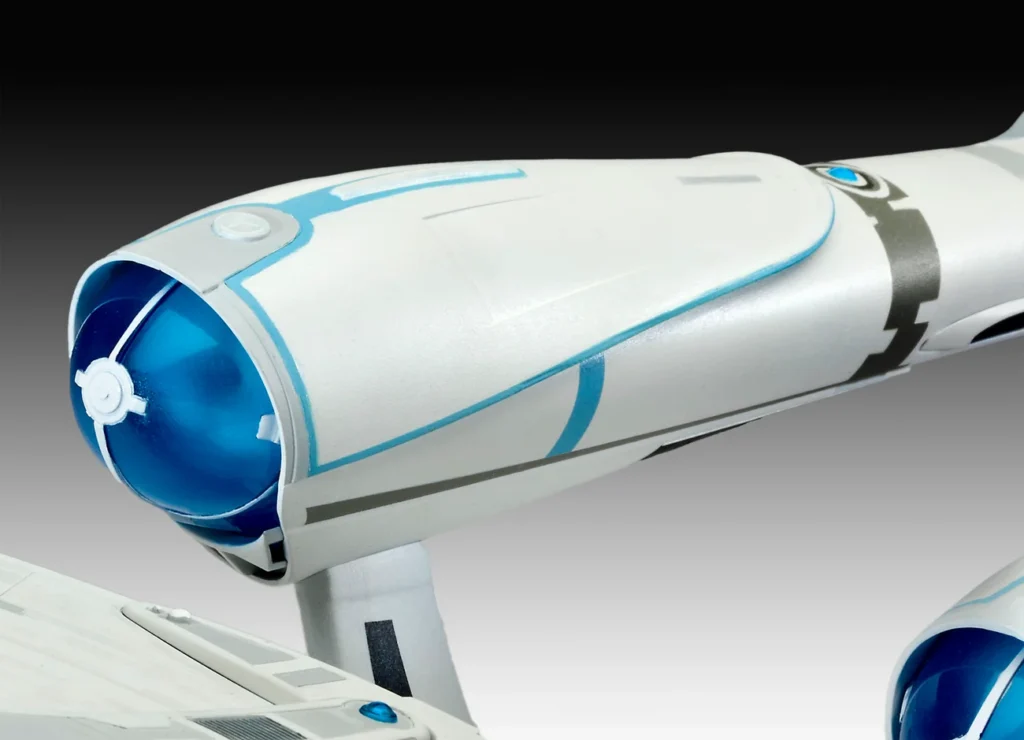
With Star Trek Into Darkness, the Enterprise returned to cinemas in 2013 in a modern interpretation. Our kit in 1:500 scale consists of 91 parts and, at almost 59 centimeters, is the largest of the three models. A two-part saucer section, separate command bridge, multi-part warp nacelles with separate pylons and many clear parts make it a real eye-catcher. If you want to go even deeper later on, you can even light the model, although the lighting components are available separately.
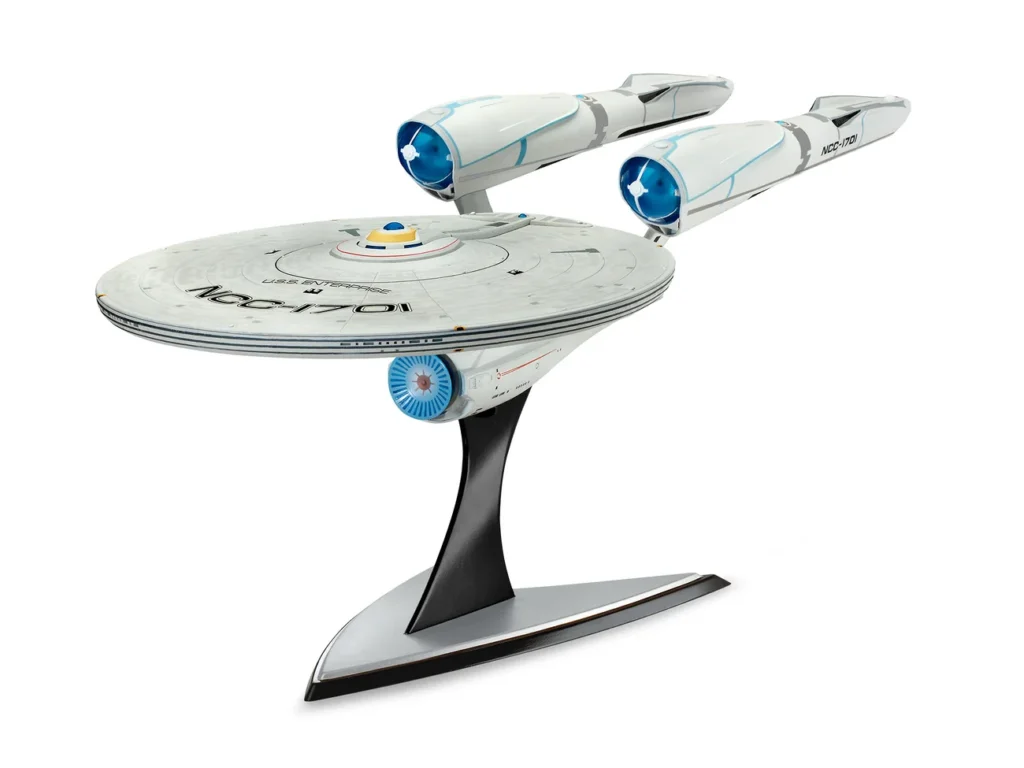
Right at the beginning, the Enterprise hides on the floor of an ocean on the planet Nibiru so as not to be discovered by the natives. The idea that a starship of this size could dive sparked passionate debates among fans, and the moment it rises out of the sea is one of the most striking images in the film.
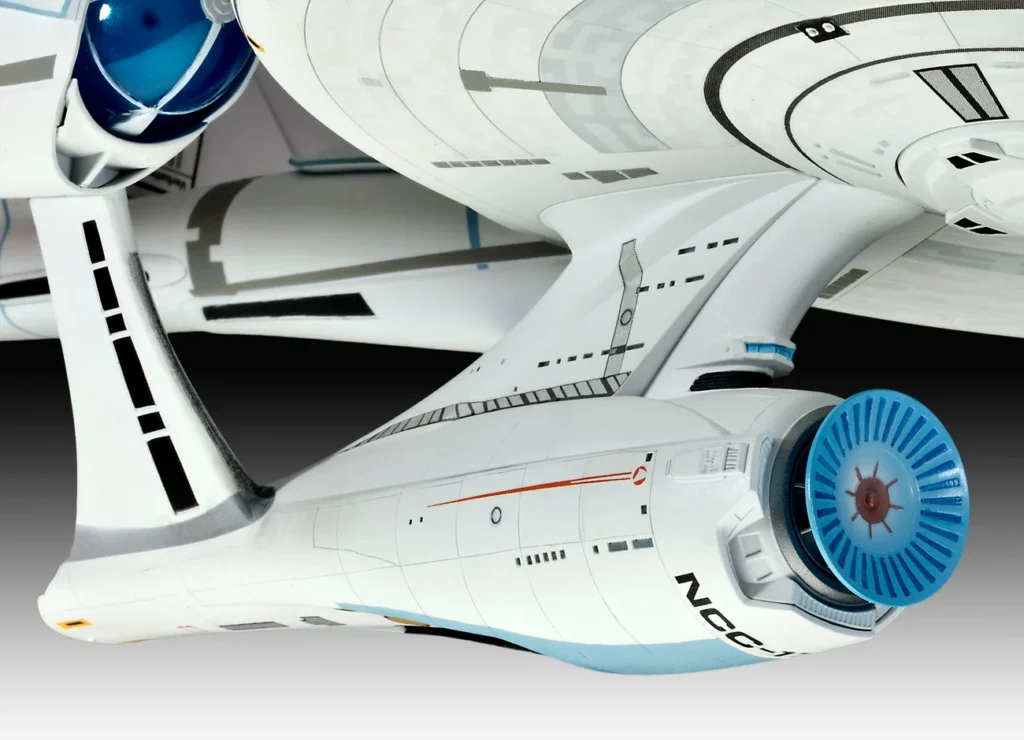
In Into Darkness, the young Chekov was played by Anton Yelchin, who sadly died far too young in 2016. When Scotty leaves the ship in the film, Chekov takes over engineering on the spot and has to put on the famous red shirt to do so, which die-hard fans greeted with a smile. The character that Koenig had once shaped thus moved to the center of the plot once again.
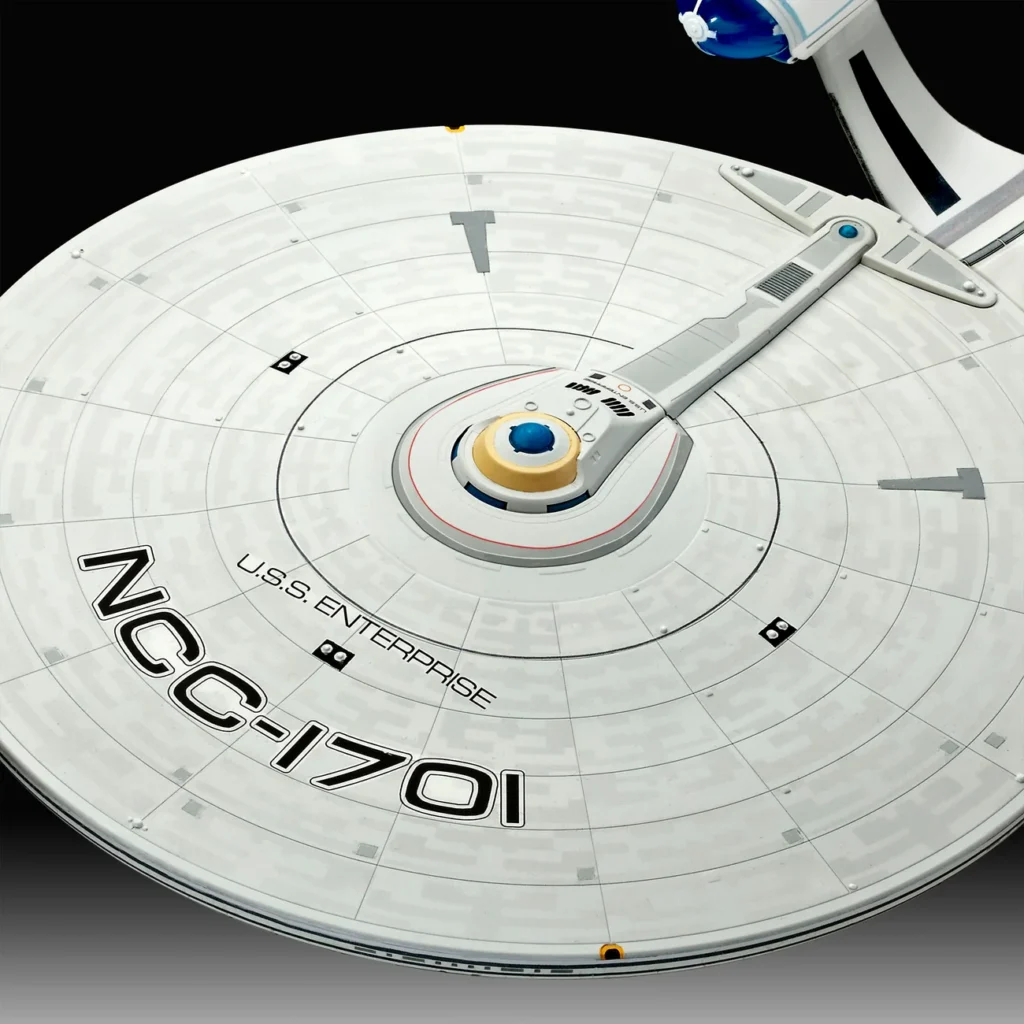
In the finale, Captain Kirk sacrifices himself in the warp core to save his ship, while Spock stands helplessly behind the glass pane. The scene deliberately mirrors the famous farewell from The Wrath of Khan from 1982, only with the roles reversed. If you know both films, you will see this Enterprise with completely different eyes.
Set your course for the long evenings
Whether you grew up with Raumschiff Enterprise in the seventies, travelled through the Delta Quadrant with Janeway or discovered the new crew in the cinema: this anniversary year is the perfect moment to turn your love of Star Trek into a hands-on project. Start with the classic Enterprise, take your time, and enjoy every evening on which your ship takes shape a little more. In the spirit of Walter Koenig and the entire crew, we wish you lots of fun along the way.
You can find all three kits in our shop: the U.S.S. Enterprise NCC-1701 (TOS), the U.S.S. Voyager and the U.S.S. Enterprise NCC-1701 Into Darkness.
Technical data of the kits
U.S.S. Enterprise NCC-1701 (TOS)
- Scale 1:600
- 117 parts
- Length 481 mm, width 213 mm, height 101 mm
- Level 3, recommended for ages 10 and up
- Decals for Enterprise, Potemkin and Constellation
- Display stand and illustrated, multilingual assembly instructions
U.S.S. Voyager
- Scale 1:670
- 67 parts
- Length 514 mm, width 201 mm, height 83 mm
- Level 4, recommended for ages 12 and up
- Swiveling pylons and many clear parts
- Display stand and illustrated, multilingual assembly instructions
U.S.S. Enterprise NCC-1701 Into Darkness
- Scale 1:500
- 91 parts
- Length 588 mm
- Level 4, recommended for ages 12 and up
- Lighting option, lighting not included
- Display stand and assembly instructions with painting guide