Hello, and welcome to the seventh installment of our Project Harrier blog series! This month will be a slightly shorter update as the team knuckles down for our Scale Model World 2026 preparations. For those joining us for the first time, it’s worth reiterating what this is all about. We have begun developing a new 1:32 first-generation Harrier family, with the first boxing (comprising parts to build either an RAF GR.1 or GR.3) being released in Q3 2027.
Rather than design the kit and begin tooling before announcing to the public, we wanted to do something slightly different: bring you along on the development journey and give you a behind-the-scenes look at the processes we go through to deliver a new kit. To that end, we’ll be providing monthly updates using a YouTube video series, blogs such as this one, plus occasional updates via social media and model shows. The blogs and videos themselves will be created by the development team working on the project, so you’re hearing it directly from the horse’s mouth!
This month has seen our design team, Chris & Horatio, continue to refine their respective designs whilst we await the green light to proceed with tooling. Chris has spent the month going over each and every element of the design, making various tweaks. Horatio has been finishing off the underwing stores after a lot of back and forth to ensure we have the shape and details of each item absolutely spot on. In addition to the design work, this month has been dominated by discussions surrounding tooling, e.g. part locations on frames, costs, and how to optimise tooling for the various versions we have planned.
Airframe Progress
Chris has made a few small changes across the airframe; these include a few corrections as a result of feedback received due to Project Harrier, so thank you! We are now confident that the airframe design is complete (I know we said that last month, but we’re 99% sure now!). I hope you’ll agree that she really is looking the business now!
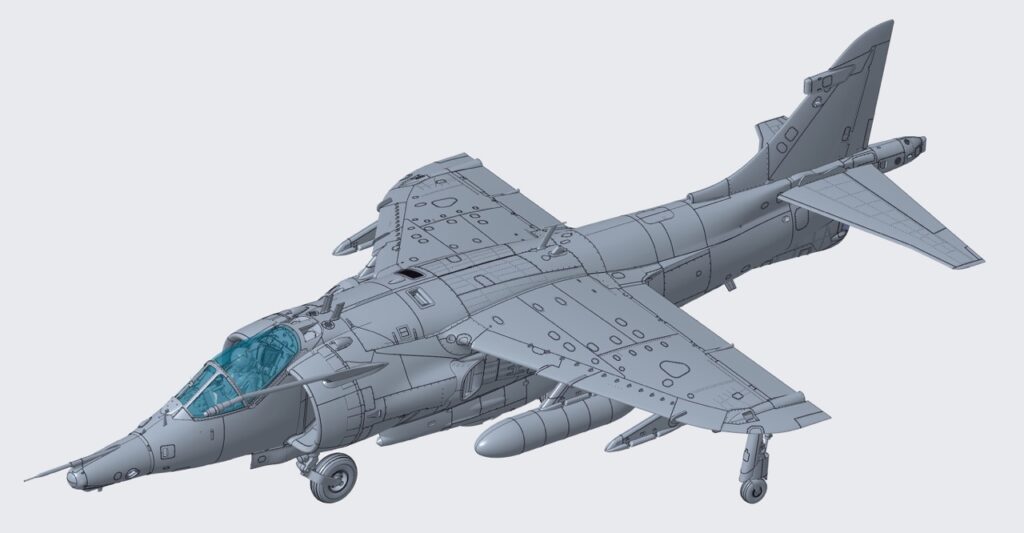
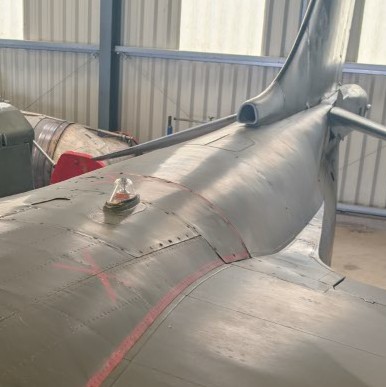
A theme throughout this project and almost all is the need to verify sources, whether that be technical drawings, photographs, or even physical examples that can be found in museums. It’s very easy to copy over details that are either incorrect or era-specific; therefore, we try to use 2 or 3 sources when checking to avoid mistakes (but they can still slip through the net!). One such item was the Ram Air Turbine (RAT) panel at the rear of the Harrier’s spine, something that is quite hard to see from ground level.
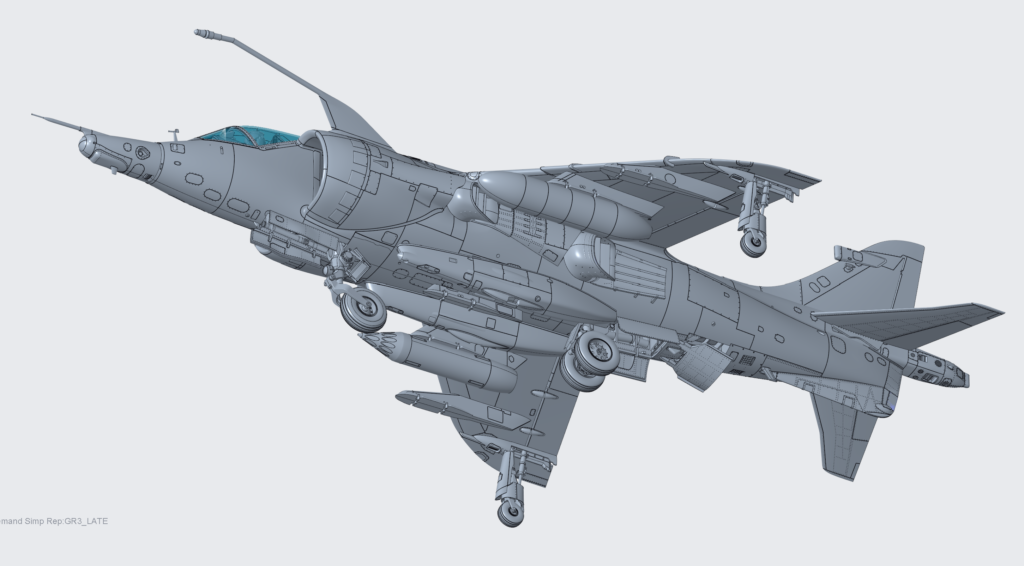
Late in the Harrier’s service life, the RAT was removed and the panel above no longer needed to open, so it was therefore blanked over. Chris had originally shown a blanked example; this was because many museum examples have this configuration. During the design check, we realised this would be incorrect for the majority of our schemes (it’s not always right/wrong; details change across an airframe’s life). Chris has therefore edited the panel to show the correct configuration.
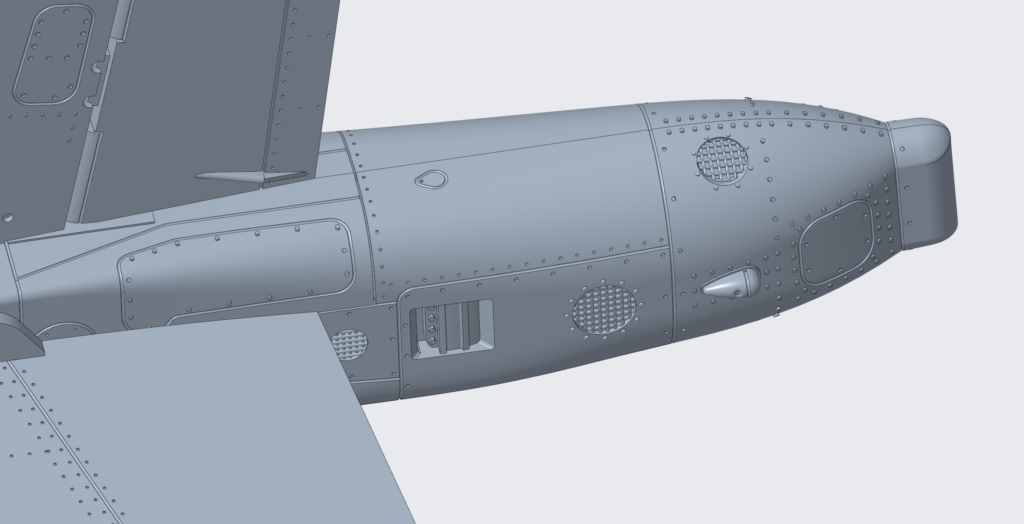
As well as the RAT, Chris has been working on the tail cone variations and detailing. Before the project we had an inkling as to how complex the Harrier was in terms of variations across its life, but the tail cone really nailed that point home with there being three versions included within the kit. One area in particular that we’ve changed as a result of the 3D printed tests is the mesh detail; originally, Chris had modelled one layer slightly offset from the other to give more depth, but in reality this failed to materialise, and so we’ve resorted back to the standard method.
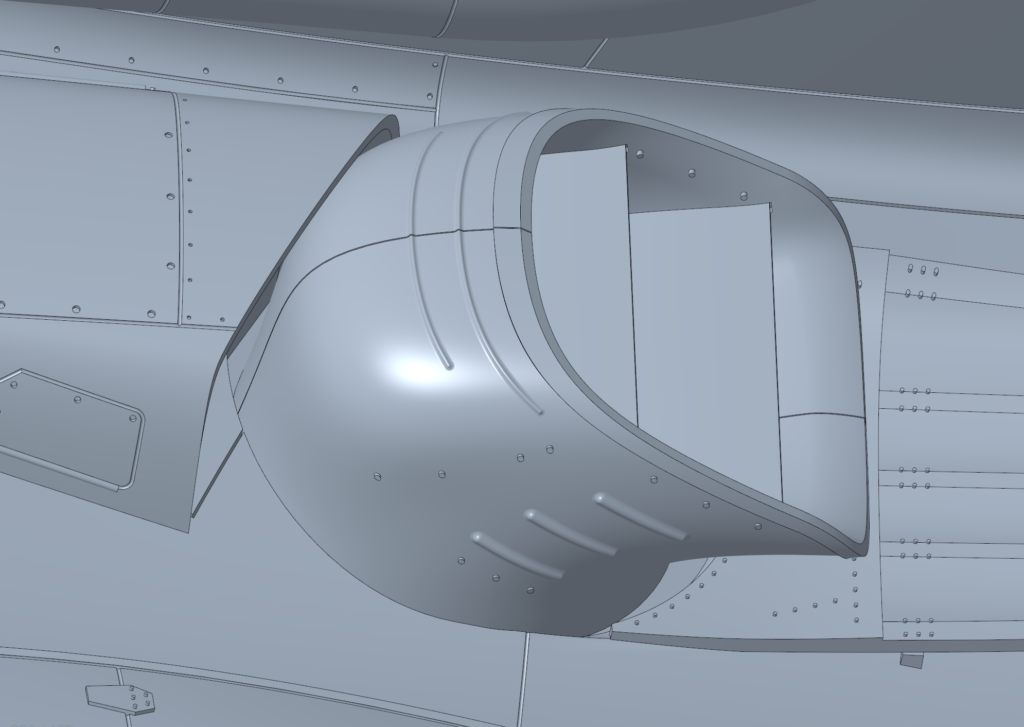
We’ve also made some changes to the nozzles, these had been devoid of detail, but we’ve now added the distinctive ribs to both the front and rear (details differ) as well as the fasteners. We’ve also tried to thin down the edges as much as possible, scale thickness is a constant battle for model kit companies.
Engine Progress
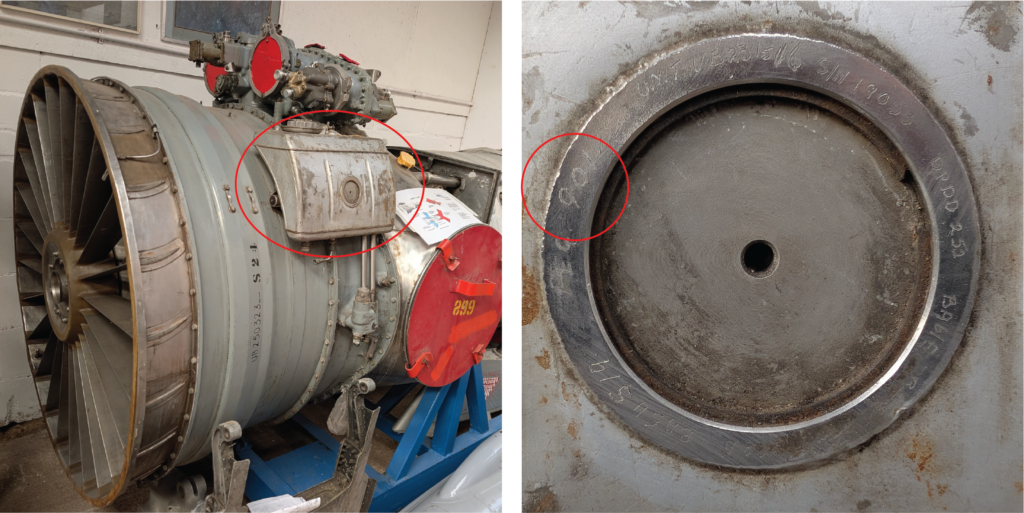
As the design for the engine was completed last month, we won’t be discussing the topic in this month’s update, but I wanted to share something I came across in my travels. I recently visited the Wings Aviation Museum to record the intro/outro for the Project Harrier update. Whilst admiring a very early Pegasus engine (technically a BE53/2) on display near their excellent Kestrel restoration, it was pointed out to me that the tank was in fact from the very first ever Pegasus engine, 901!
Underwing Stores
Last month the basic shape of each of the underwing stores was near enough ready; this helped us get accurate tool quotations created. The past few weeks have been focused on adding detail to the assemblies; this has required an awful lot of back and forth between Horatio, myself and subject matter experts to ensure they are as close to the real thing as we can get them.
As a recap, we plan to include the following items within the tooling:
- 1 x Harrier Recce Pod (AKA Vinten pod, although Vinten have confirmed it was in fact designed and developed by Hawker Siddeley)
- 2 x Matra 155 Rocket Pods (With & without frangible cover on cone)
- 2 x AIM-9
- 2 x 1000lb GP Bombs (Mk.114 tail & Mk.117 tail options)
- 2 x BL755’s
- 2 x 100 Gallon Tanks (Metal and Phenolic Asbestos versions)
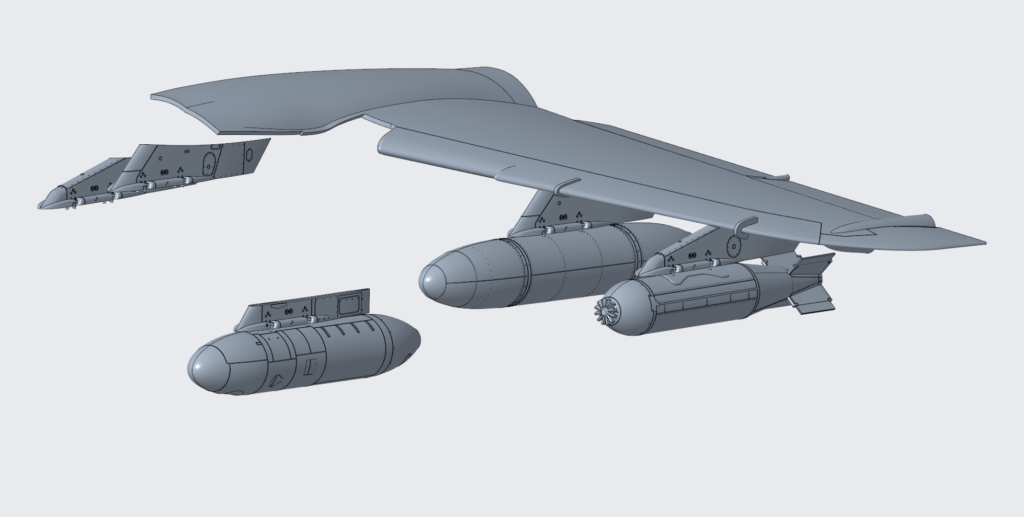
The recce pod has proved particularly difficult to get right; this is due to the fact that there don’t seem to be any in existence and photos showing detail are sparse, mainly because it’s always on the centre pylon. We used excerpts from the AP’s and some overall dimensions we were given alongside 2 or 3 photos to take a best guess…and we were pretty happy with the result. However, upon further probing, our friends at Key Publishing were able to help by providing a fantastic image showing the underside of the pod. Again, we tweaked the design and were content that we probably had the most accurate representation of this pod to date.
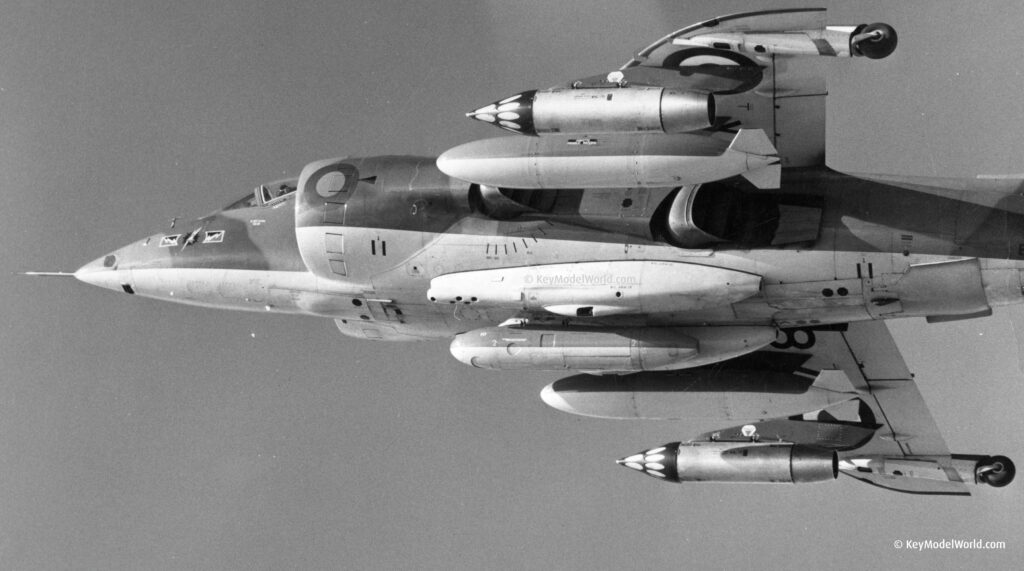
However, in the process of recording this month’s update video, we visited the Wings Aviation Museum where Dave Cotton was able to share some more information that led to yet further tweaks. So, we are now happy that what you see below is the most accurate representation of the pod to date.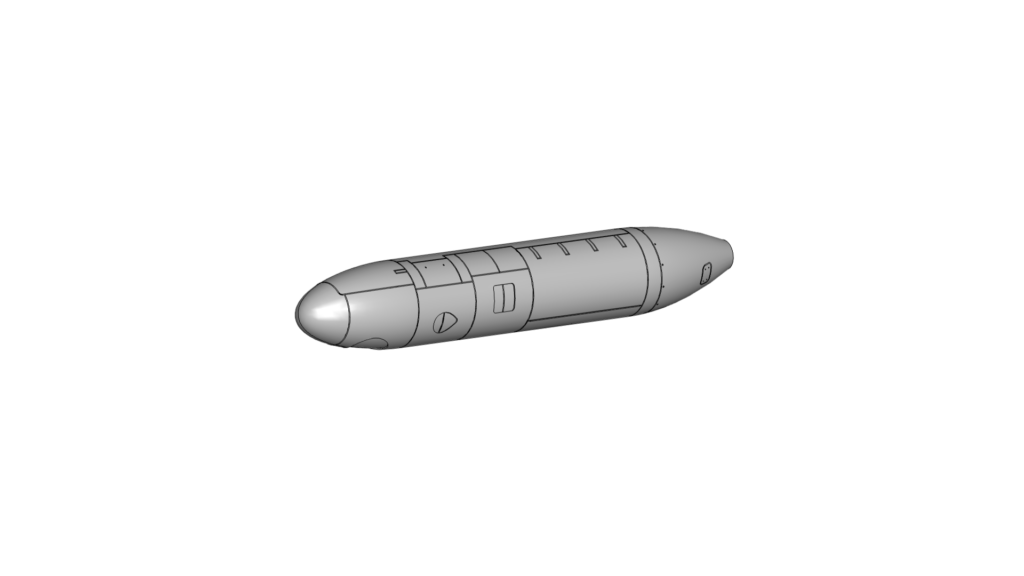
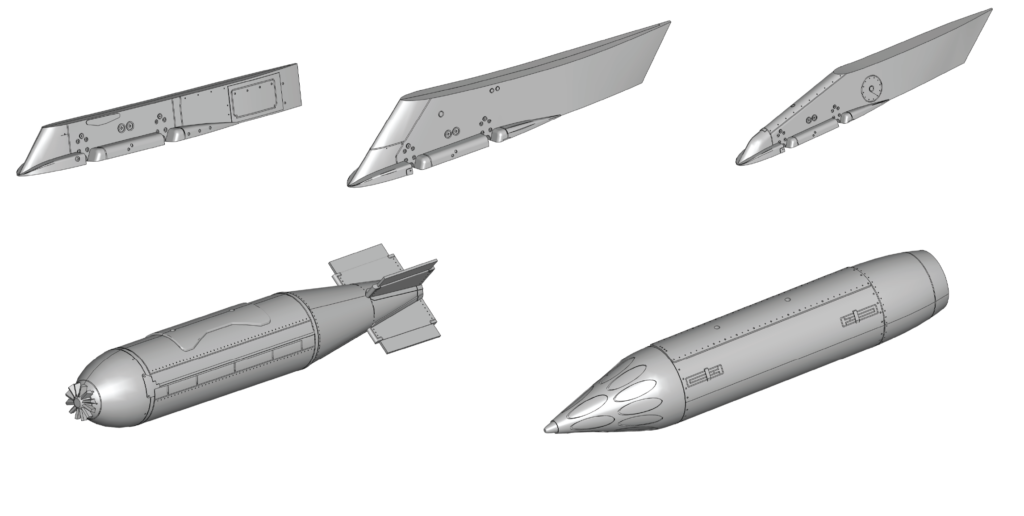
Aside from the Recce pod, Horatio and I have been working closely on the other items, with a few rounds of revisions, each one taking us closer to the finish line. Work is still ongoing with some items, namely the sidewinders and 1000lb’s but by the time you read this they will be done (fingers crossed!).
Tooling
With the design work now tailing off, we’ve been busy getting quotes for tooling from various suppliers and working to optimise the tooling for user experience and cost (not things that go hand in hand!). We’re yet to decide which tooling company we’ll be going ahead with, but we hope that by the December update we’ll have this sorted and we’ll have pictures to show of the steel!
Part of the process before cutting steel is creating a ‘tool plan’; this lets the tool shop know how we want the parts split up in an ideal world. When creating the plan, we have to consider a number of factors such as future versions, keeping sub-assemblies together in rough build order, and the most efficient way to mould multiple parts.
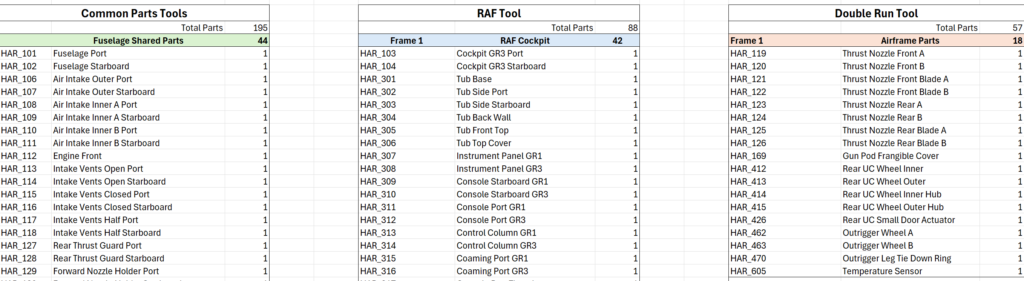
Now, as I said above, this list is what would happen in an ideal world but when we compile it we’re not thinking about pressures and other complexities of mould design; we lean on the toolshop’s expertise for this. We therefore often have a fair bit of back and forth finding the best solution that balances user experience and technical requirements of mould design all whilst keeping price in check; it’s a balancing act!
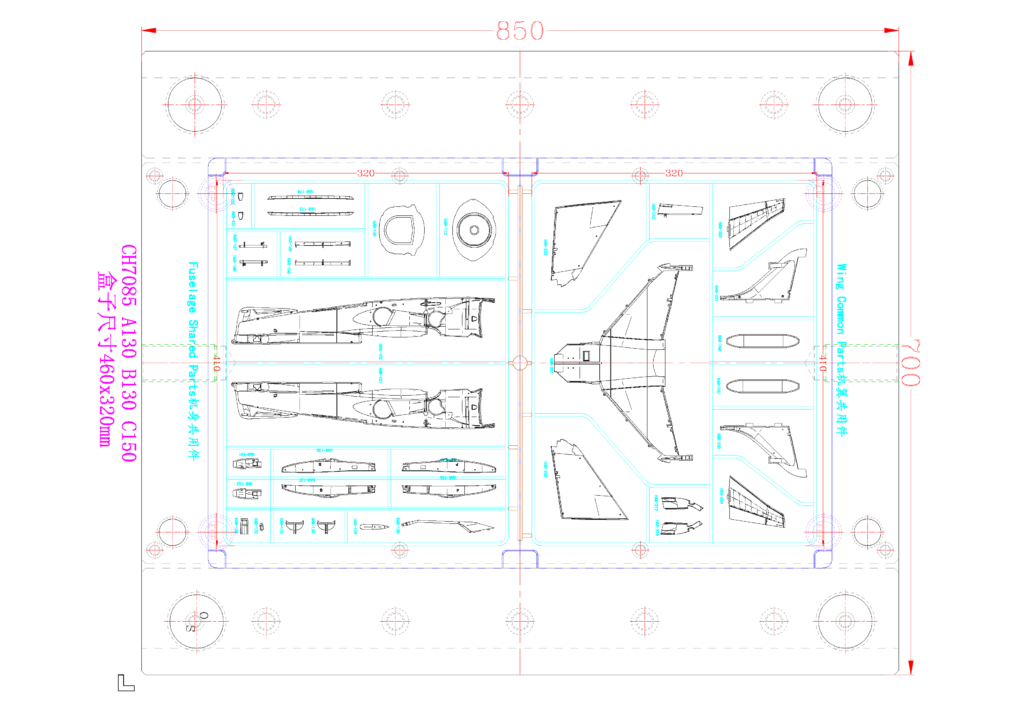
We have already started this process of back and forth with our suppliers, and we’ll soon be in a position to show off the final plan, but for now, here’s a sneak peek at one of the moulds:
“Your Name Here” Competition
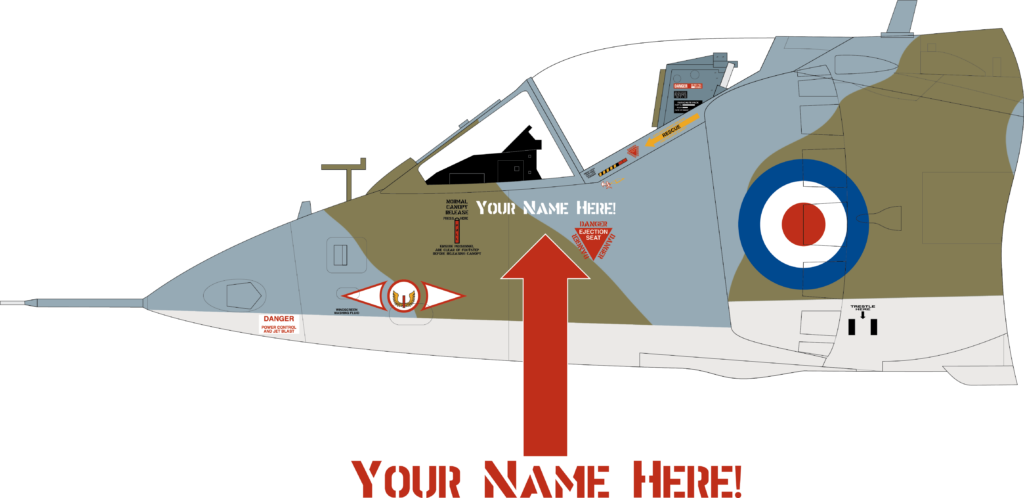
As part of our ongoing partnership with the modelling charity Models for Heroes, we have come together to launch a competition to raise funds to help them with the amazing work they do. You can find out more about Models for Heroes here: https://www.modelsforheroes.org.uk/
The prize? One lucky winner will have their name added to the Harrier decal sheet in the form of a pilot/crew name and receive a copy of the kit when released in Q3 2027. Now, it won’t just be added to one decal sheet; the winner’s name will feature on the entire production run!
You’ll need to act quickly as the competition closes at 12:00 GMT on Sunday 8th November with the winner announced shortly afterwards.
For more details and to enter, please use this link: Enter the raffle on Raffall
YouTube
As with every update, we have also recorded and released a video update covering much of the same content but with a few differences. So, if you simply can’t get enough of us wittering on about Harrier (pun intended!), then please check the YouTube video out:
What Next?
The next month is likely to see work slow on the design/tooling side of the Harrier whilst we await the green light from the bosses to proceed (these things don’t come cheap after all!). Don’t fear, we’ll still have plenty to show you in the next update; we’ll be turning our attention towards the decal choices for the kit and the work that goes on behind the scenes to decide these. Our next update will be back to the usual spot (first Friday of the month), which is the 4th December. Also, a bit of advance warning regarding the January update: this will be a week later than usual (8th) due to the Christmas/New Year shutdown.
If you would like to share your knowledge about the Harrier or point out common pitfalls, please send an email to info.de@carrera-revell.com with the subject line “Project Harrier”. I will try my best to read them all and answer them if possible!
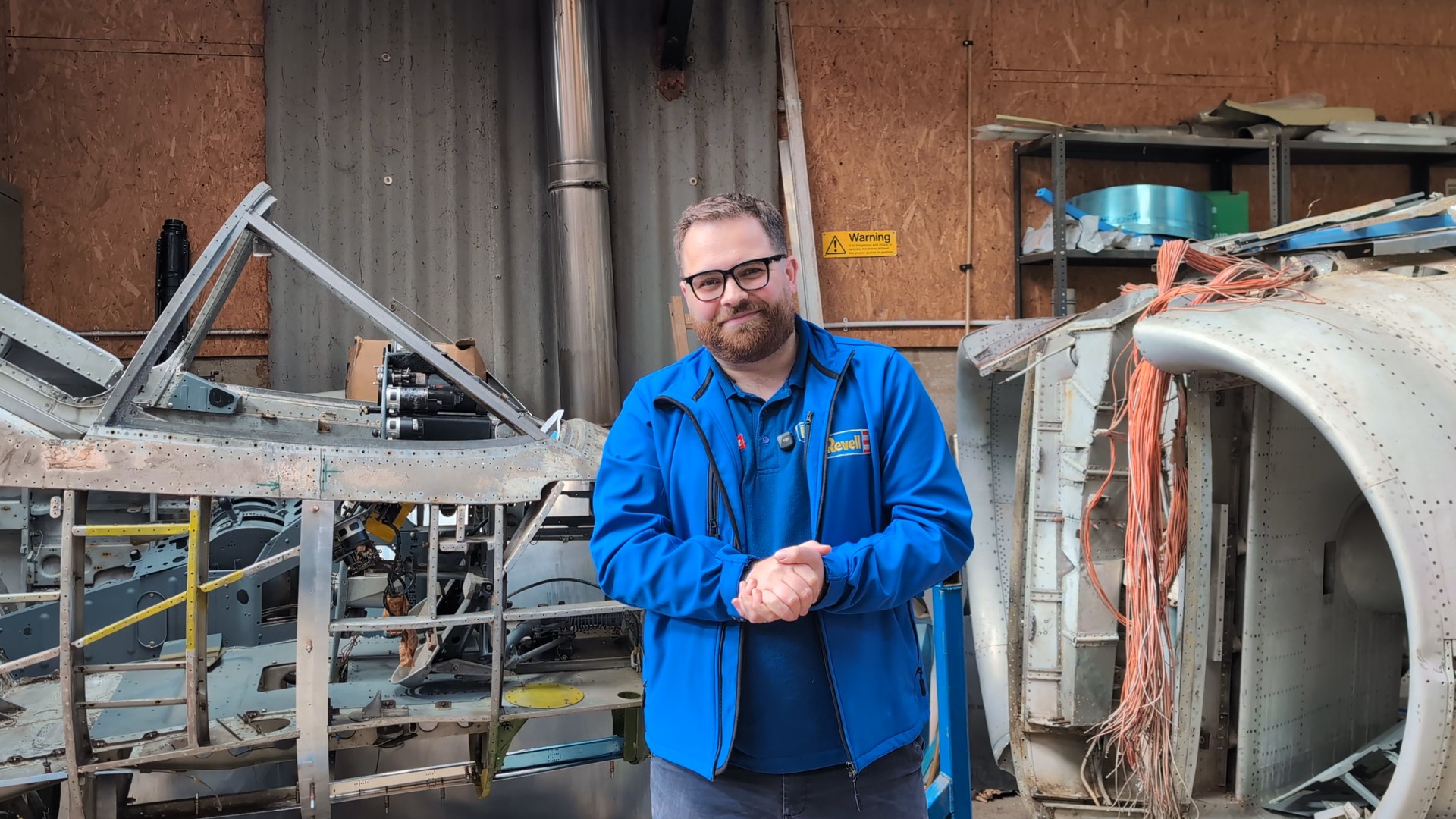
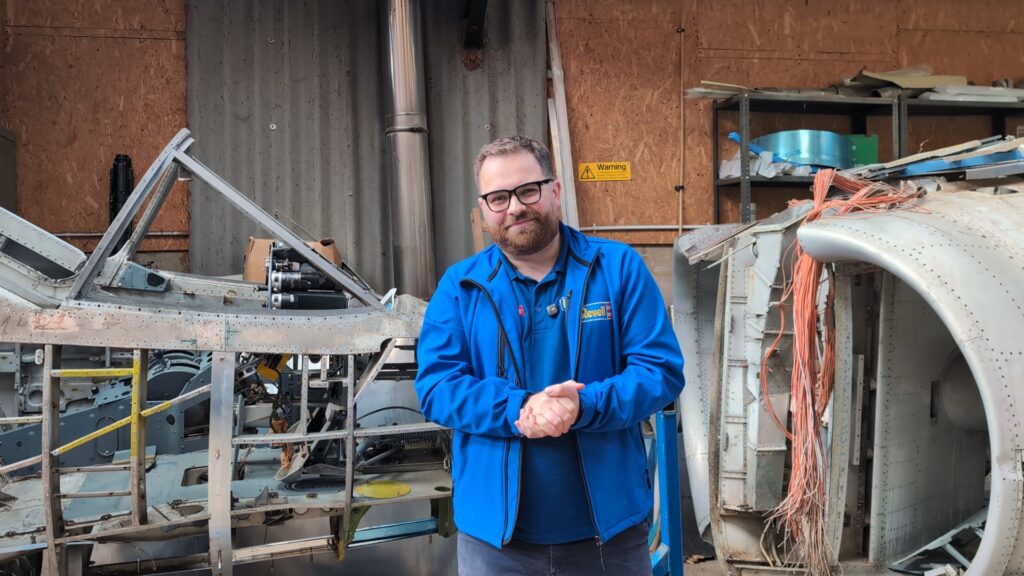
Thank you to the Wings Aviation Museum for allowing us to visit earlier this month to record the video update, this time in front of a Kestrel rather than a Harrier! Dave Cotton has been a tremendous help throughout the project, and we’d like to thank him for facilitating this visit plus all the helpful information he has sent over the past months.
As in previous months, Nick Greenall has been providing invaluable support to the whole team, and we count ourselves lucky to have his expertise to rely upon. Thank you, Nick!
Until next time!
Luke