
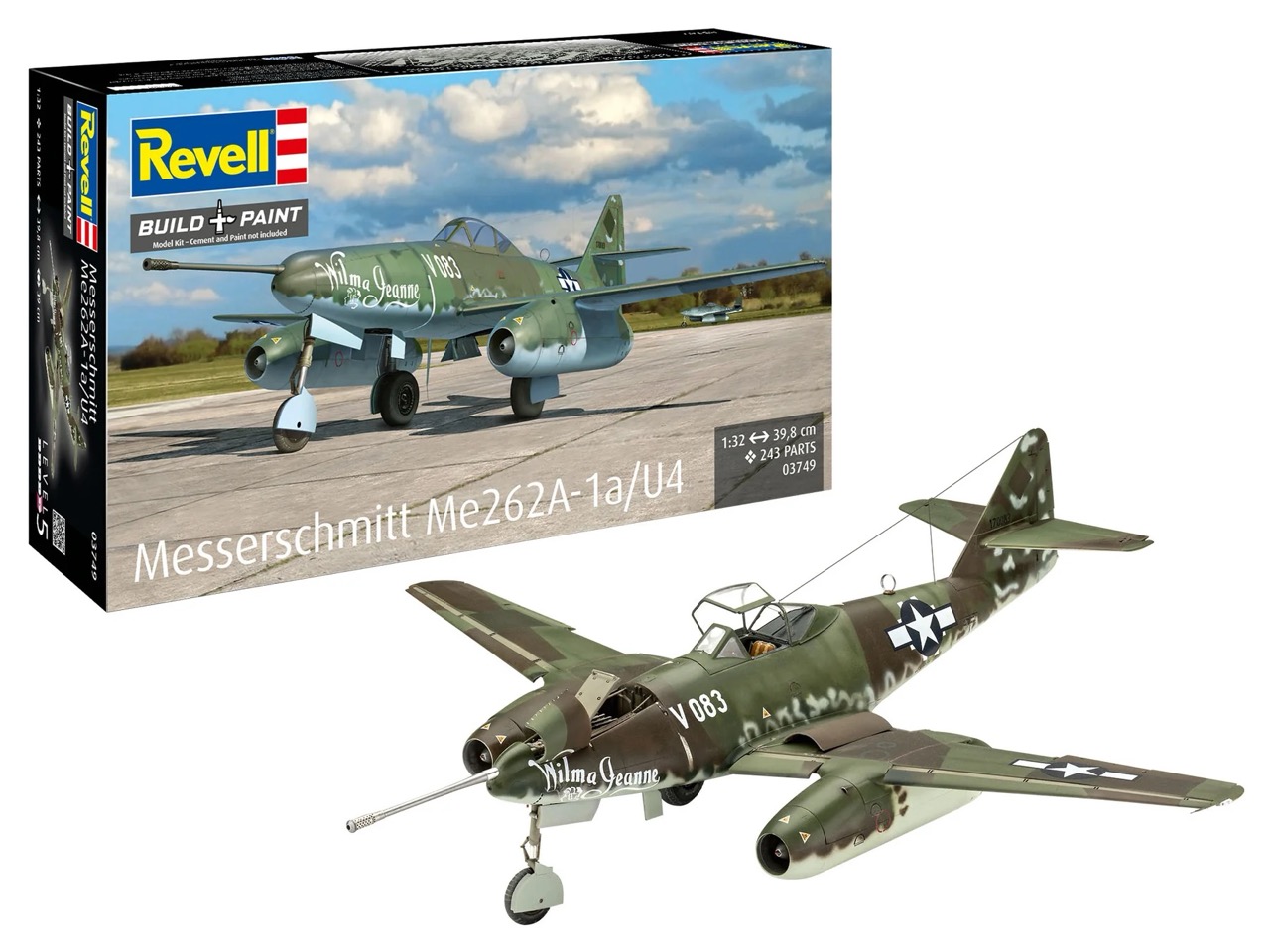
There are moments in the history of aviation when you encounter an aircraft carrying so many superlatives at once that it takes a few seconds to grasp what you are actually looking at. The Messerschmitt Me262 View the kit in the Revell Shop is one such aircraft. It was the world’s first series-produced jet aircraft, faster than anything the Allies could throw against it, and yet, thankfully, it arrived too late to change the outcome of the war. Our kit of the Me262A-1a/U4, however, does not show you just any version of this milestone. It shows you the most radical, rarest and most extraordinary offshoot of an already exceptional aircraft: a flying narwhal with an anti-tank cannon in its nose.
From Concept to Aircraft: The Long Development History of the Me262
In autumn 1938, the Bayerische Flugzeugwerke AG, the predecessor company of Messerschmitt AG, received a commission from the Reich Aviation Ministry to develop a jet-propelled fighter aircraft. The project was designated P 1065. In other words, the idea that would eventually become the Me262 is, like so many others, older than the Second World War itself. What followed was years of struggle against technology, bureaucracy and political stubbornness.
Due to delays in the development and delivery of suitable jet engines, official disinterest from the leadership, damage caused by Allied air raids, and a development programme plagued by difficulties, it took almost six years before the Me262 could enter service with squadrons of the German Luftwaffe.
The biggest stumbling block was the engines. The Jumo 004B powerplants that ultimately gave the Me262 its thrust were based on technology for which there was simply no prior experience. Heat-resistant alloys were unavailable, manufacturing methods had to be developed from scratch, and each individual engine had a service life of barely more than 25 hours in operation.
Then came the political chapter that many regard as the true drama behind the Me262. On 26 November (author’s note: “Well, that’s my birthday”) 1943, the Me262 — fitted with a nose wheel from the V5 prototype onwards — was presented to Adolf Hitler. Hitler reportedly asked company director Willy Messerschmitt whether the aircraft could be loaded with bombs, to which Messerschmitt agreed, as investigations in this regard had already been conducted. Hitler approved mass production on the condition that the aircraft be used primarily as a bomber, which he urgently needed to counter the anticipated Allied landings.
This decision triggered one of the most legendary disputes in German military history. Field Marshal Erhard Milch is said to have retorted to Hitler: “Any small child can see that the Me262 is not a bomber but a fighter.” Hitler remained unconvinced. Nevertheless, research has since established that his insistence on the bomber concept was not the sole cause of the delays. The fundamental technical problems with the jet engines would have prevented its introduction regardless.
The Schwalbe in Action: Faster Than Anything Else
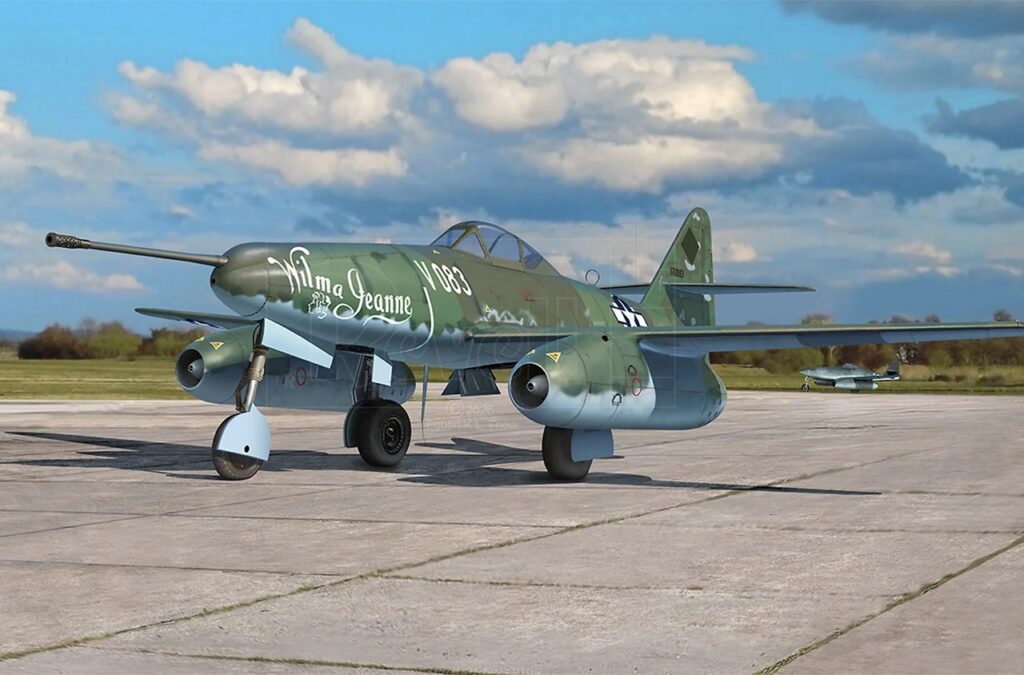
When the Me262 finally entered serious service in the summer of 1944, it left the Allies in a state of simple disbelief. With a top speed of around 869 km/h, the Me262 was approximately 193 km/h faster than the famous North American Mustang at the same altitude and could, despite being less manoeuvrable, engage in or disengage from combat entirely at will.
Although 1,443 Me262s were completed, it is estimated that only around 300 could actually be deployed in combat. The reason was straightforward: the massive Allied bombing raids, combined with a shortage of fuel, spare parts and trained pilots. Towards the end of the war, the last Me262 units were even forced to operate from hastily prepared sections of the Autobahn, because the airfields were under constant attack.
Nevertheless, the psychological impact of this aircraft was enormous. Any Allied bomber pilot who spotted the Schwalbe knew he could not outrun it. The only truly effective tactic was to attack the Me262 during take-off or landing, the only moment when its speed advantage could not come into play.
The Pulkzerstörer: When One Cannon Is Not Enough
And here begins the story of our kit. The Messerschmitt Me262A-1/U4 Pulkzerstörer, also known as the Narwhal, was a prototype interceptor variant of the Me262 conceived in 1943. It was specifically ordered by the Luftwaffe to counter Allied bombing raids, as the already heavy armament of four 30 mm MK 103 autocannons was deemed still insufficiently efficient to destroy a bomber.
The reasoning behind it was militarily sound. To accomplish this task, the Narwhal was equipped with a large 50 mm Mk 214 autocannon derived from the 50 mm Pak 38 anti-tank gun, designed to destroy a bomber with just a few shots. The plan was to approach bomber formations from outside the range of their defensive gunners and bring down a heavy aircraft with a single well-placed hit. No dogfights with escort fighters. Simply one cannon, one shot, one hit.
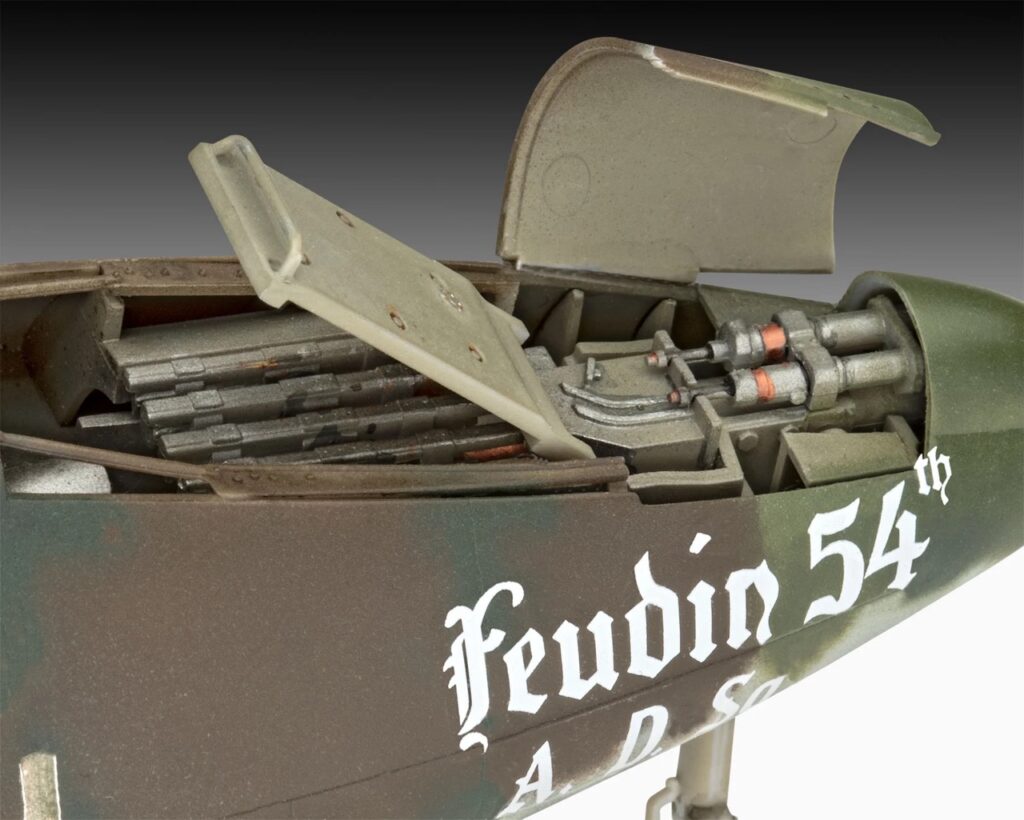
The reality proved more complicated. Since the weapon was difficult to manufacture and the airframe had to be modified to withstand the recoil of such a large cannon, refinement continued until February 1945. During this period, the two prototypes were fitted with a similar-calibre BK 5 autocannon as a placeholder.
On 19 March 1945, chief test pilot Karl Baur made the first flight in Werk-Nr. 111899. He completed a total of 19 test flights and fired 47 rounds on the ground and 81 in the air. On 5 April, the aircraft was handed over to Major Wilhelm Herget for operational evaluation. After several practice shots against ground targets, Herget flew the aircraft on 16 April in two sorties against American bombers, but the cannon failed on each occasion.
That was the end of the Pulkzerstörer’s combat career. Two prototypes, barely any test flights, no confirmed combat kill, and then the war, which was in any case drawing to a close.
The “Wilma Jeanne”: A Narwhal in American Hands
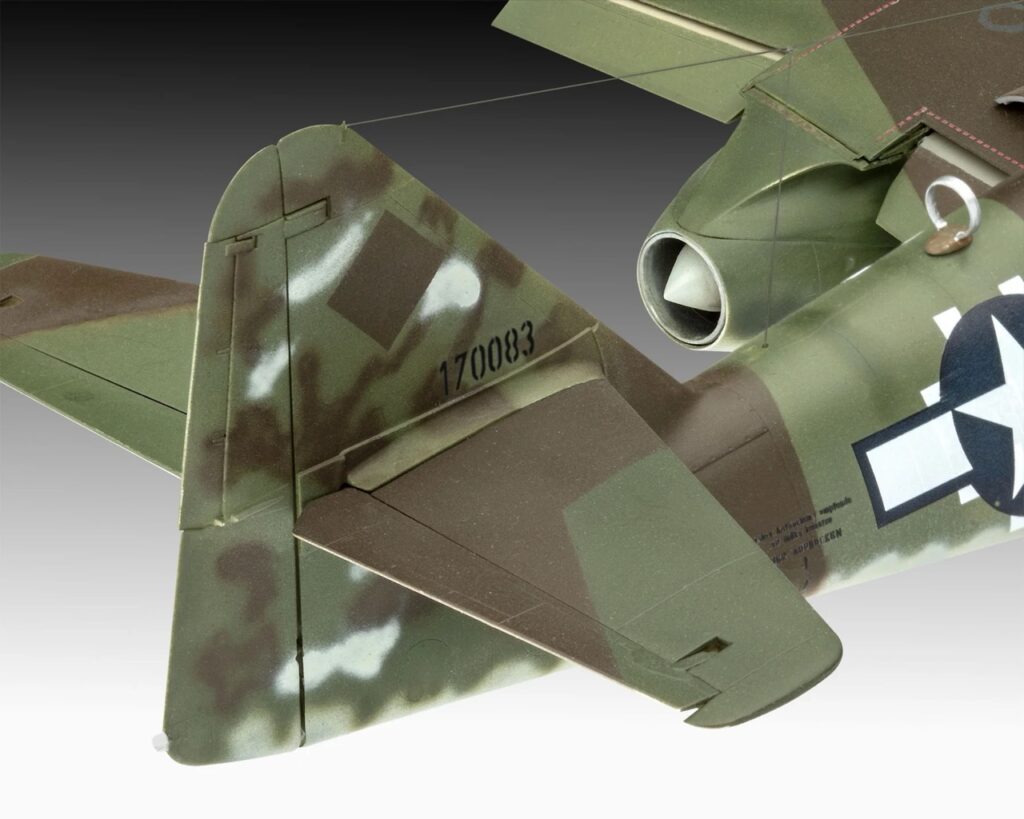
Werk-Nr. 170083 was captured by the Americans at the end of the war and crashed during a ferry flight from Melun to Cherbourg on 11 July 1945. It is this second prototype that has made the kit famous, for it carries a story that extends beyond the end of the war.
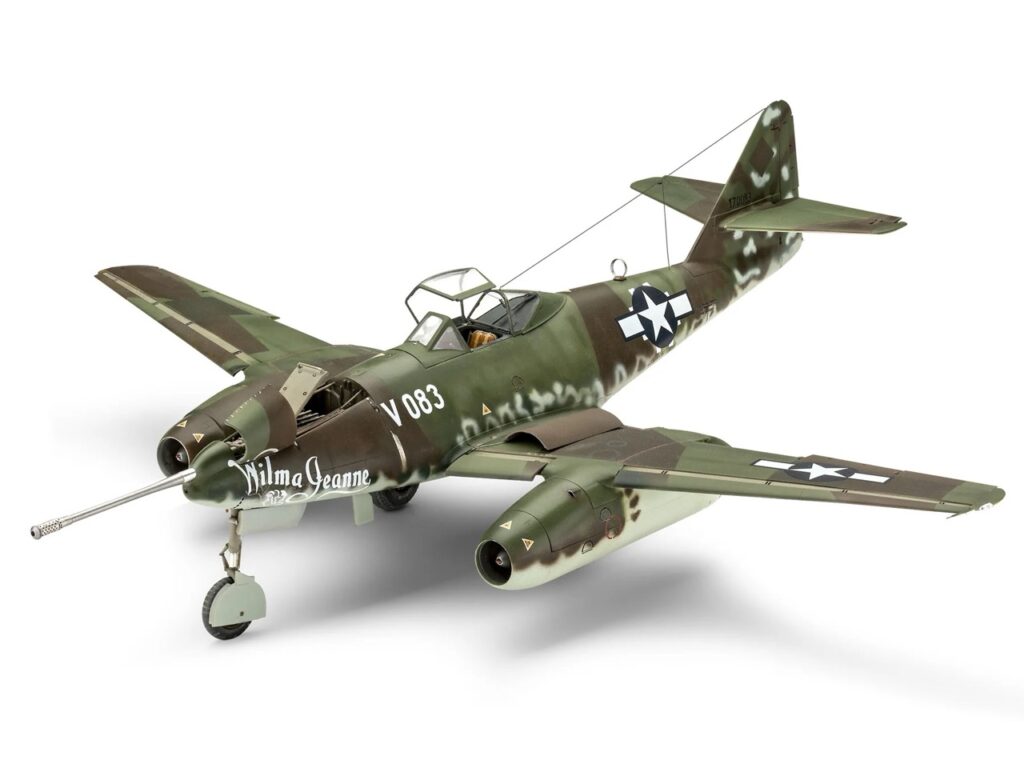
The aircraft, designated V083, was found in early May 1945 at Lechfeld Airfield by Colonel Harold E. Watson and his team, known as Watson’s Whizzers, while they were securing valuable technology and equipment for transfer to the United States. The aircraft was initially named “Wilma Jeanne”, after the wife of Watson’s Whizzer Sergeant Eugene Freiburger, and was later renamed “Happy Hunter II”. The aircraft was flown by Messerschmitt’s chief test pilot Karl Baur while the American team conducted ground firing tests with the cannon and were impressed by the recoil-damping system, which barely moved the aircraft.
Watson and his Whizzers were in pursuit of the Me262’s secrets. The swept wings, originally intended to adjust the centre of gravity, proved to be an elegant design solution for aircraft flying close to the speed of sound. The findings from this technology transfer fed directly into American aviation development in the post-war years. The Boeing B-47, its successor the B-52, as well as the North American F-86 and its supersonic successor the F-100 Super Sabre, were immediate results of this German technology transfer and secured America’s future in the darkest days of the Cold War.
The Me262 has shaped the collective memory far beyond specialist literature. The History Channel produced its own documentary with “Stormbird: The Me262 Story”. In computer games, it is a permanent fixture of virtually every WWII flight simulator. The Schwalbe appears in countless books, autobiographies and war memoirs, sometimes as a technological marvel, sometimes as a symbol of possibilities that came too late.
The historical debate over whether an earlier deployment as a pure fighter could have turned the air war around remains unresolved to this day. General Carl Spaatz, the Supreme Commander of US Air Forces in Europe, summed it up aptly at the time when, after a demonstration by Watson’s Whizzers, he said he was glad that Germany had botched the tactical deployment.
The Kit: 220 Parts and a Very Special Nose
What makes this 1:32 kit so special? The answer lies exactly where it also lay with the real aircraft: in the nose. The Me262A-1a/U4 looks at first glance like any other Schwalbe, until you look at the nose and see the far-protruding gun barrel that gave the aircraft its nickname, the Narwhal.
Our kit is based on the proven Me262 model but has been extended with specially developed new parts for the nose section and the cannon. For you, this means receiving the elegant, swept silhouette of the jet fighter that everyone knows, combined with a nose geometry that exists in no other kit. The distinctive bulge housing the gun is authentically reproduced, and the barrel protrudes as far as it did on the original. It is precisely this detail that immediately sets the kit apart from any standard collection.
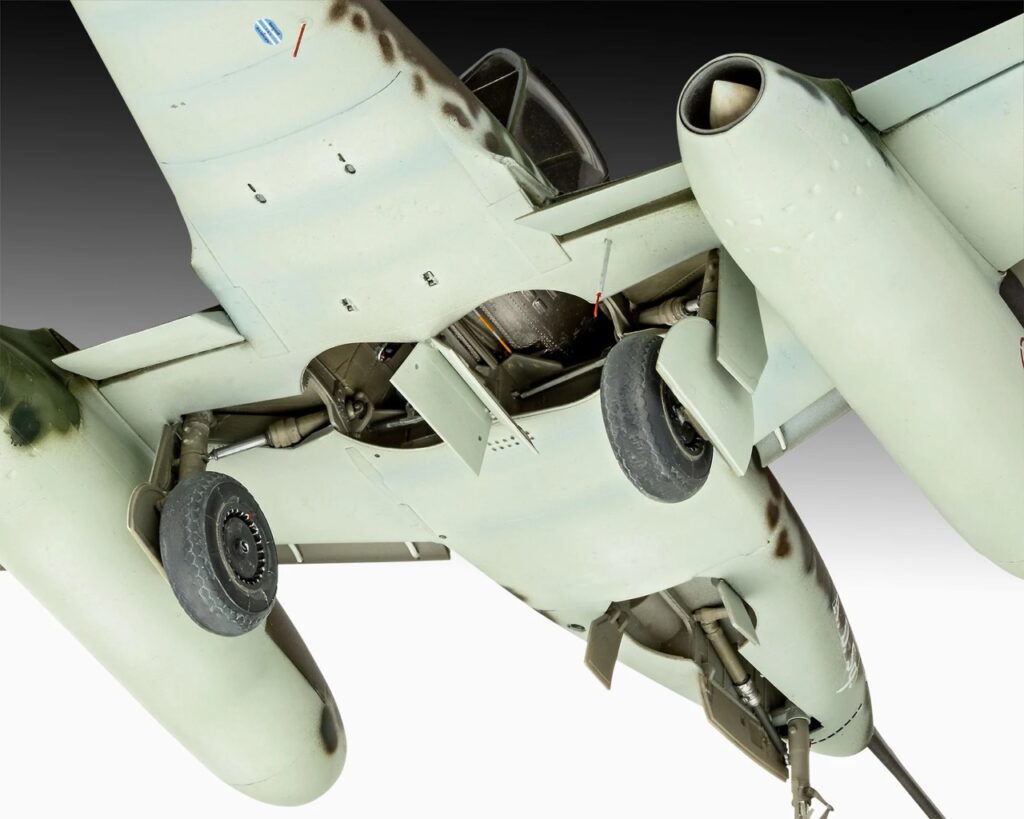
In the large 1:32 scale, the strengths of this aircraft can truly come into their own. You can work out the aerodynamic lines of the swept wings in their full elegance, detail the finely crafted cockpit, and carefully construct the Jumo engines with their characteristic circular intakes. The detailed undercarriage gives the finished model stability and authenticity.
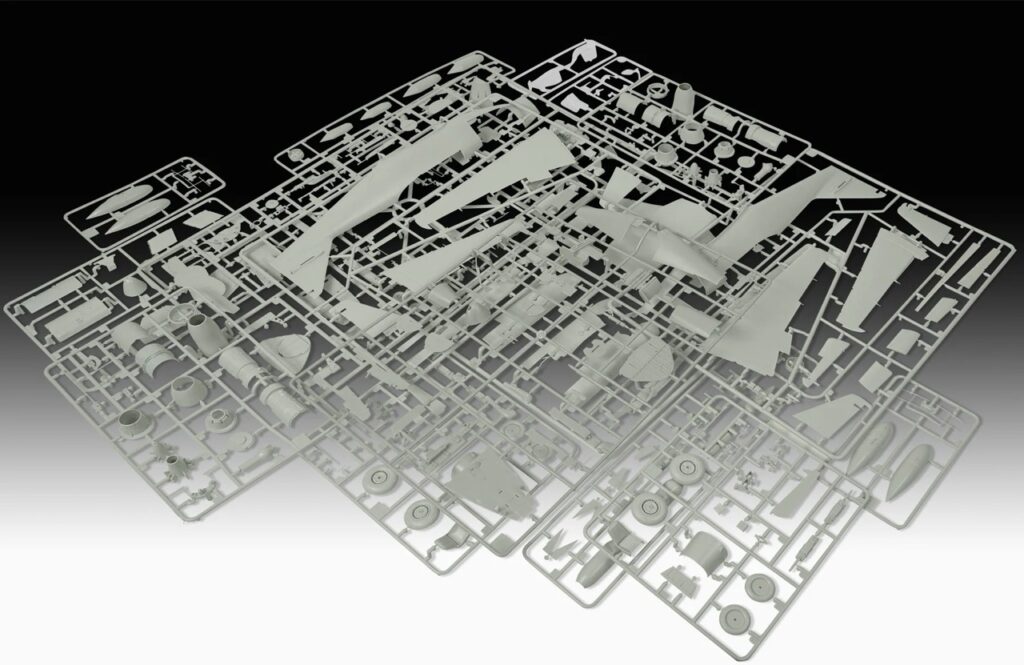
With 220 individual parts and a difficulty rating of Level 5, this kit is not a weekend project for beginners. This is a model for experienced builders who bring patience and know how to handle fit tolerances, panel gaps, and careful surface preparation before painting. The reward is a model that immediately draws eyes in your collection and invites questions. What kind of Me262 is that? Why does it have a cannon in the nose? And that is precisely the moment when the story that you can read in this article begins.
The decal sheet contains authentic markings that allow you to depict one of the two historic prototypes. Combined with a carefully applied primer coat, a solid grey base colour for the airframe, and a subtle weathering layer showing dirt streaks and wear marks on a heavily used test aircraft, the result is a model that not only demonstrates craftsmanship but also tells a story.
When working with the new parts for the nose section, pay particular attention to the transitions where they meet the standard airframe. Sand the filled seams smooth once dry and dry-fit all components multiple times before committing to final assembly. The nose section with the gun is the first thing observers will notice on the finished model, and the transition between the new and existing geometry should be seamless.
The Me262A-1a/U4 on your workbench is an object that stands at the intersection of technological vision and historical failure.
It shows what engineers were capable of in an extreme situation: within just a few months, at the end of a lost war, under bombardment and with dwindling resources, they engineered a variant of the world’s first jet fighter that used an anti-tank cannon as an airborne weapon. The concept was visionary. The execution was technically sound.
Whoever builds this model is not simply building some aircraft from the Second World War. They are recreating the only series-produced jet aircraft in history, in its most unique and rarest configuration, based on a machine that was first tested by German test pilots, then renamed by American intelligence officers, and finally lost in a crash during a ferry flight over France. That is aviation history in 220 parts.
Order the Messerschmitt Me262A-1a/U4 in the Revell Shop now