
The history of the Leopard 2 (Revell Shop Link) actually begins with a failure. In the early 1960s, the Federal Republic of Germany and the United States agreed to jointly develop a new main battle tank. The so-called Kampfpanzer 70 was intended to do everything: fire on the move against moving targets, automatic loader, driver’s position in the turret. These were concepts so far ahead of their time that the technology simply could not keep up. After seven prototypes and 830 million Deutschmarks in development costs, the programme was cancelled in 1969. On the US side, the experience fed into the M1 Abrams; on the German side, into the Leopard 2.
What looked like a setback became the foundation of a global success story. The engineers at Krauss-Maffei in Munich (now KNDS) took the technological findings of the failed project and used them to develop a tank that resolved the balance between firepower, protection and mobility as elegantly as almost no vehicle before it. The first Leopard 2 rolled off the production line in 1978 and began replacing the Leopard 1 in the Bundeswehr from 1979 onwards. The rest is military history.
40 Years, One Vehicle Family, One Legend
The Leopard 2A4 is not just any variant in the long development history of this tank. It is the version that turned the Leopard 2 into a genuine global export success. Built in series for 40 years by Krauss-Maffei Wegmann, the Leopard 2 has been exported to 18 countries, including Switzerland, Austria, Sweden, Finland, Norway, Denmark, the Netherlands, Canada, Greece, Chile, Portugal, Poland, Hungary and Turkey.
The A4 brought decisive improvements over its predecessors: a digital fire control system, additional armour on the hull and turret, and a thermal imaging sight for the gunner. This combination made it the most capable serial export tank of its era and established the reputation the Leopard 2 carries to this day. Over 70 tonnes of composite armour, 1,500 horsepower, a fuel-efficient diesel engine, a top speed of 72 kilometres per hour and a 120-millimetre Rheinmetall smoothbore gun with 42 rounds. These are figures that still impress even in 2026.
Combat Deployments That Shaped the Myth
A tank that has never seen action remains theory. The Leopard 2 had to prove itself in practice, and it did so in a way that revealed both its strengths and the limits of even the finest equipment. German Leopard 2s took part in Kosovo, Canadian and Danish Leopards fought in countless combat operations in Afghanistan, and the Turkish army deployed Leopard 2s against ISIS in Syria.
The deployment of German Leo 2 tanks in Kosovo in 1999 is a particularly notable chapter: during the Kosovo War, it is said to have fired only warning shots. That may sound like little, but it demonstrates the tank’s strength as a deterrent. Anyone who sees 70 tonnes of steel with a 120 mm gun bearing down on them thinks twice.
The deployments in Afghanistan and Syria were considerably more intense. In Syria, Turkish Leopard 2A4s of the variant Germany had sold to the NATO partner suffered significant losses in urban guerrilla combat. Military experts attributed these losses in part to the tactical use of the vehicle: a heavy main battle tank is structurally at a disadvantage in close-quarters urban fighting against attacks from all directions by light anti-tank weapons, regardless of its reputation. These experiences fed directly into the further development of later variants, in particular the Trophy active protection system that distinguishes the A7A1 today.
The Anniversary Design: TRON Meets Technical Drawing
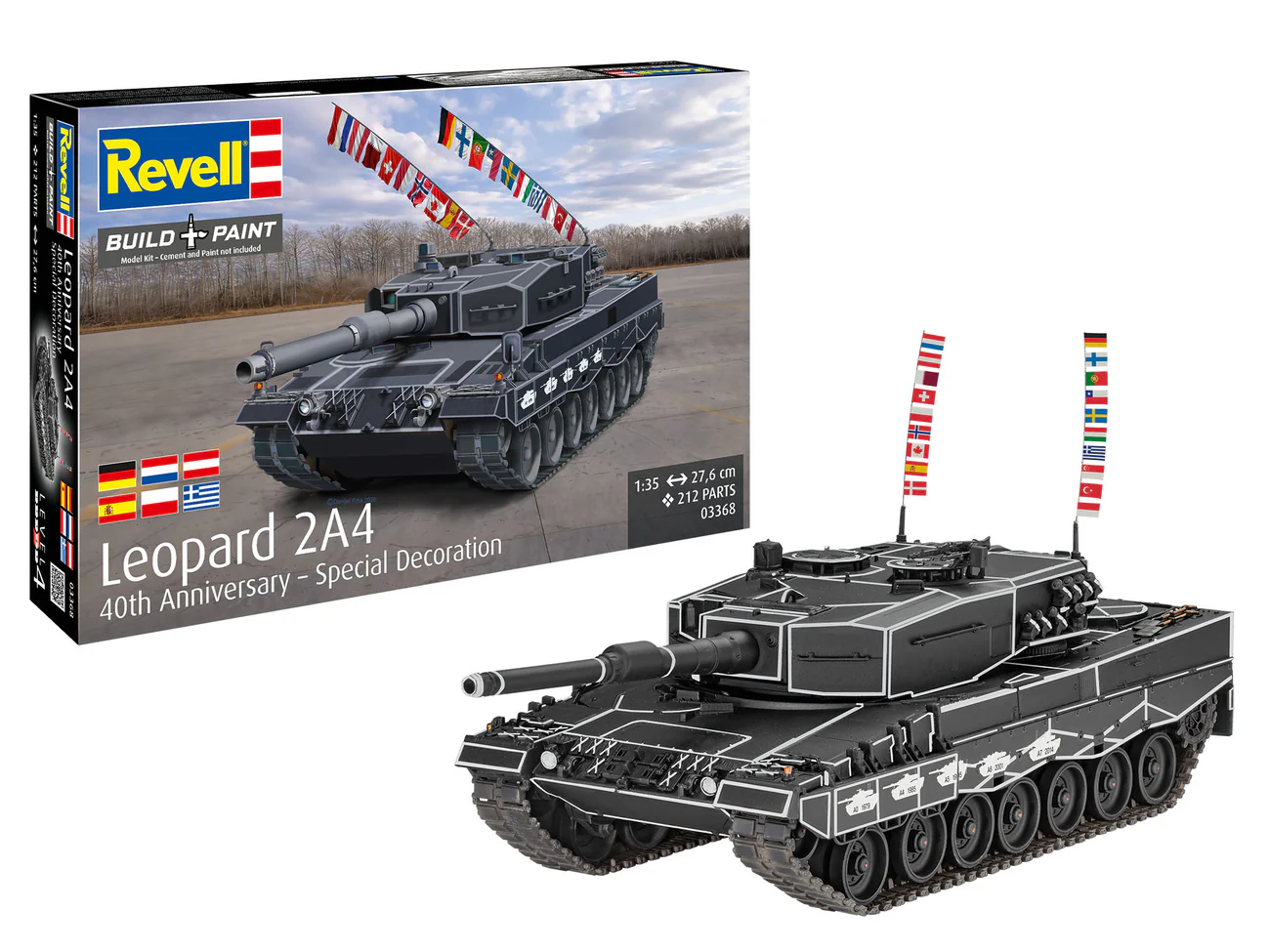
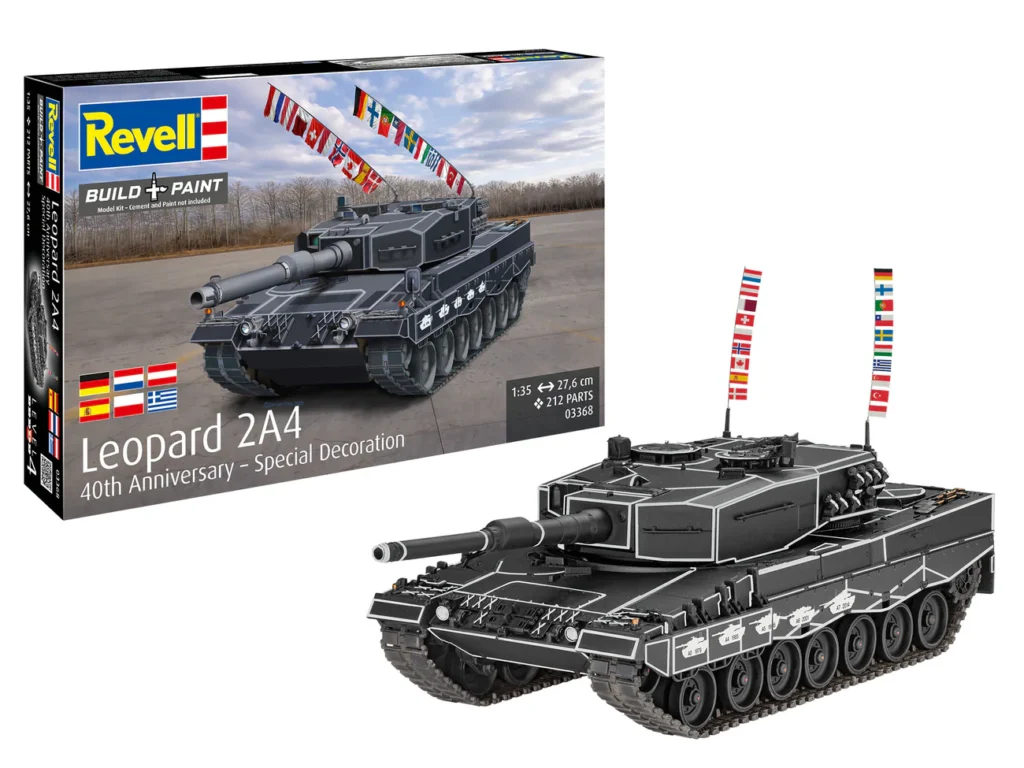
Let’s get to the true centrepiece of this kit: the special livery. It is the reason this model immediately catches the eye in any standard display cabinet and why every visitor inevitably asks: what is that?
The underlying concept is as simple as it is effective. Applied to a deeply dark-primed hull are elements that simultaneously recall a technical construction drawing and digital circuit board graphics. Lines run along the vehicle’s contour lines, as though someone had printed the technical documentation directly onto the steel. These elements are complemented by the flags of the Leopard 2’s most important operator nations, making the type’s international significance visible, as well as anniversary text and key figures documenting the 40-year history of the vehicle family and the evolution of the individual models along the tank’s side.
We particularly enjoyed seeing the comparison with TRON appearing in several YouTube comments. The original 1982 film established a visual aesthetic in which technology is not hidden but celebrated. Glowing outlines on a dark background, geometric precision, the feeling of looking into the interior of a circuit board. The Leopard 2A4’s anniversary livery achieves something similar: it makes the vehicle transparent in a figurative sense, laying bare its history, its international reach and its technological character rather than concealing it beneath a layer of camouflage paint.
Unboxing: What’s in the Box
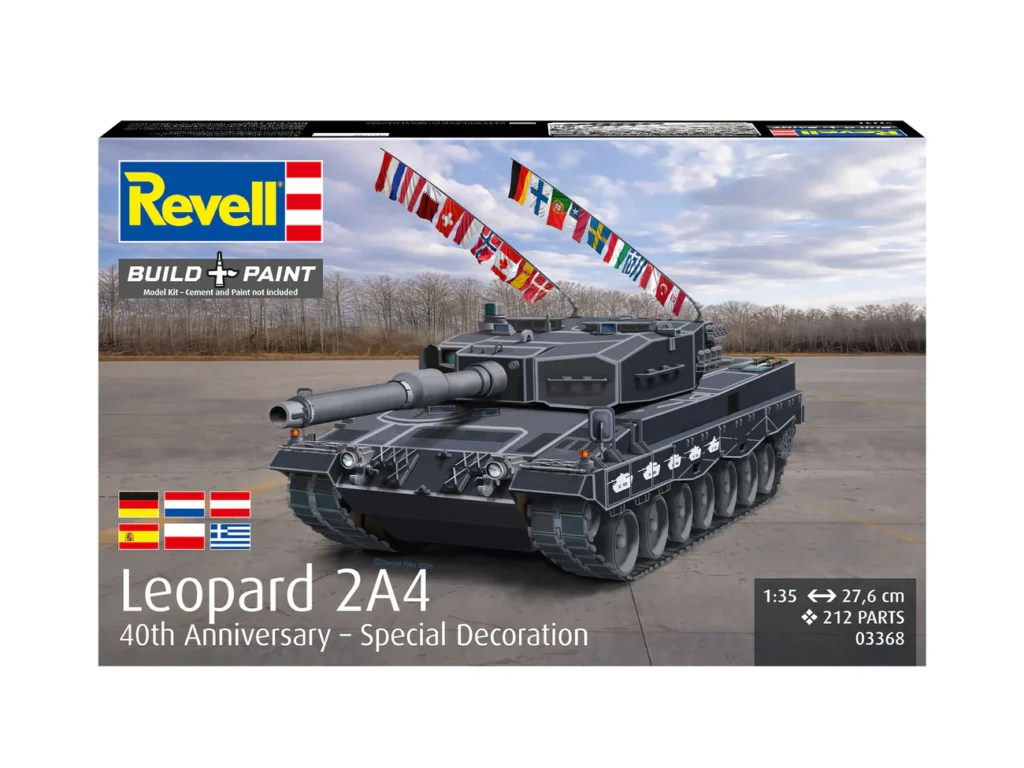
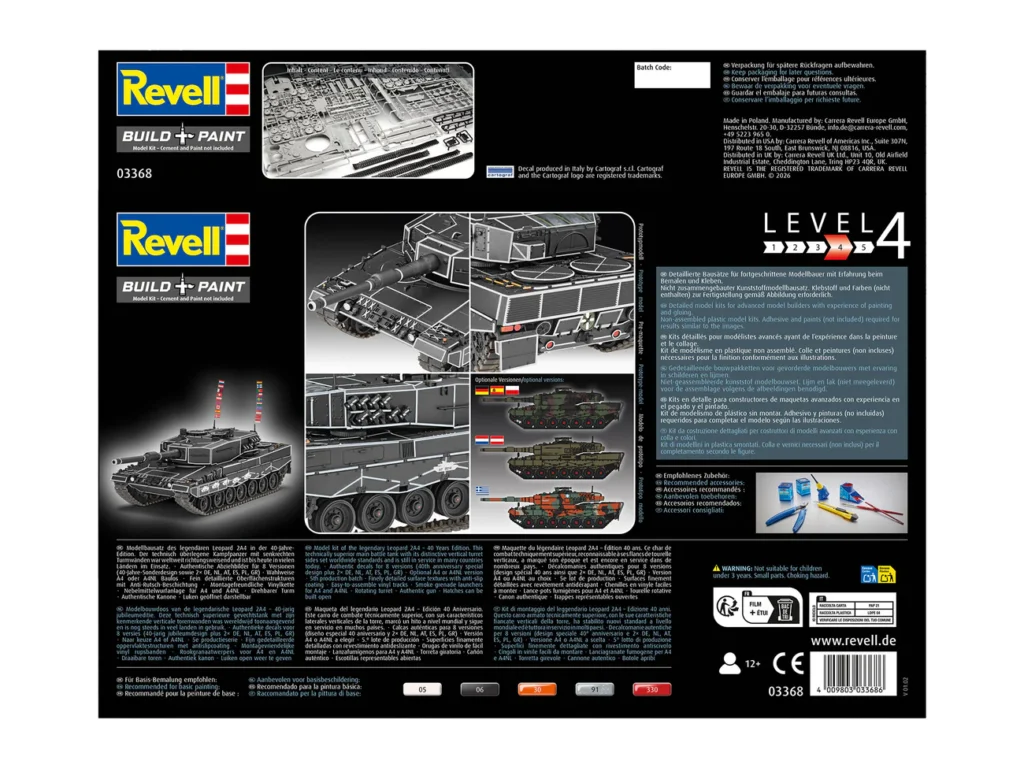
Our Model Set for the 40th anniversary is a complete package that lets you get started from the very first moment. In 1:35 scale, 212 individual parts come together to form a Leopard 2A4 that, in its finished state with its rotating turret and finely detailed tracks, is a convincing replica of the original. The set includes matching Aqua Color paints, a brush and Contacta Professional Mini glue, so that the frustrating moment of discovering missing essentials at the start of a build is eliminated.
The particular challenge of this model lies in the extensive decal set. The anniversary graphics must be applied precisely to the prepared hull surface in order to achieve the intended effect.
Difficulty Level 4 means: this is not a b
eginner’s project. Anyone who has already built armour kits and applied decals will relish the challenge. Those who are still starting out should practise on a simpler kit first before tackling this anniversary model, because a botched graphic on a finished model would be a real shame.
View now in the Revell Shop
From the Anniversary Livery to the Current State of the Art
The Leopard 2A4 at the heart of this kit is the version that laid the foundations of this vehicle family’s story. But development has of course not stood still. Anyone interested in the current state of the art is recommended our kit of the Leopard 2A7A1, which is also available in our range.
The roll-out of the first Leopard 2A7A1 took place on 29 October 2024. The Bundeswehr has ordered 17 vehicles of this variant. The turrets with integrated Trophy system are married to specially reworked hulls. The Trophy active protection system uses its sensors to detect incoming anti-tank guided missiles and neutralise them with a blast charge before they can reach the armour. This is the defining feature of the Leopard 2A7A1. You can find our kit for it at
Looking Ahead: The Leopard 2A8 as the Rebirth of a Legend
And the story doesn’t end there. Because following the A7A1 comes the next major step. On 19 November 2025, the Leopard 2A8 was presented to the public for the first time by prime contractor KNDS at its Munich plant. What makes this version special is that it is not a refit of existing vehicles but a genuine new build. No new Leopard 2s had been manufactured since 1992. The A8 is the first to be built entirely from scratch again, meaning the armed forces do not need to hand in existing tanks for industry to upgrade them.
The first new Leopards are set to reach the troops from 2027 onwards, with Armoured Brigade 45 in Lithuania being the first to be equipped. Once all ordered vehicles have been delivered, the Bundeswehr’s fleet strength is expected to grow to approximately 430 main battle tanks. Whether the Leopard 2A8 will one day find its way onto our workbenches? That’s really not a question of if, only of when 🙂
Conclusion: A Model for Collectors Who Want Character
The Leopard 2A4 in the Special Decoration for the 40th anniversary is not a tank model for those who like things conventional. It is for everyone who wants a piece in their display cabinet that immediately draws attention, invites questions and tells a story that goes beyond camouflage paint and mud stains.
And when you immerse yourself in the history of the Leopard 2 as you build – from the failed prototypes of the 1960s, through the A4 as a global export success, to the deployments in Kosovo, Afghanistan and Syria – you are not simply building a model. You are recreating 46 years of German engineering history on your workbench.
Order the Leopard 2A4 Special Decoration in the Revell Shop now