
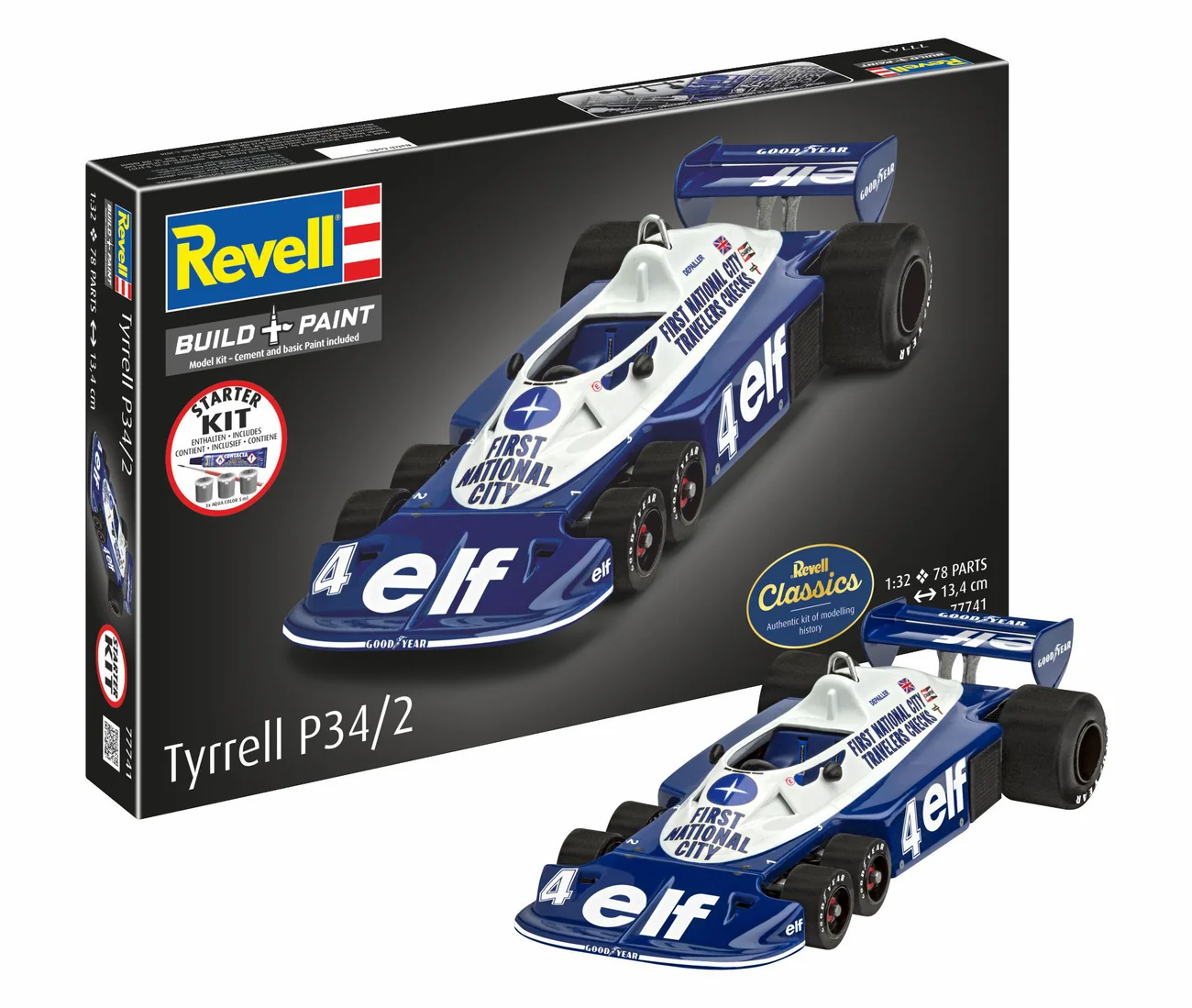
There are racing cars that need explaining, and then there is the Tyrrell P34. Anyone seeing this car for the first time needs no data sheets and no lap times, they simply start counting: four small wheels at the front, two large ones at the back. No other vehicle has rubbed Formula 1 up the wrong way so radically and still won. This is exactly the piece of motorsport history you can bring to your workbench with our Starter Kit, complete with paints, brush and cement, so you can get started straight away: Starter Kit Tyrrell P34/2 6-Wheeler.
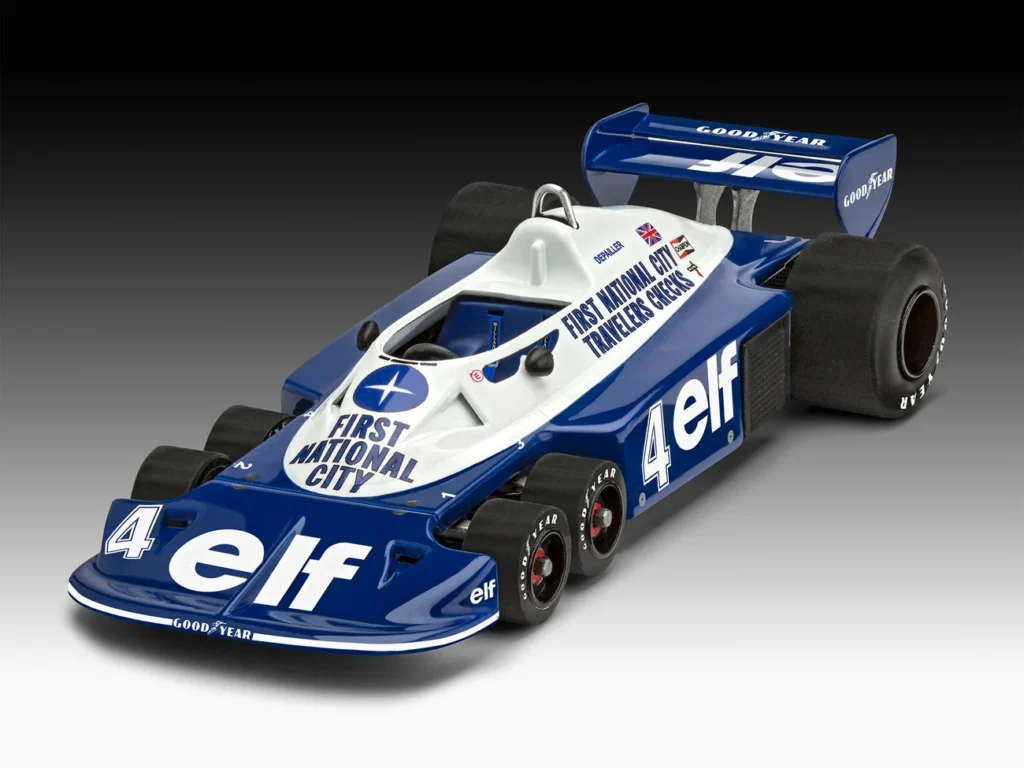
Before you cut the first part from the sprue, it is worth taking a look at the original. Because hardly any other car has produced so many stories, given so many engineers something to think about (or driven them mad :)) and found its way into comics, cartoon series and even a song lyric as often as this six-wheeler.
Project 34: How a question about tyres turned into a six-wheeler
The man behind the idea was Derek Gardner, chief designer at Tyrrell and someone who came from the world of four wheel drive. He had worked on drive systems for racing cars at Ferguson Research before Ken Tyrrell brought him in during 1970 and entrusted him with the design of the team’s first own chassis. The name of the project was about as unromantic as it gets: P34 simply stood for the thirty fourth set of design drawings the team had produced.
Gardner’s problem was an aerodynamic one. The regulations of the mid seventies limited the width of the front wing to one and a half metres. But because the driver’s feet, the steering and the suspension all needed space, the normal sized front tyres protruded above and beyond the sides of the wing. They created drag, they created lift and they disturbed the airflow that was supposed to reach the rear wing cleanly. Gardner simply turned the question around: how small would a wheel have to be in order to disappear completely behind the wing?
The answer was around ten inches in diameter, and that is where the real feat began. Wheels that small have far too little contact patch to carry a racing car cleanly through a corner. So Gardner simply doubled them. Four small wheels put more rubber on the road than two large ones, they also offer twice as many brake discs and therefore considerably more braking area. To keep the steering from becoming a nightmare, Gardner connected only the front pair of wheels directly to the steering rack, with the rear pair following via a bell crank. Goodyear agreed to manufacture bespoke racing tyres for these little ones, and the entire development took place under the strictest secrecy.
A tarpaulin, a few hoops and a collective intake of breath
On 22 September 1975, Tyrrell invited the press to a hotel at Heathrow Airport. Hoops underneath the cover made sure the silhouette looked like that of a perfectly normal racing car. Only when the tarpaulin was pulled away from the back towards the front did the journalists see the four tiny front wheels, and for a moment the room went very quiet. Some of those present thought the whole thing was an elaborate publicity stunt. Even the team’s own drivers, Jody Scheckter and Patrick Depailler, found out only on that day what they would be racing in the coming season.
On 8 October 1975, the car took to the track for the first time at Silverstone. After further testing, Tyrrell decided to build two additional examples with a slightly longer wheelbase for the 1976 season. The supposed gimmick had become a race car.
Anderstorp 1976: the day six wheels won
The P34 made its debut at the 1976 Spanish Grand Prix at Jarama. Depailler qualified third, directly behind James Hunt and Niki Lauda, and was therefore eleven places ahead of the conventional Tyrrell in the same team. At that point at the latest it was clear that nobody here was doing publicity, but that somebody knew how to do the maths.
The great moment came at the Swedish Grand Prix at Anderstorp. Scheckter took pole position and won the race, with Depailler following in second place. A one two finish for a six wheeled racing car, and to this day Jody Scheckter is the only driver to have won a Grand Prix in such a car. Over the season the tally came to one win and eight second places, and at the end Tyrrell stood third in the Constructors’ Championship behind Ferrari and McLaren.
What is interesting is where the car shone and where it struggled. On fast, smooth circuits with long corners such as Anderstorp, Watkins Glen, Mosport, Fuji or the Österreichring it handled superbly. On bumpy tracks like Brands Hatch, Jarama or the Nürburgring things became unpredictable, because depending on the bump either the front or the rear of the two wheels on one side would lose contact. The grip therefore changed in the middle of the corner, and that is exactly what made the set up so difficult.
The drivers disagreed as well. Depailler raved about the car in every interview, while Scheckter left the team after the season and described the six-wheeler, rather undiplomatically, as junk. Both were right in their own way, and that is precisely what makes this project so appealing.
1977: the season of the P34/2
For 1977, Ronnie Peterson came in as Scheckter’s successor and the car was revised. It is this evolution that you have in front of you in our kit. The bodywork was aerodynamically cleaned up, and at the same time the cockpit had to be adapted to Peterson’s height. Both cost weight, and the car now weighed around 620 kilograms instead of the 595 kilograms of the previous year. Because the understeer could not be brought under control, the team widened the front track during the season. That put the small wheels back into the airflow next to the wing, and the original basic idea behind the design was gone.
On top of that came a problem no engineer can do anything about. Goodyear consistently kept developing the normal racing tyres, while the bespoke items for the front axle remained at their 1976 level. The balance between front and rear no longer worked. Derek Gardner left the team, Maurice Phillippe took over, and the results became more modest. Depailler still took podium finishes in South Africa, in Canada and in Japan, Peterson managed third place at Zolder and the fastest race lap at Watkins Glen, but ten retirements in seventeen races spoke a clear language. In November 1977, Ken Tyrrell presented the conventional successor, the 008, and declared the chapter closed. He added at the time that the six-wheelers would probably become collector’s items, and he was more right than he could have known.
If you want to build your own collector’s item, you will find it here in the Revell shop: Starter Kit Tyrrell P34/2 6-Wheeler.
Six wheels set a trend
The P34 did not remain alone. March, Williams and Ferrari also built six wheeled test cars, but approached the matter the other way round and put four wheels on the rear axle. Neither the March 2-4-0 nor the Williams FW07D and FW08B nor the Ferrari 312T6 ever appeared in a Grand Prix. In 1983 the FIA banned cars with four driven wheels, and later the maximum number of wheels was simply written into the regulations as four. That makes the Tyrrell the only six-wheeler with a win in Formula 1 for all time.
On the road the idea nevertheless found imitators. Panther Westwinds presented the Panther 6 in 1977, a sports car with two steered front axles, and Covini Engineering from Italy presented the C6W in 2005, a modern interpretation of the same idea.
The original cars themselves have long been out and about again. After Avon agreed in 2000 to manufacture the special tyres with a ten inch diameter once more, the P34s returned to historic racing. Martin Stretton won the Thoroughbred Grand Prix series with one of the cars in 2000, and Mauro Pane repeated that in 2008 with a sister chassis. At the Goodwood Festival of Speed, at the Grand Prix Historique in Monaco and at the Historic Grand Prix in Zandvoort, those small front wheels remain among the most reliable crowd pullers to this day.
From racing car to pop culture star
Hardly any other racing car has made it onto screens so often. In the cartoon series Transformers, the P34 served as the model for the Decepticon Drag Strip, who appeared in yellow with red accents. Lupin III chases around the Monaco circuit in a version of the six-wheeler in episode eleven of the second series. The car appears in the first episode of the 1993 anime series Moldiver just as it does in the fourth season of Phineas and Ferb, where a racing car clearly inspired by the P34 is put to use. And anyone who has seen the feature film Rush about the duel between James Hunt and Niki Lauda has already had the four small wheels on screen, because without the Tyrrell the 1976 season cannot be told in full.
Even in music the car has left its traces. George Harrison, an avowed motorsport fan, released the track It’s What You Value on the album Thirty Three & 1/3 in 1976, which mentions in passing somebody driving a six-wheeler. The line is regarded to this day as a nod to the Tyrrell, and the song itself comes with an anecdote of its own, because it was written after Harrison had given his drummer Jim Keltner a Mercedes instead of a fee.
The relationship between the P34 and Japan is particularly close. At the 1976 Japanese Grand Prix at Fuji, the team ran with lettering in Japanese characters, Depailler finished second, and the six-wheeler became an icon there. Tamiya even bought a real P34 as a reference for its own models, which shows how seriously the subject was taken in scale modelling.
What awaits you at the workbench
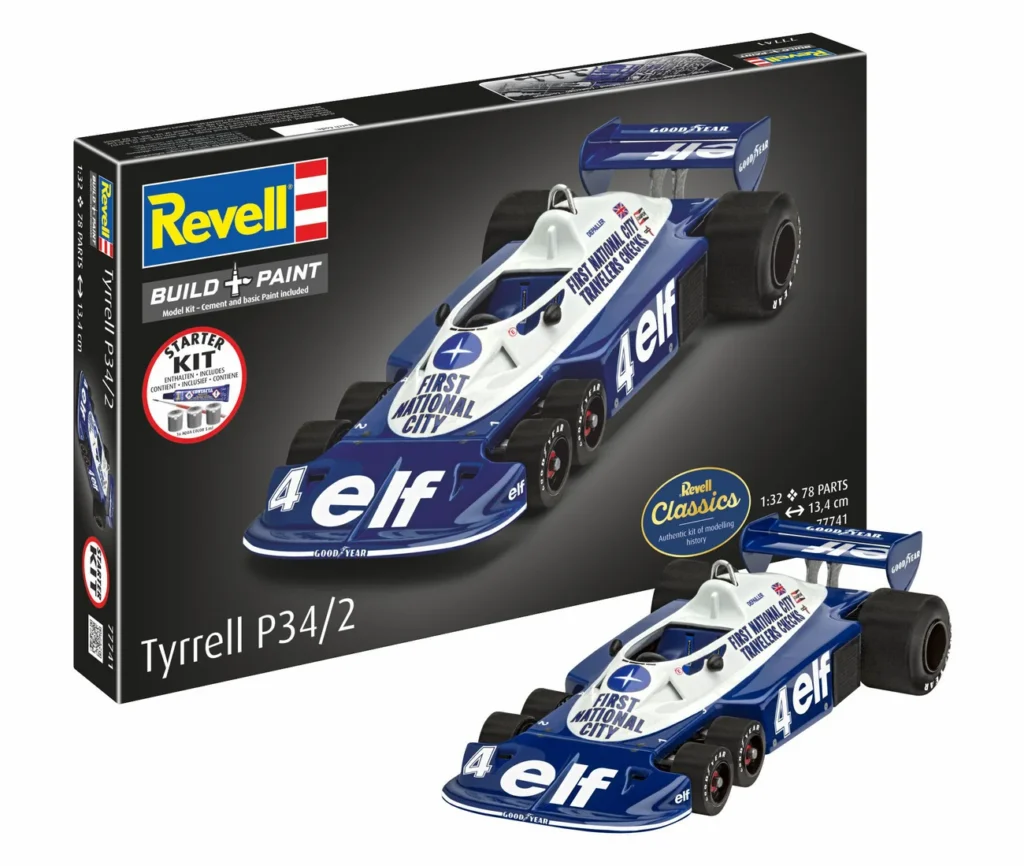
Level 5 is not just decoration on the box. The 105 parts in 1:32 scale contain a multi part Ford Cosworth engine, detailed bodywork and, above all, that suspension which has to hold four front wheels in position. That is exactly where the challenge lies, because in the end all four wheels should sit cleanly on one plane. Nothing gives away a rushed assembly as quickly as a six-wheeler standing on five wheels.
Our tip: dry fit the suspension first and check the alignment on a glass plate before the Contacta cement comes into play. Apply the cement sparingly, because with parts of this size one drop too many forgives nothing. It is best to paint the engine and the cockpit while the parts are still easily accessible, as it gets tight afterwards. The Aqua Color paints in the set cover the base tones, and if you like you can add a little depth with a dark wash in the recesses of the bodywork. For the decals the rule is: work patiently, position them with plenty of water and only press them down once everything sits correctly.
Once the model is finished, you will have something in your display cabinet that needs no explanation. Visitors will count the wheels, ask about it and then listen to the story you have just read 🙂
Specifications and contents
Starter Kit Tyrrell P34/2 6-Wheeler
Scale 1:32
105 parts
Skill level 5
Recommended age from 13 years.
The P34/2 raced in the 1977 season and remains to this day the only six wheeled vehicle to have won a Formula 1 race, although that win goes to the account of the previous version from 1976.
Included in the set:
- Plastic model kit, not assembled
- Illustrated, multilingual assembly instructions
- Authentic decal set
- Brush
- Basic paints Revell Aqua Color
- Adhesive Revell Contacta plastic tube cement
Do you dare take on the Six Wheeler? Then bring this demanding piece of racing history to your workbench: Starter Kit Tyrrell P34/2 6-Wheeler in the Revell shop.
Inspiration for your build
Here Patrick Depailler takes you on board for a lap around Monaco
And here you also have modern on board footage from the Tyrrell once again
and if you would rather have it explained how the car works, Drivetribe has something for you here: