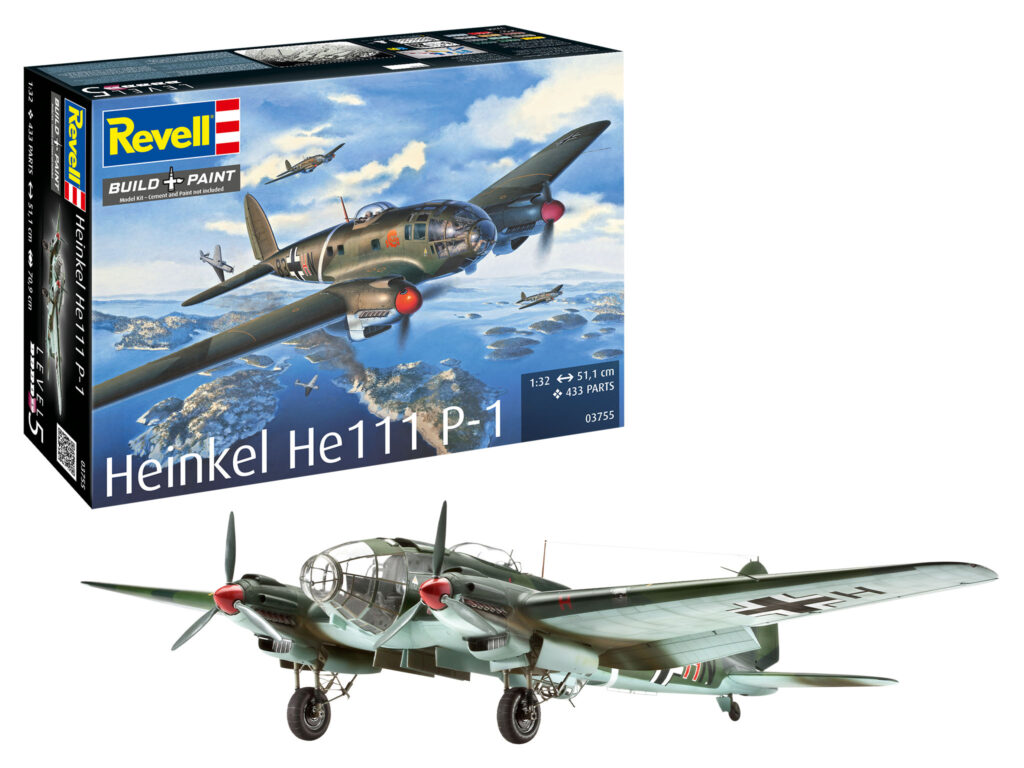
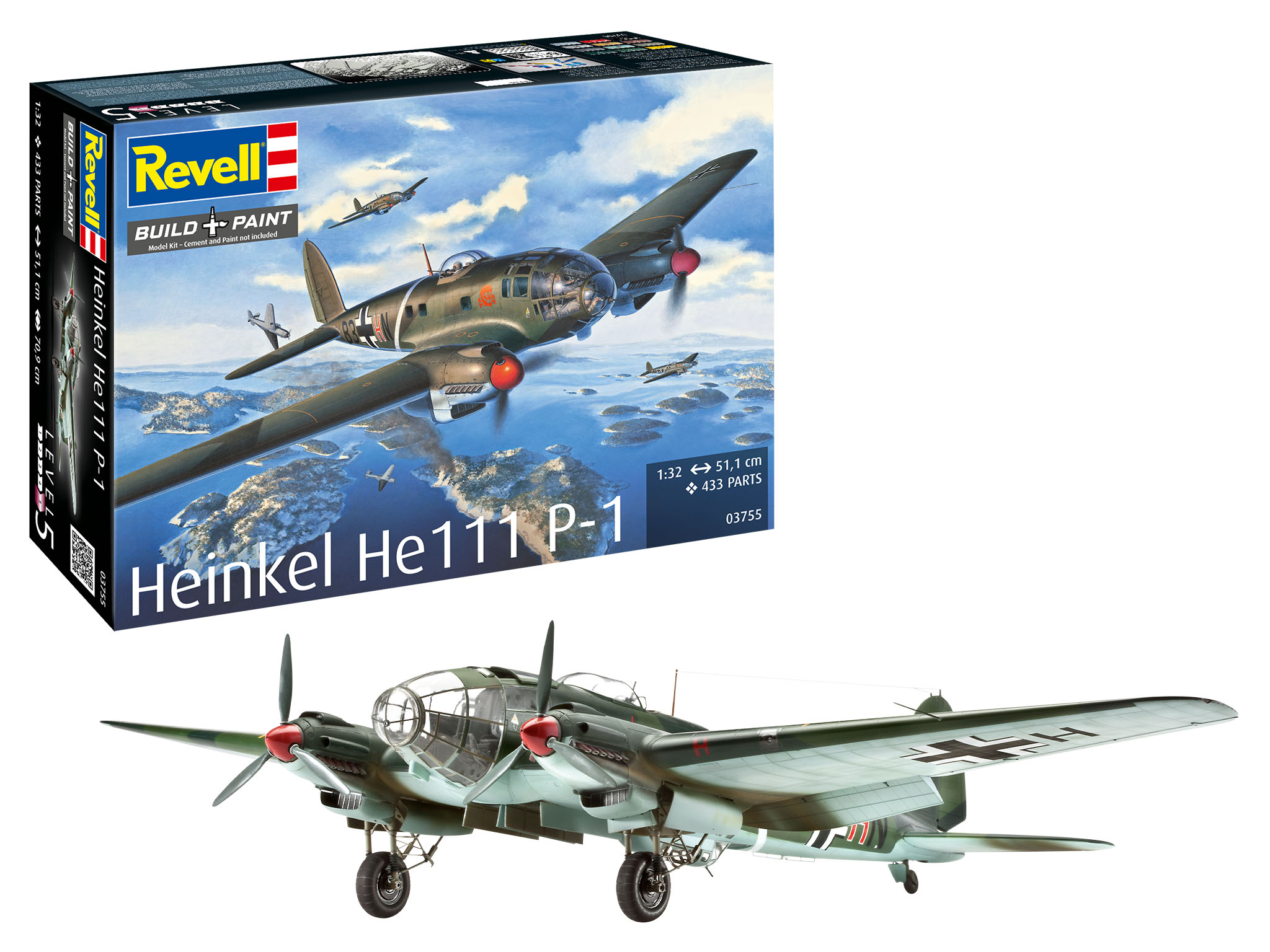
There are kits that only exist in collector circles as a story. Someone knows someone who still has one down in the cellar, fantasy prices are asked on auction platforms, and you wonder whether you will ever get to tackle the project. The Heinkel He 111P-1 in 1:32 scale was exactly such a case. That is why we are reissuing it, freshly boxed and with revised instructions: Heinkel He 111P-1 in the Revell shop.
Before you open the box, it is worth taking a look at the original. Because hardly any other aircraft of the 1930s and 1940s carries as much engineering history, as many curiosities and as much film history with it as this twin engined bomber with its distinctive glazed nose.
From civil high speed airliner to standard bomber
The He 111 was created in Rostock in the early 1930s, designed by the twin brothers Siegfried and Walter Günter at the Ernst Heinkel Flugzeugwerke. The starting point was the single engined He 70 “Blitz”, a very modern fast commercial aircraft for its day with retractable landing gear and clean aerodynamic lines. That idea was scaled up into a twin engined machine, officially listed as an airliner for ten passengers and mail freight. The maiden flight took place on 24 February 1935 at Rostock-Marienehe.
This civil facade was quite deliberate. The Treaty of Versailles forbade Germany to build bombers, which is why the design was laid out from the outset so that it could be converted for military use with little effort. English language literature has kept the image of the wolf in sheep’s clothing for it to this day. Lufthansa did in fact receive a number of machines and operated them on scheduled services, but the real career began as a bomber. By the time production ended in 1944, almost 8,000 examples of all variants had been built.
What makes the P version so special
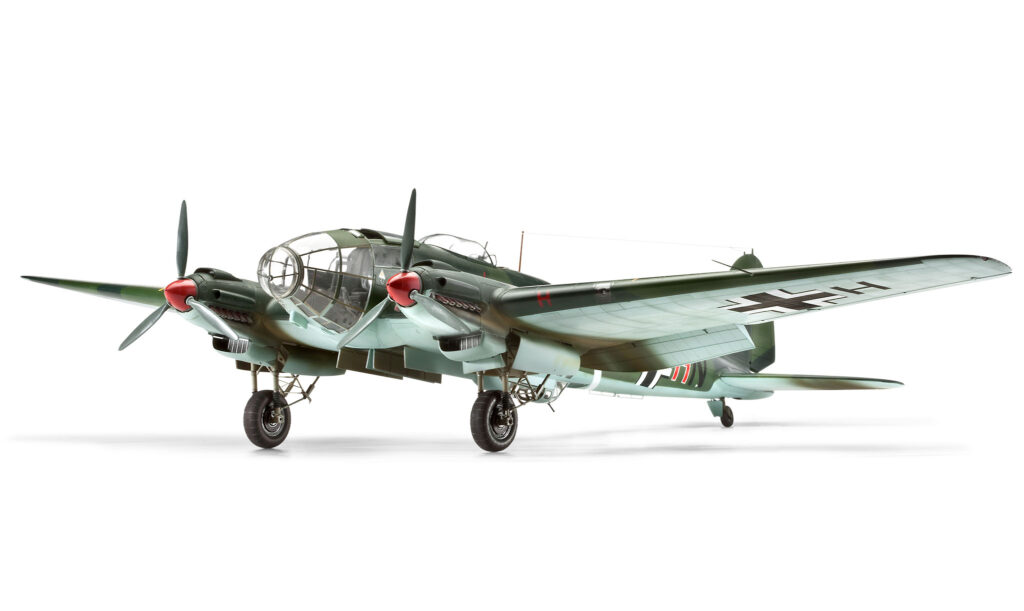
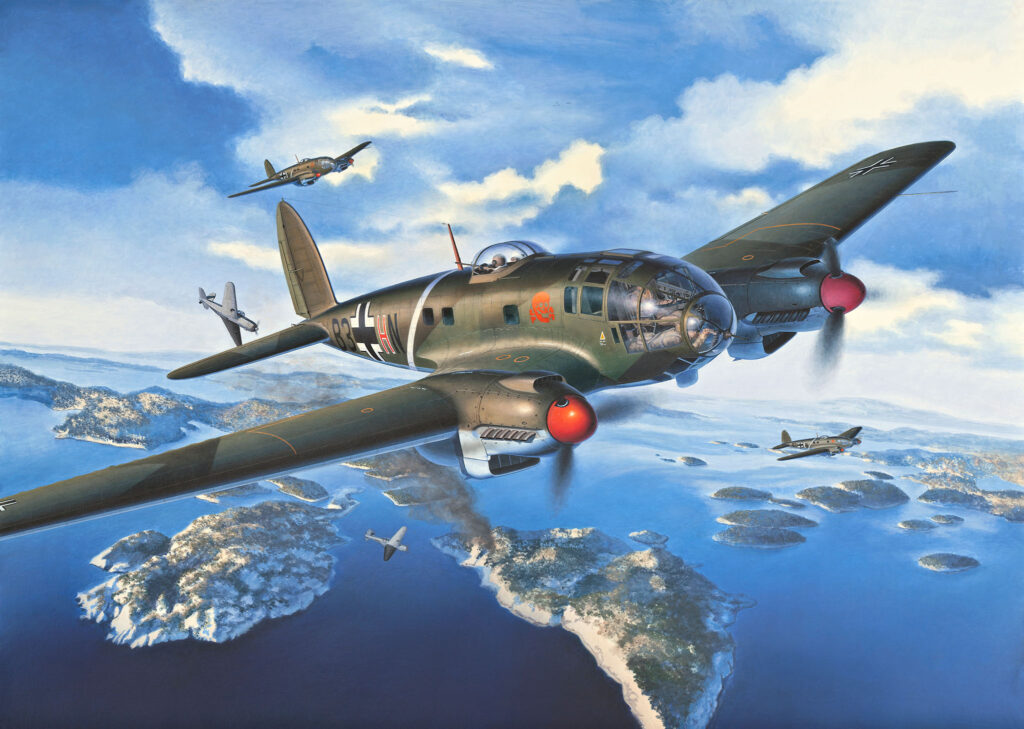
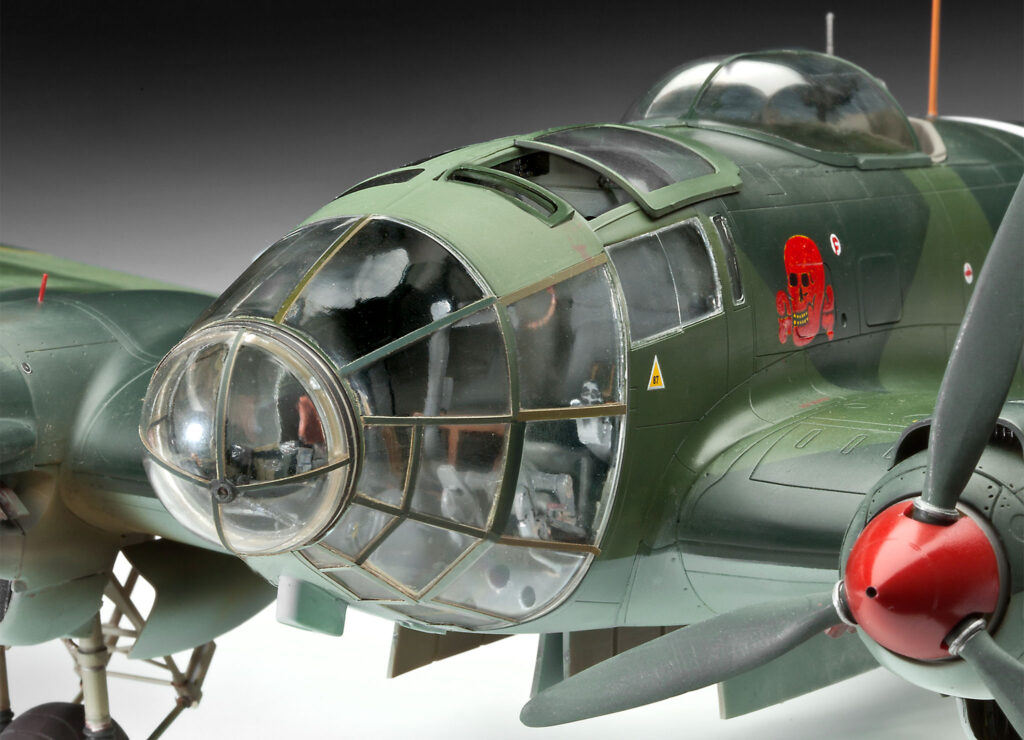
The early production series still had a conventional stepped cockpit with a separate pilot’s windscreen. In 1937 reports came back from flight operations about poor visibility, and Heinkel responded with one of the most striking changes in all of aviation history: the fully glazed, asymmetric nose. The crew now sat closely together in the greenhouse, and the pilot’s seat could be raised so that his head reached above the glazing for take off and landing. The He 111 P received this nose together with Daimler-Benz DB 601 engines of around 1,100 hp each and was delivered to the Luftwaffe from the beginning of 1939.
For us as modellers, one figure is particularly interesting: only around 95 machines of the P-1 sub variant were built, produced in Rostock and Wismar. It was followed by the far more numerous P-2. The entire P series was already being phased out at the start of 1940, because the DB 601 engines were needed for fighter aircraft. Further series production was taken over by the H version with Jumo 211 engines. So anyone who builds this kit is putting one of the rare early machines into the display case, not the run of the mill version.
The He 111 in service: quick successes and a rude awakening
At the outbreak of war the He 111 was the Luftwaffe’s standard bomber with around a thousand machines delivered, and it flew with Kampfgeschwader 1, 4, 26, 27, 28, 53, 54, 55 and 100. With a top speed of about 410 km/h it was faster than many fighters in the mid 1930s, an advantage that had been used up by 1940.
Over England the weakness of the design was exposed mercilessly. The defensive armament of individual MG 15 machine guns was not enough against the Spitfire and the Hurricane, the armour was thin, the aircraft too slow for daylight operations. The losses forced the Luftwaffe into night attacks. That was where the technology came into play that is known today under the heading of the radio navigation war, or the “Battle of the Beams”: Knickebein and later the X-Gerät, which made it possible to approach targets along radio beams even in complete darkness. Kampfgruppe 100 flew ahead as pathfinders with suitably equipped He 111s.
The best known and at the same time most distressing use of this technology was the raid on Coventry on 14 November 1940. Thirteen aircraft of Kampfgruppe 100 marked the target for the formations that followed, and at least 568 people died that night. Anyone who builds a model of this aircraft always builds a piece of that history along with it, and somehow that is part of the hobby too.
An anecdote from the other direction: the first German machine to come down on British soil in the Second World War was also a He 111. On 28 October 1939 an H-2 of Kampfgeschwader 26 was intercepted over the Firth of Forth by Spitfires of 602 and 603 Squadron and came down near Humbie in East Lothian. The wounded pilot brought the aircraft down in a glide, the “Humbie Heinkel” became a media attraction and gave British intelligence a largely intact object of study. A fragment of its skin can still be seen today at the Kelvingrove Museum in Glasgow.
If this big project has caught your interest: here you can go straight to the Heinkel He 111P-1 in the Revell shop.
Curiosities on the side: Zwilling, Spain and a second life
The He 111 is also a treasure trove for everyone who likes unusual engineering solutions. Two fuselages and an additional fifth engine in a new centre wing section produced the He 111 Z “Zwilling”, a tug aircraft for the giant Me 321 transport glider. Late H versions were converted into flying launch ramps for V1 flying bombs. And in the East the aircraft served mainly as a transport towards the end of the war.
The most curious chapter, however, takes place in Spain. There CASA continued to build the He 111 under licence, and around 200 examples of the 2.111 version were produced up to 1956. Because German engines were not available, the machines were fitted with British Rolls-Royce Merlin engines of all things, in other words exactly the engines that powered the Spitfire and the Hurricane in 1940. The Spanish air force flew these bombers into the 1970s.
Film star against its will: the He 111 on the big screen
It was precisely this Spanish fleet that made perhaps the most famous war film in aviation history possible in 1968. For “Battle of Britain” the Spanish air force made its entire fleet of 32 CASA 2.111s available, complete with crews. The negotiations were tough, because the dispute over Gibraltar was simmering between Madrid and London, and things only began to move once Rolls-Royce came into play by withholding spare parts. Filming took place around Seville, the formation flights were shot out over the Atlantic, because the Spanish landscape simply does not look like Kent. Only two machines were ferried over to England and appear in the scenes at Duxford.
After that the aircraft stayed in the film business. A CASA 2.111 flew in the British television series “Piece of Cake”, other machines ended up in museums. Today no He 111 is airworthy any more, the last flying CASA was destroyed in a forced landing in 2003. Modern productions therefore turn to digital models. In flight simulations and games such as War Thunder, on the other hand, the He 111 has been a fixture for years, there mostly as the H-3, H-6 or H-16.
Where you can still see the original today
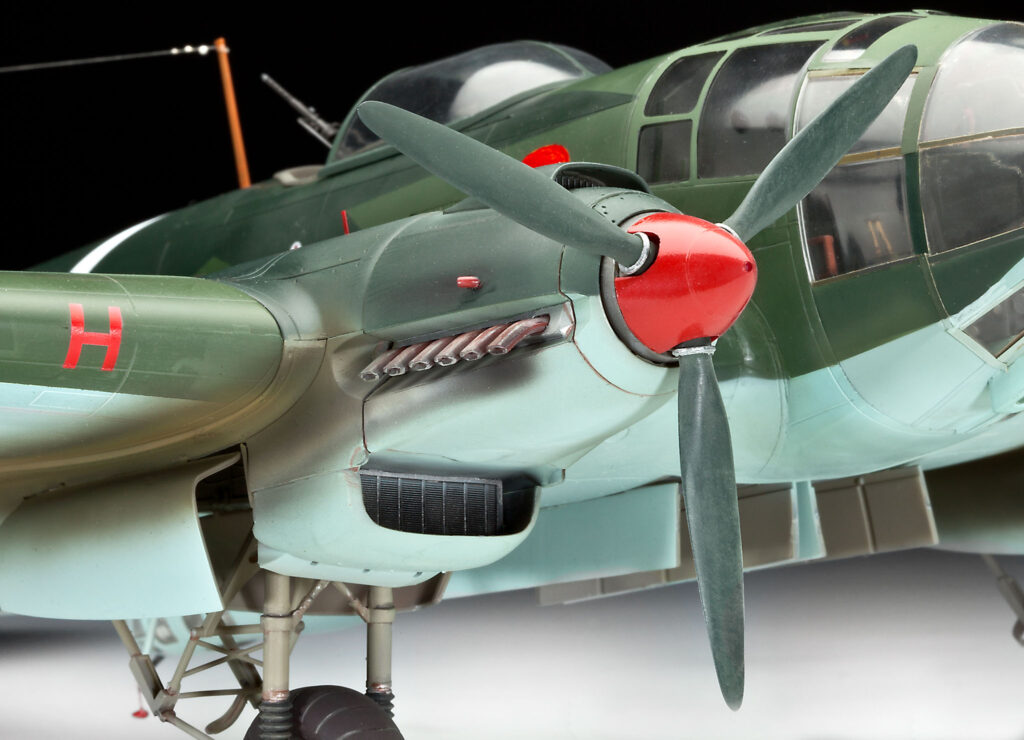
A museum visit is worthwhile for research and detailing. A CASA 2.111 B stands in the Deutsches Museum’s Flugwerft Schleißheim, and you will find further machines at the Military History Museum at Berlin-Gatow Airfield, at the Auto und Technik Museum Sinsheim, at the Flugausstellung Hermeskeil and at the Musée de l’air et de l’espace at Le Bourget. Genuine German originals are extremely rare. One of the few examples is a He 111 P carrying the code 5J+CN in the collection of the Norwegian armed forces at Gardermoen, which is precisely the version you are building here in 1:32.
The kit: 433 parts, over 70 cm wingspan, level 5
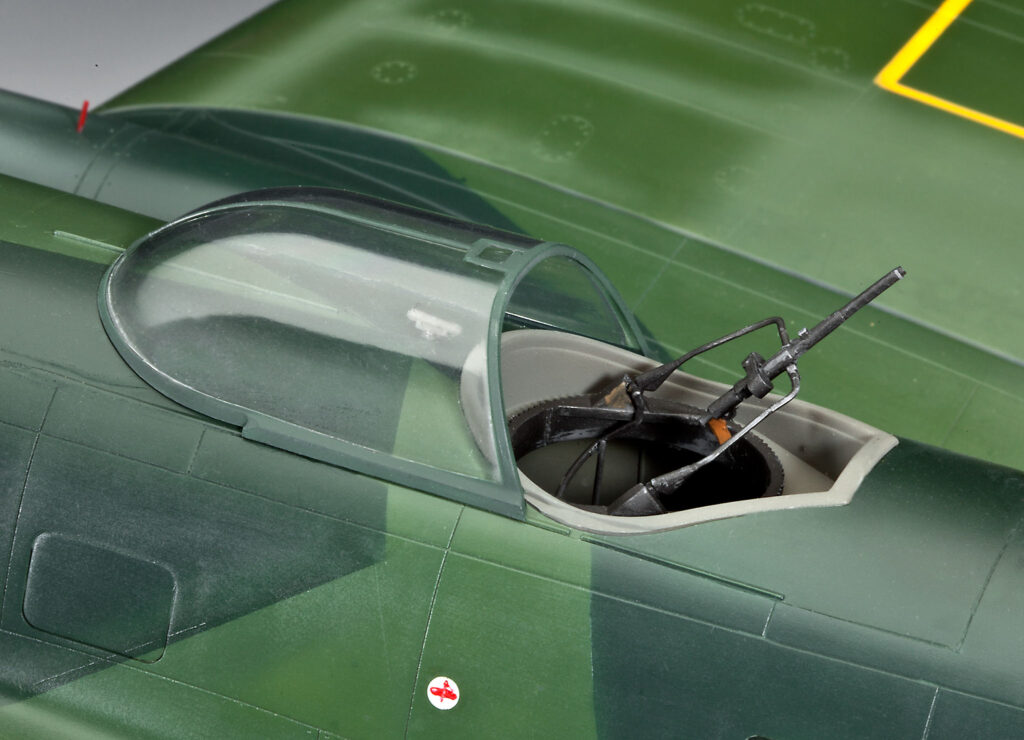
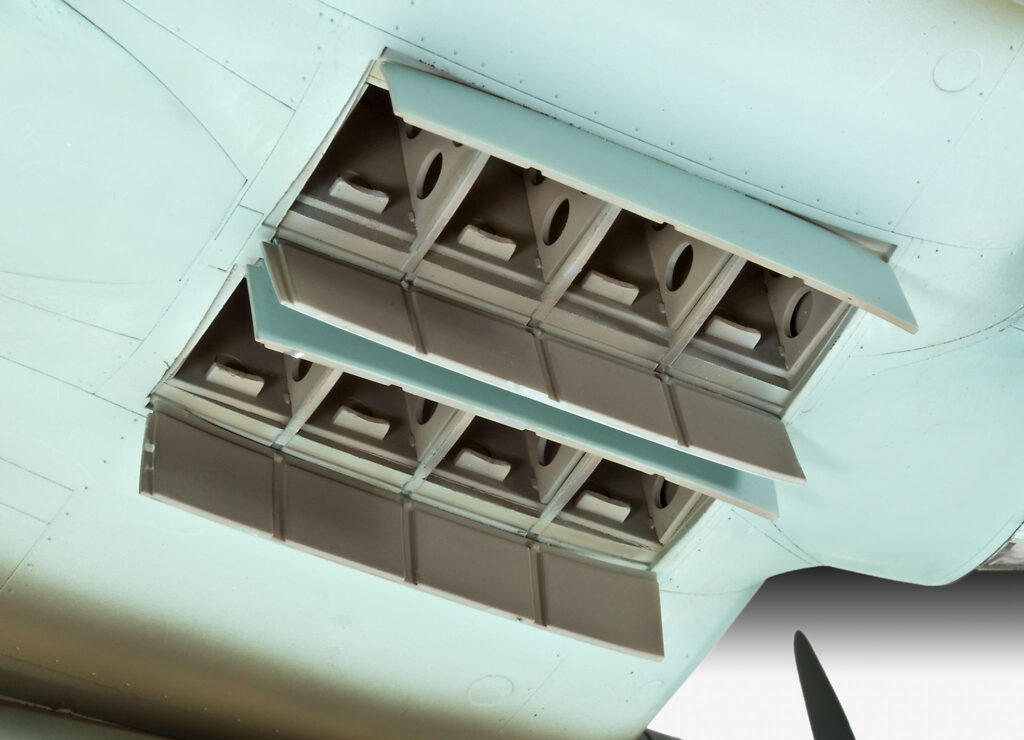
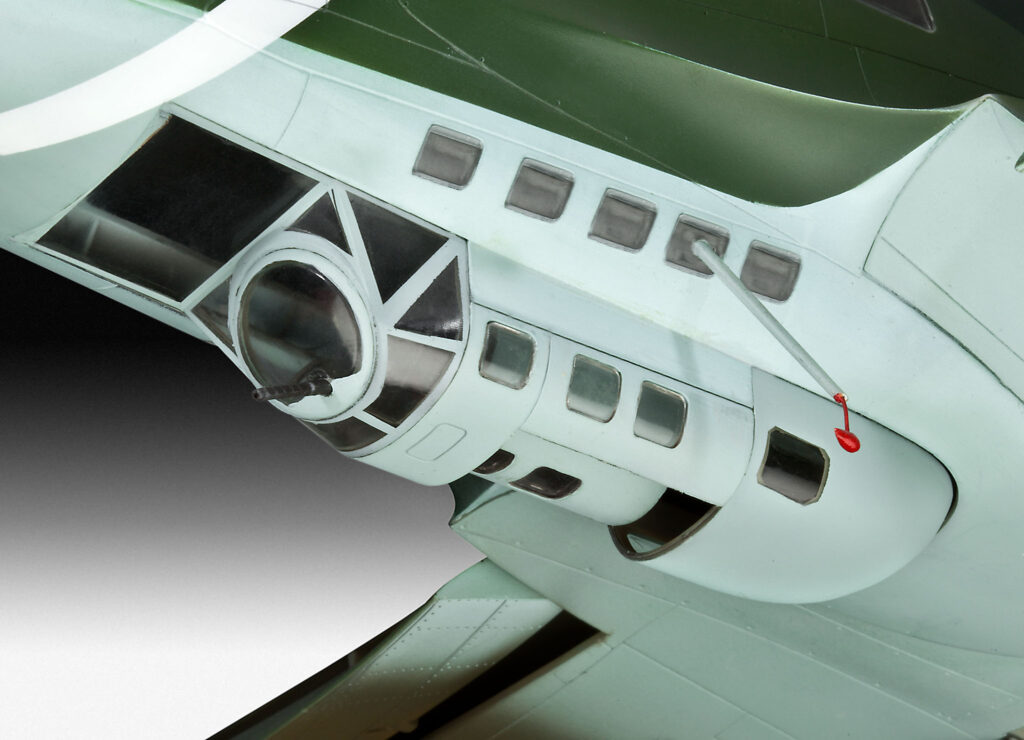
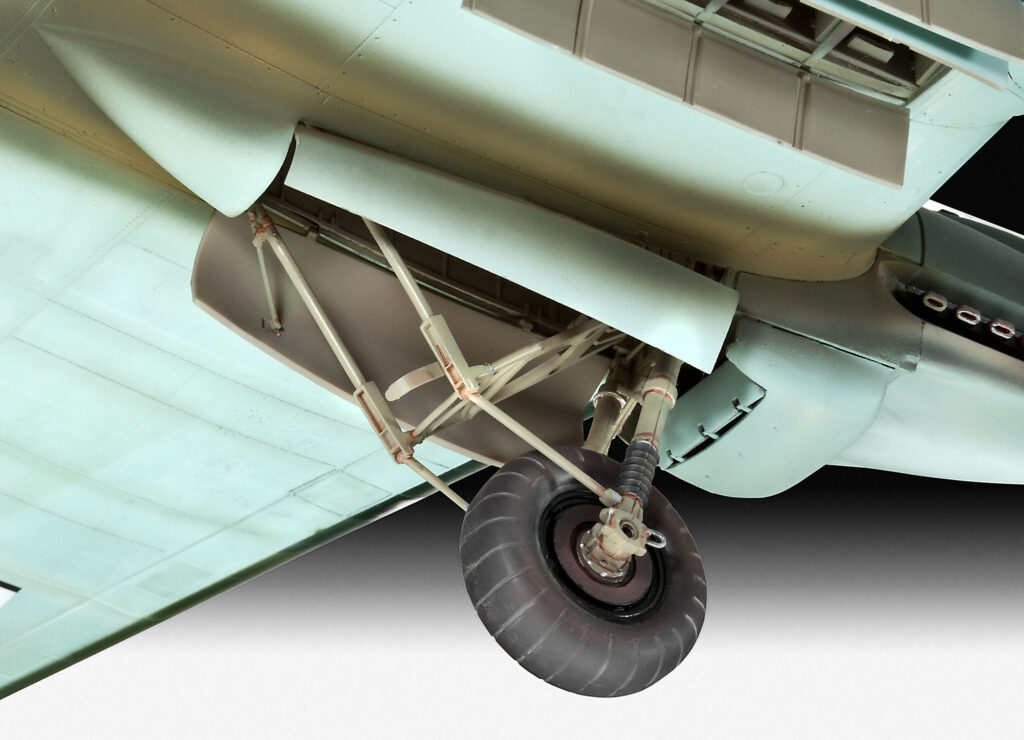
Let us turn to the box. The kit is based on tooling developed specifically for this scale and remains to this day the only plastic kit of the He 111 in 1:32 available anywhere in the world. At 51 cm long and with a wingspan of over 70 cm, the finished model needs a shelf of its own, and that is exactly where its appeal lies: rows of rivets, the structure of the glazed nose, the bomb bay and the gun positions can be reproduced at this size in a way that is simply not possible in 1:72 or 1:48.
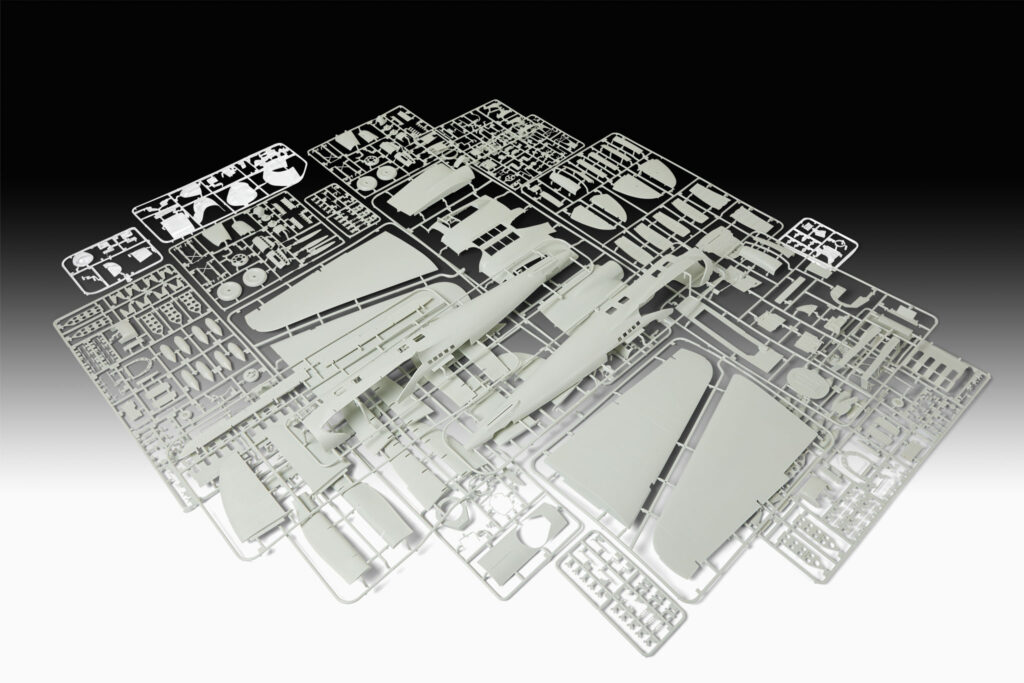
An overview of the technical data:
- Scale: 1:32
- Number of parts: 433
- Difficulty: level 5
- Recommended age: 13 and up
- Contents: plastic model kit (not assembled), illustrated multilingual assembly instructions in an updated version, decal sheet
Level 5 means this is not an afternoon project. Plan the interior first, because the fully glazed nose will later reveal everything you have built and painted in the cockpit and at the gun positions. If you want to get the maximum out of it, mask the numerous glazing panels cleanly, work with pre shading inside the fuselage and keep a decal softener to hand for the large format decals, because otherwise the carrier film will show at this scale.
 Conclusion: a project, not a quick evening build
The He 111P-1 in 1:32 is a kit for everyone who wants a model that tells a story and takes up the whole table while doing so. You get an aircraft that is fascinating in terms of engineering history, a rare early version, a glazed nose that invites detailing, and a result that draws attention at any show. If you want to treat yourself to this project, get one while the release is available: Heinkel He 111P-1 in the Revell shop.