
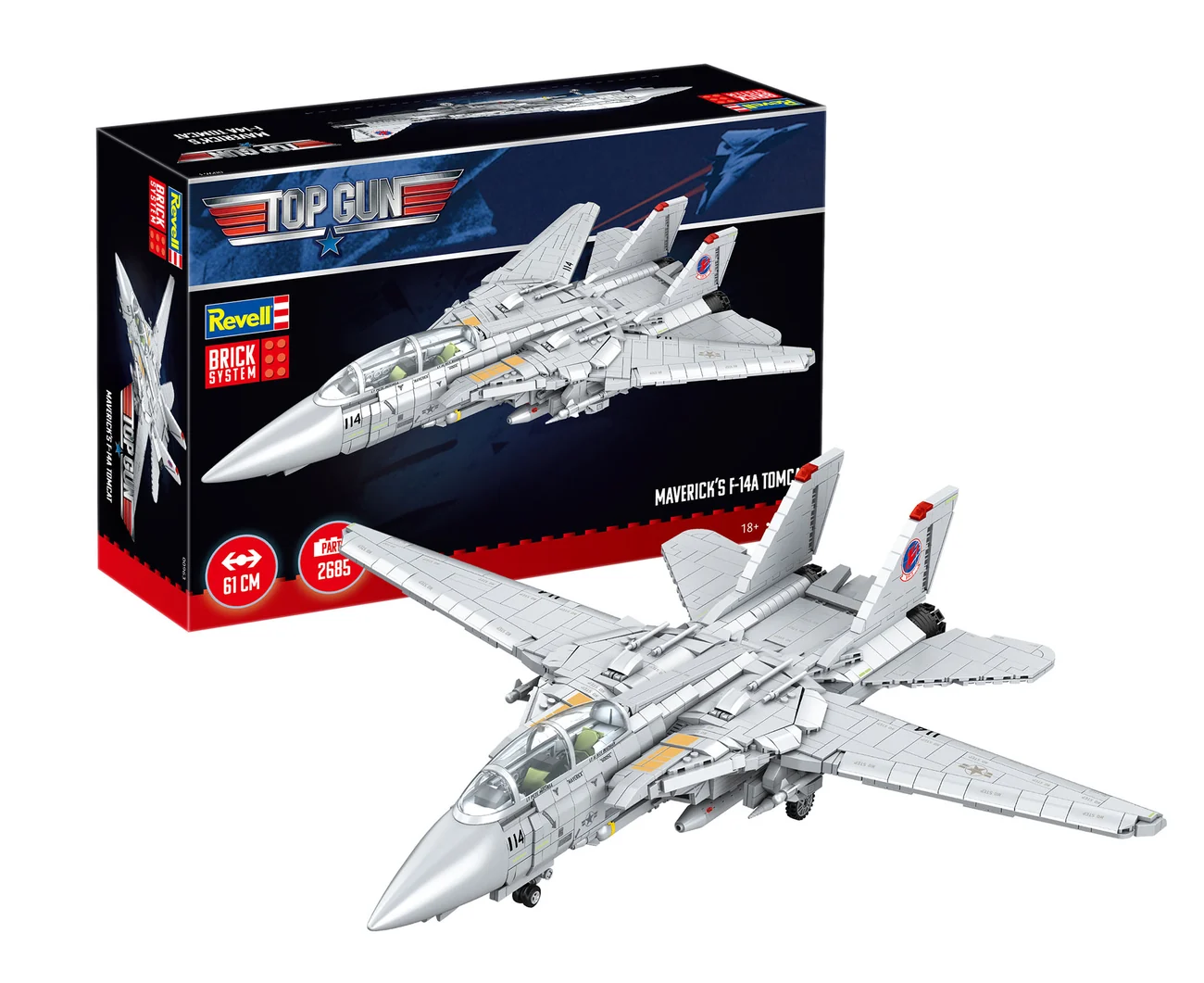
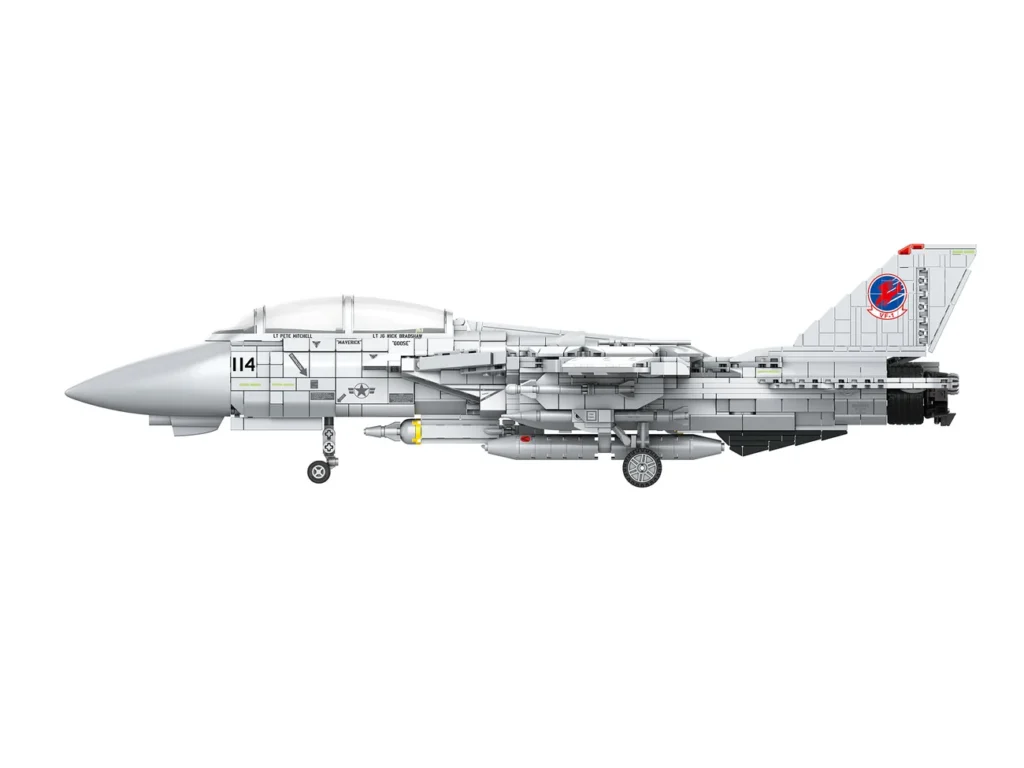
There are aircraft you recognise from their silhouette alone. The wide, flat centre fuselage, the twin vertical tails, the long cockpit with its two crew members seated one behind the other and, of course, the wings that sweep back in flight. Anyone who grew up in the eighties immediately hears the guitar riffs of “Danger Zone”. The Grumman F-14 Tomcat is not only one of the best-known combat aircraft in history, it is a genuine pop culture icon.
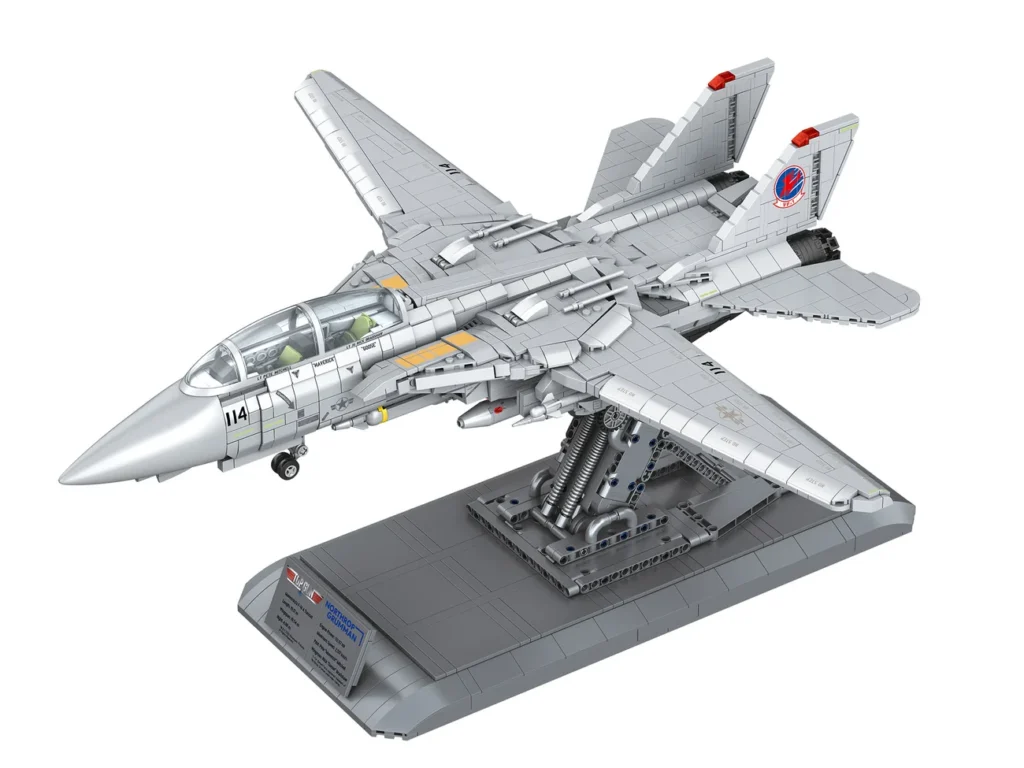
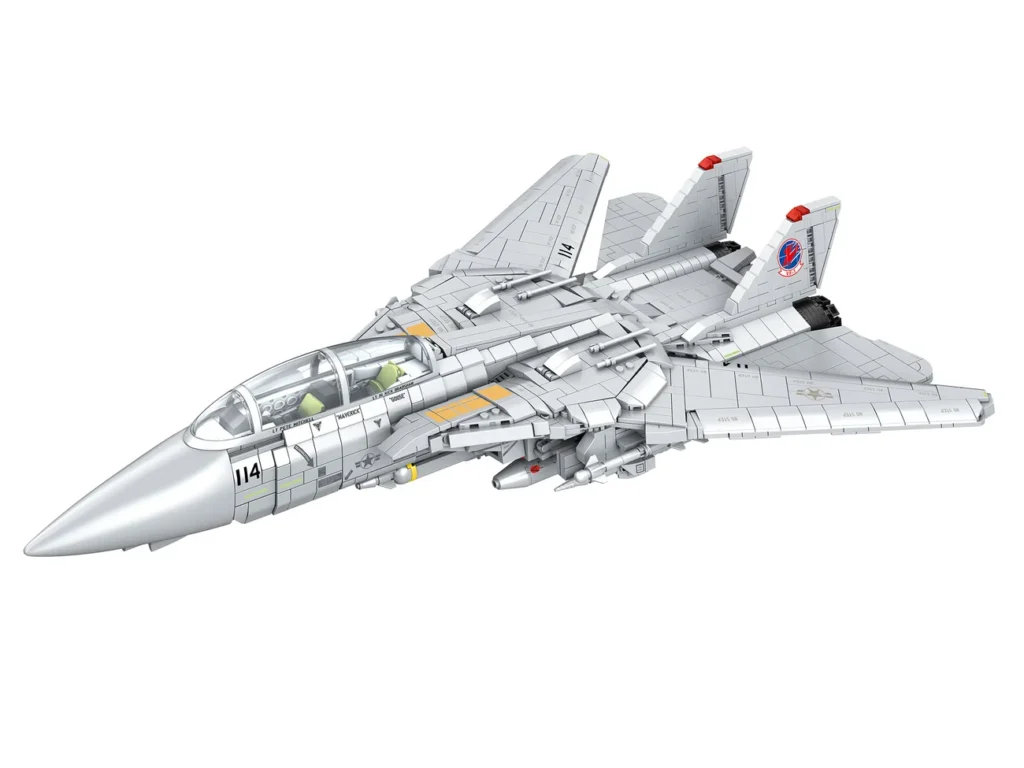
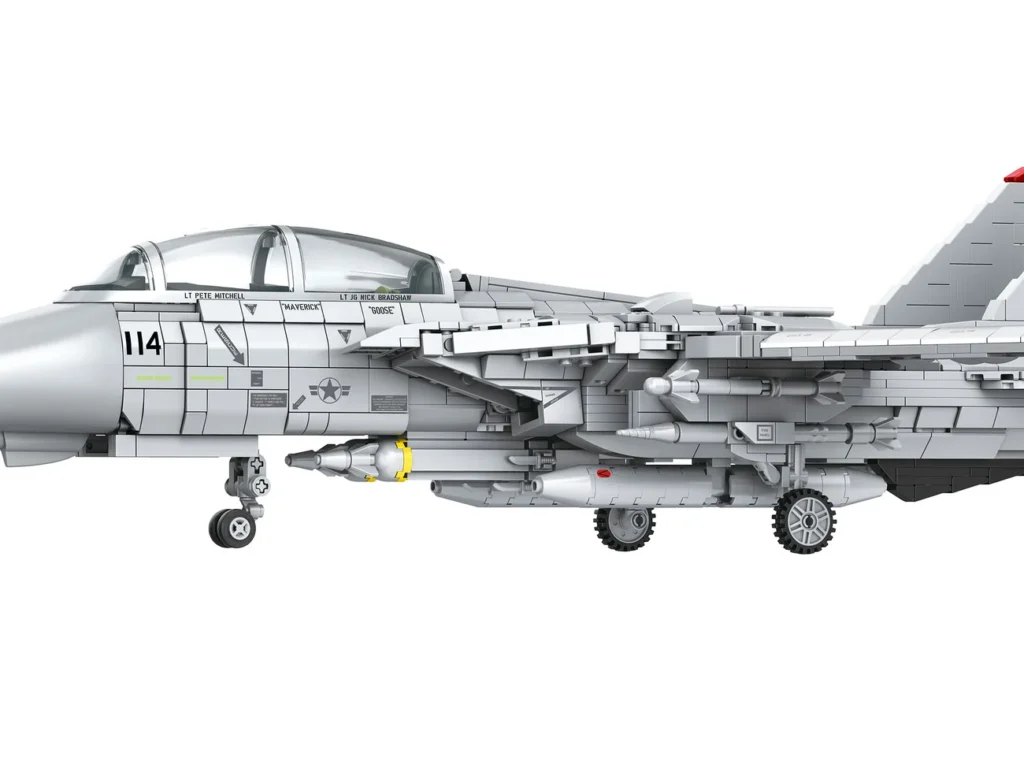
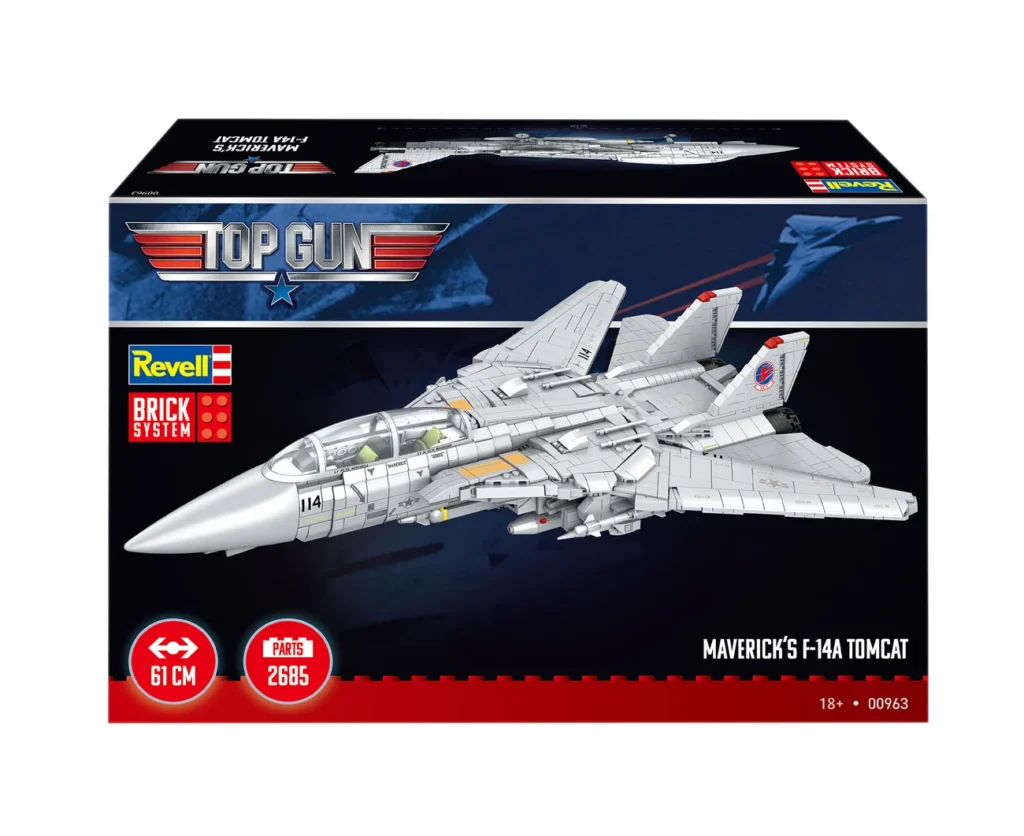
We are now bringing exactly this aircraft into your home as a large display model made of interlocking bricks: Maverick’s F-14A Tomcat “Top Gun” in the Revell Brick System.
Here you will find out what is behind our Brick System and why the kit is exciting for classic modellers and experienced brick fans alike, and then we take you on a journey through more than fifty years of Tomcat history. From the dramatic first test flights to real air combat and the filming in Hollywood.
What is the Revell Brick System?
With the Brick System (Revell Shop overview) we combine two worlds that, at first glance, have little to do with each other. On one side is our decades of experience in true-to-scale plastic modelling, on the other the intuitive plug-together system of interlocking bricks. You need neither glue nor paint, because all the bricks are already moulded in colour and are held together purely by their clutch power. We use special moulded parts wherever curves, sharp edges or distinctive silhouettes demand it, so that the finished model does not look like a random jumble of colourful bricks, but like the original.
For anyone who already has a large brick collection at home, one point is especially important: our bricks use the common standard grid dimensions and are compatible with the interlocking bricks of other well-known manufacturers. So you can easily carry out your own modifications and extensions. The Tomcat joins a growing family that includes, among others, the U-boat from “Das Boot”, the Bell Boeing V-22 Osprey, the Iron Maiden Spitfire “Aces High” and, soon, the Cutty Sark.
You can find an overview of all sets in our Brick System collection.
A New Challenge for Modellers and Brick Veterans
You actually feel at home at the workbench with side cutters, brush and plastic cement? Then the Tomcat offers you a relaxing change of perspective. Instead of drying times, filling work and painting schedules, the model grows layer by layer in your hands, and yet at the end you have an aircraft in the familiar 1:32 scale. This scale in particular should appeal to you, because the real Tomcat had a wingspan of around 19.5 metres with its wings spread. Divided by 32, that gives exactly the good 60 centimetres our model reaches.
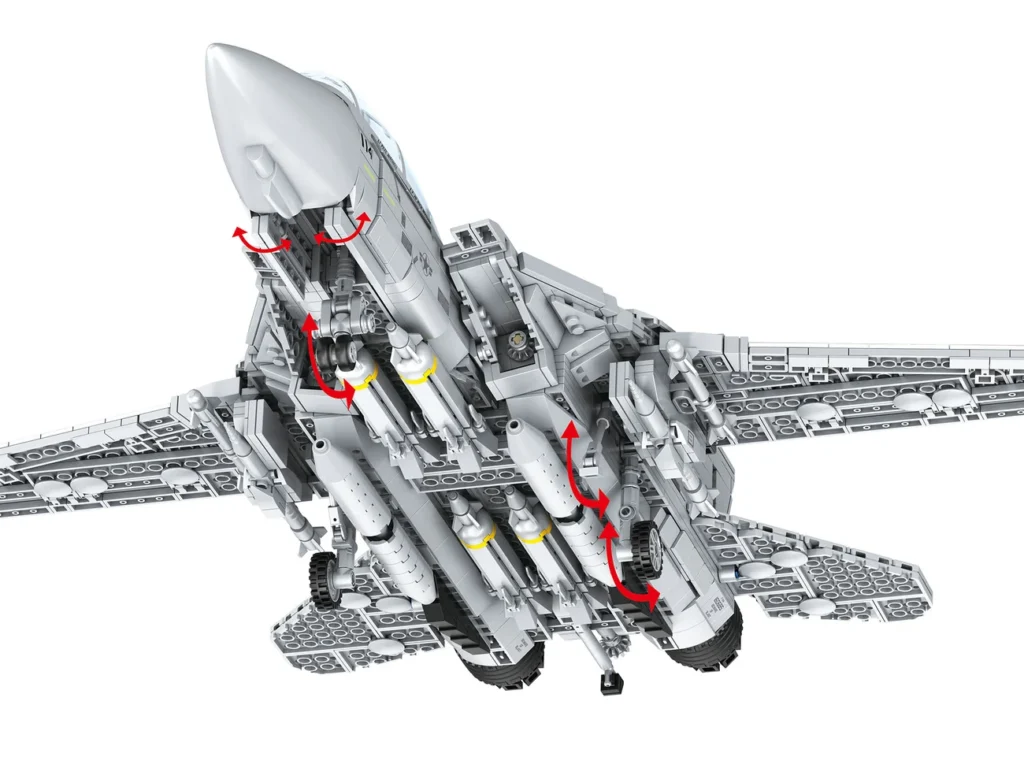
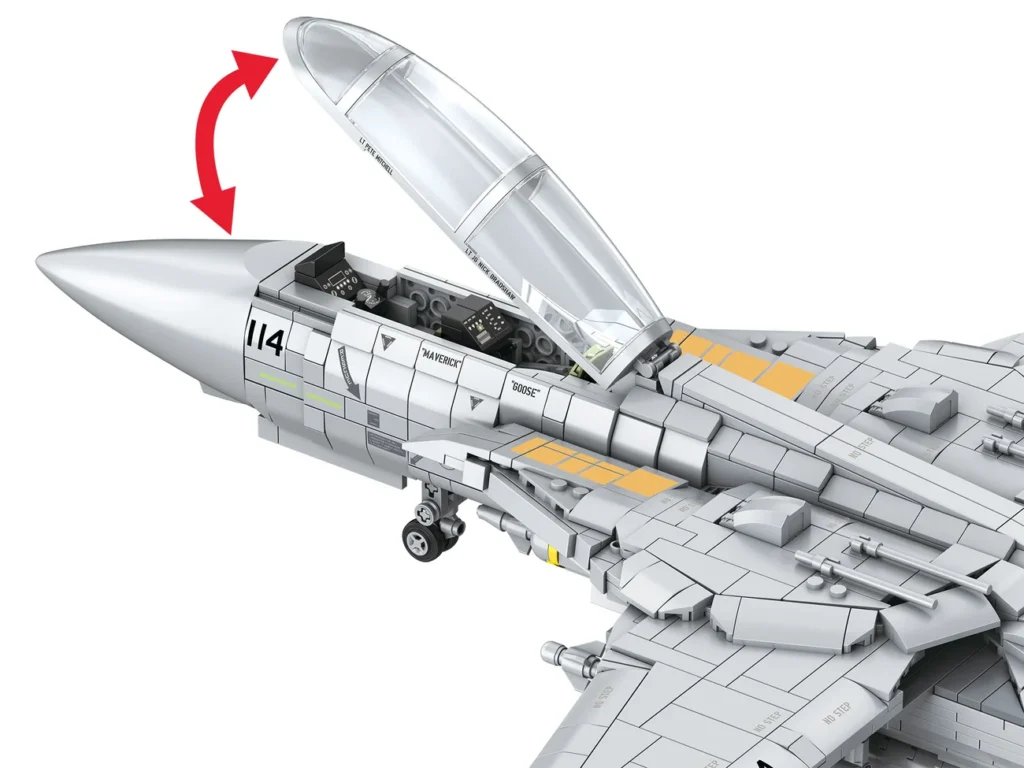
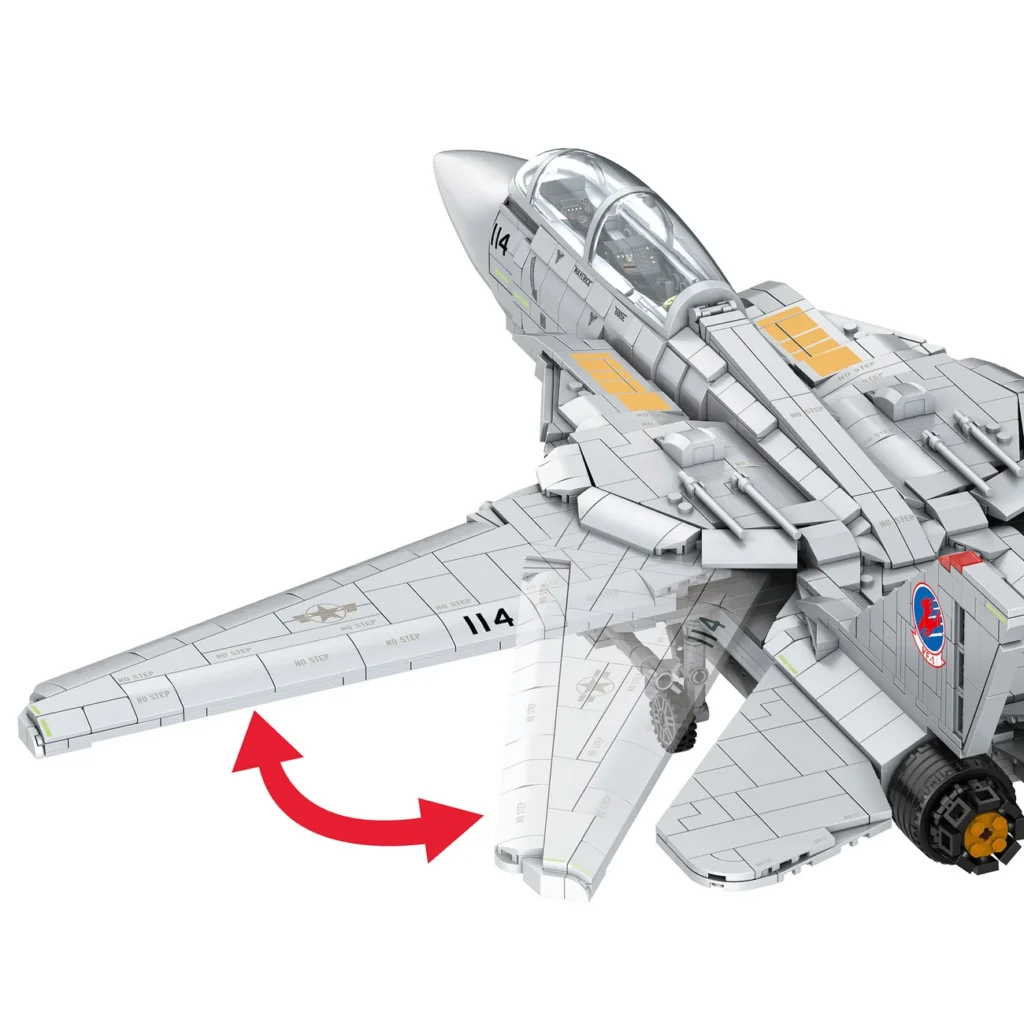
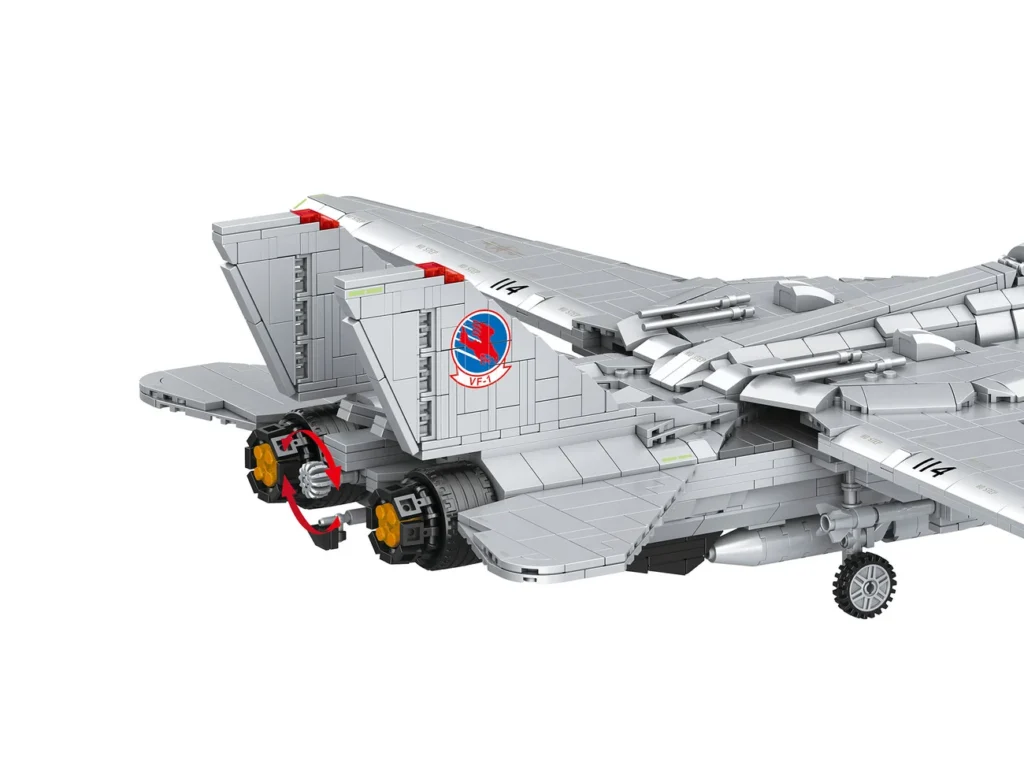
 You have already built countless castles, spaceships and supercars from bricks and are looking for something that challenges you again? With 2,687 parts, the Tomcat is not a project for a single afternoon. Things get especially exciting with the functions, because the swing wings can be swept back just like on the original, you can extend and retract the landing gear, and the armament is removable. Anyone who wants to recreate the smooth surfaces and aerodynamic shapes of a jet from interlocking bricks cannot avoid bricks mounted sideways and upside down, and this is exactly where the appeal lies for experienced builders. The kit is therefore expressly aimed at adults aged 18 and over.
The Birth of a Legend: How the F-14 Tomcat Came About
The story of the Tomcat begins with a failure. In the sixties, under pressure from Secretary of Defense Robert McNamara, the US Navy was supposed to adopt a naval version of the General Dynamics F-111 in order to save development costs. However, the F-111B proved far too heavy for carrier operations and was cancelled in 1968. The Navy then launched its own competition, called VFX, which Grumman won with its Model 303 design. The contract was signed on 3 February 1969, and just 22 months later the first aircraft was on the runway.
The name fitted perfectly with the tradition of the Long Island manufacturer, which had been naming its naval fighters after big cats since the Second World War, such as the Wildcat, Hellcat, Tigercat and Cougar. According to tradition, the name was also a tongue-in-cheek nod to Vice Admiral Thomas Connolly, who had campaigned vehemently against the F-111B and for a true naval fighter.
On 21 December 1970, Grumman test pilots Robert Smyth and William Miller took off from Calverton on Long Island for the maiden flight. Due to bad weather, they had to land again quickly. The second flight on 30 December went even worse, as a sudden hydraulic failure caused the prototype to crash. Both pilots were able to escape using their ejection seats, and the programme continued. In January 1973 the first squadron received its aircraft, and in 1974 the Tomcat went on its first major deployment with squadrons VF-1 and VF-2 aboard USS Enterprise. Tomcats were already flying patrols in the final days of the Vietnam War without becoming involved in combat.
Swing Wings, Phoenix and a Man in the Back Seat: The Technology of the Tomcat
Its role in the Cold War was clearly defined. The Tomcat was to protect the Navy’s carrier battle groups from Soviet bombers and cruise missiles, long before they came within range. At the heart of this was the massive AWG-9 radar, which could track up to 24 targets simultaneously and engage six of them at once with six Phoenix missiles. The AIM-54 Phoenix had a range of more than 160 kilometres and, throughout its entire service life, was carried exclusively by the Tomcat. This system was operated by the Radar Intercept Officer in the rear seat, which is why Maverick was never without his Goose in the film.
Even more famous are the swing wings. For slow landing approaches and tight dogfights they were spread wide at around 20 degrees, while for supersonic flight they folded close to the fuselage at around 68 degrees. An onboard computer adjusted the wings automatically according to speed and altitude, so the pilot did not have to worry about it. With a top speed of up to Mach 2.34, the Tomcat was among the fastest jets of its time. It was not entirely without weaknesses, however, as the TF30 engines of the F-14A were prone to compressor stalls during hard manoeuvres. Only the later F-14B and F-14D versions received, in the General Electric F110, the powerful and reliable engines the crews had always wanted.
An affectionate anecdote to make you smile: among the crews, the Tomcat was nicknamed “Turkey”. On approach to the carrier, with its wings spread wide, flaps lowered and landing gear splayed, it looked a little like a turkey waddling clumsily through the air. With your model, you can recreate exactly this look by extending the landing gear and wings.
The First Aerial Victories over the Gulf of Sidra
The Tomcat earned its reputation as a fighter off the Libyan coast. In 1973, Libyan ruler Muammar al Gaddafi had declared almost the entire Gulf of Sidra to be territorial waters and drawn a line, the crossing of which he intended to answer with military force. When the US Navy held exercises there in August 1981, two Libyan Su-22s fired on two Tomcats of squadron VF-41 “Black Aces”. The response came promptly, and both Su-22s were shot down. These were the Tomcat’s very first aerial victories.
Eight years later, on 4 January 1989, history repeated itself. Two Tomcats of squadron VF-32 “Swordsmen” from the carrier USS John F. Kennedy encountered two Libyan MiG-23s. The American crews changed course several times to demonstrate their peaceful intentions, but each time the MiGs turned back onto an intercept course. Eventually, both Libyan aircraft were shot down. The radio communications from this engagement can still be heard online today. Incidentally, the 1981 incident is considered one of the inspirations for the final dogfight in the first Top Gun film.
The Tomcat Conquers Hollywood: The Final Countdown and Top Gun
The Tomcat’s talent for show business was evident even before Top Gun. It made its cinema debut in 1980 in the science fiction film “The Final Countdown”, in which the aircraft carrier USS Nimitz is transported by a mysterious storm back to 6 December 1941, the day before the Japanese attack on Pearl Harbor. Legendary is the scene in which two Tomcats of squadron VF-84 “Jolly Rogers”, with the skull and crossbones on their tails, chase two Japanese Zero fighters from the Second World War. The pilots flew so low over the water that the jets kicked up spray.
The Tomcat truly became a superstar, however, on 16 May 1986, when Top Gun opened in American cinemas. The idea for the film came from a 1983 magazine article about the Navy Fighter Weapons School at Naval Air Station Miramar near San Diego, nicknamed “Fightertown USA”. For his research, screenwriter Jack Epps Jr. attended declassified classes at the school and even flew in the back seat of a real F-14 himself.
Behind the Scenes of Top Gun
The Navy supported the production with real aircraft from squadron VF-51 “Screaming Eagles”, which Commander Viper even mentions by name in the film, and aircraft from VF-111 “Sundowners” were also involved. The scenes aboard the aircraft carrier were filmed on USS Enterprise with Tomcats from squadrons VF-114 and VF-213. The enemy MiG-28s were in reality black-painted Northrop F-5s of the Fighter Weapons School with red stars. Grumman built special camera mounts that were fitted to the jets, and a modified Learjet served as an airborne camera platform.
None of this came cheap. For the aircraft, including fuel, pilots and ground crew, the production paid around 7,800 dollars per hour. Director Tony Scott wanted take-offs and landings backlit by the setting sun, and turning the aircraft carrier in the right direction alone is said to have cost 25,000 dollars. The filming was overshadowed by the death of aerobatic pilot and aerial cameraman Art Scholl, whose camera plane went into a spin and crashed into the Pacific. The film is dedicated to him.
The effort paid off. Top Gun cost around 15 million dollars and grossed some 357 million dollars worldwide, making it the most successful film of 1986. “Take My Breath Away” won the Oscar for Best Original Song, and the Navy was delighted by a noticeable rush on its recruiting offices. For an entire generation, a fighter jet was from then on simply a Tomcat. If you would like to have this fascination in your display cabinet too, then take a closer look at Maverick’s F-14A Tomcat in the Revell Brick System.
Iran, the Bombcat and the Long Farewell
Besides the USA, there was only one other customer for the Tomcat. In the seventies, the Shah of Iran ordered 80 aircraft, 79 of which were delivered before the 1979 revolution ended the cooperation. During the war between Iran and Iraq in the eighties, the Iranian Tomcats saw their most intensive action, and it was the only time the Phoenix was used in combat. Because the country had to manage without American spare parts, a veritable smuggling war over Tomcat components developed over the decades.
In the US Navy, the role of the Tomcat changed after the end of the Cold War. In the 1991 Gulf War it flew reconnaissance and escort missions, and one F-14 was lost to enemy fire, the only Navy Tomcat to suffer this fate. From the mid-nineties onwards, the pure fighter became an all-rounder, deployed with precision-guided bombs over Bosnia, Iraq and Afghanistan. The crews affectionately named this version the “Bombcat”. The last combat mission was flown by two Tomcats in February 2006 from the carrier USS Theodore Roosevelt over Iraq.
On 22 September 2006, after 36 years of service, the Navy officially retired its Tomcat in a ceremony at Naval Air Station Oceana. The last squadrons were VF-31 “Tomcatters” and VF-213 “Black Lions”. What followed was an unusual step in aviation history: to prevent spare parts from reaching Iran, the Pentagon had most of the retired aircraft scrapped and halted the sale of all Tomcat parts. Only selected examples were preserved as museum pieces. Iran was thus the sole remaining operator for years, although according to reports from spring 2026, the last Iranian aircraft may also have been destroyed in air strikes.
The Comeback in Top Gun: Maverick
When the sequel “Top Gun: Maverick” finally arrived in cinemas in 2022 after 36 years, the production faced a problem. There was simply no airworthy Tomcat left in American hands. The team found what they were looking for at the San Diego Air and Space Museum, where an F-14A with the serial number 159631 was on display. The aircraft was dismantled, transported more than 800 kilometres to a filming location near Lake Tahoe and used there as a prop without an engine.
Disguised with black tails and a phoenix-like insignia, the same aircraft later even appeared on the deck of the aircraft carrier USS Theodore Roosevelt, caught in the crash barricade used for emergency landings. Anyone who has seen the film knows which scene was shot there. All the flying scenes featuring the Tomcat were computer-generated, including the spectacular duel against a modern Su-57. After filming, the Tomcat returned to its museum, where it still bears witness to its second film career today.
The Tomcat in TV Series, Books and Video Games
The Tomcat has left its mark away from the big screen too. In the TV series “JAG”, the lead role was a former Tomcat pilot, and for the flying scenes the production partly drew on footage from Top Gun. The Tomcat also made an appearance in the 1996 action film “Executive Decision”. Former Navy pilot and bestselling author Stephen Coonts packed his novel “Final Flight” full of Tomcat expertise, and in Japan the F-14 became the star of numerous anime such as “Area 88” and “Macross Zero”.
In the world of video games, the Tomcat has been at home since the eighties. As early as 1986, the first Top Gun game was released for home computers such as the Commodore 64 and the ZX Spectrum, followed in 1987 by Konami’s version for the Nintendo Entertainment System, in which you fly four missions as Maverick in the F-14. The Tomcat is also a fixture in almost every instalment of the Ace Combat series. Fifty years after its maiden flight, it is more alive than ever.
Cleared for Your Hangar
The F-14 Tomcat combines everything that makes a true legend: groundbreaking technology, a dramatic operational history and an appearance in one of the most successful films of all time. With our Brick System kit, you bring this story home in a format that challenges modellers and brick fans alike. Sweep the wings back for supersonic flight, extend the landing gear for the carrier landing and recreate your favourite scene from the film. We look forward to seeing your build reports and photos.
Your mission starts here: Maverick’s F-14A Tomcat “Top Gun” in the Revell Brick System.
Kit Specifications
- Scale: 1:32
- Number of parts: 2,687 interlocking bricks
- Wingspan: over 60 cm
- Recommended age: 18 and over
- Functions: swing wings, retractable landing gear, removable armament
- Construction: no glue or paint required, compatible with common standard interlocking bricks
- Contents: kit of interlocking bricks (unassembled), illustrated multilingual building instructions
BUILD INSPIRATION
The Insane Engineering of the F-14 Tomcat (Real Engineering): A documentary of just under half an hour about the technology of the Tomcat, from the swing wings to the AWG-9 radar and the Phoenix, right through to the problems with the TF30 engines. Ideal for understanding what made the original so special while you build the wing mechanism.
Fighter Fling 1989: Original footage from the US Navy’s Tomcat community at the height of the F-14 era, with catapult launches, carrier landings and formation flights. Uploaded by former Tomcat Radar Intercept Officer Ward Carroll and perfect for getting a feel for the real F-14A in action.
Bonus for film fans, Fighter Pilot Breaks Down Every Fighter Jet From Top Gun: Maverick (WIRED): Former Navy fighter pilot Matthew “Whiz” Buckley explains all the jets from Top Gun: Maverick and talks at length about why, for pilots of his generation, the Tomcat is still the most beautiful aircraft in the world.