
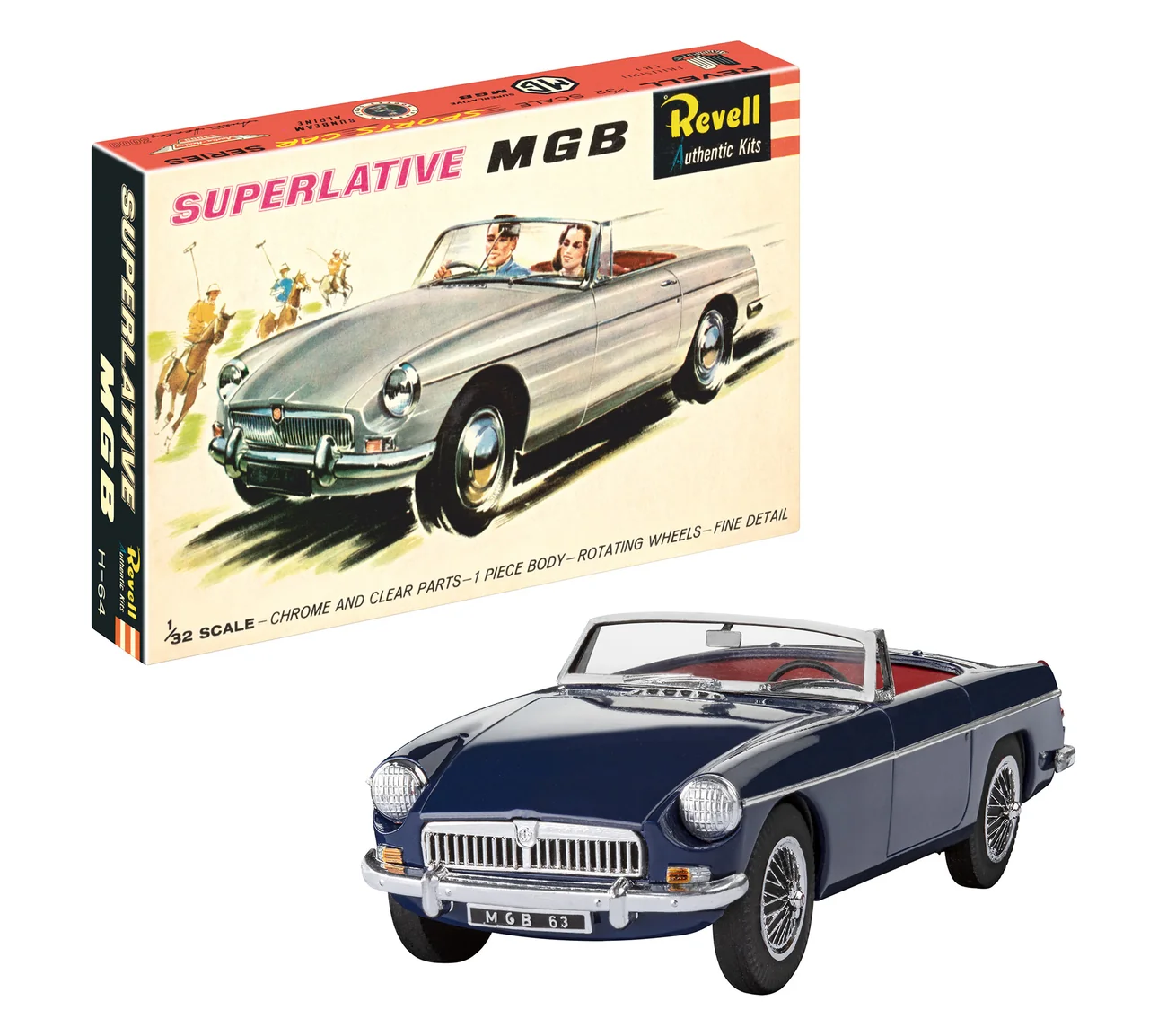
This kit is a time capsule on wheels. Our MGB Roadster in 1:32 scale comes out of the original 1964 tooling, it arrives in the packaging design of the first edition, and it demands exactly those skills that defined model making sixty years ago. As part of our new Vintage Kit series it is appearing in a strictly limited edition, and you will find it right here in our shop: MGB Roadster.
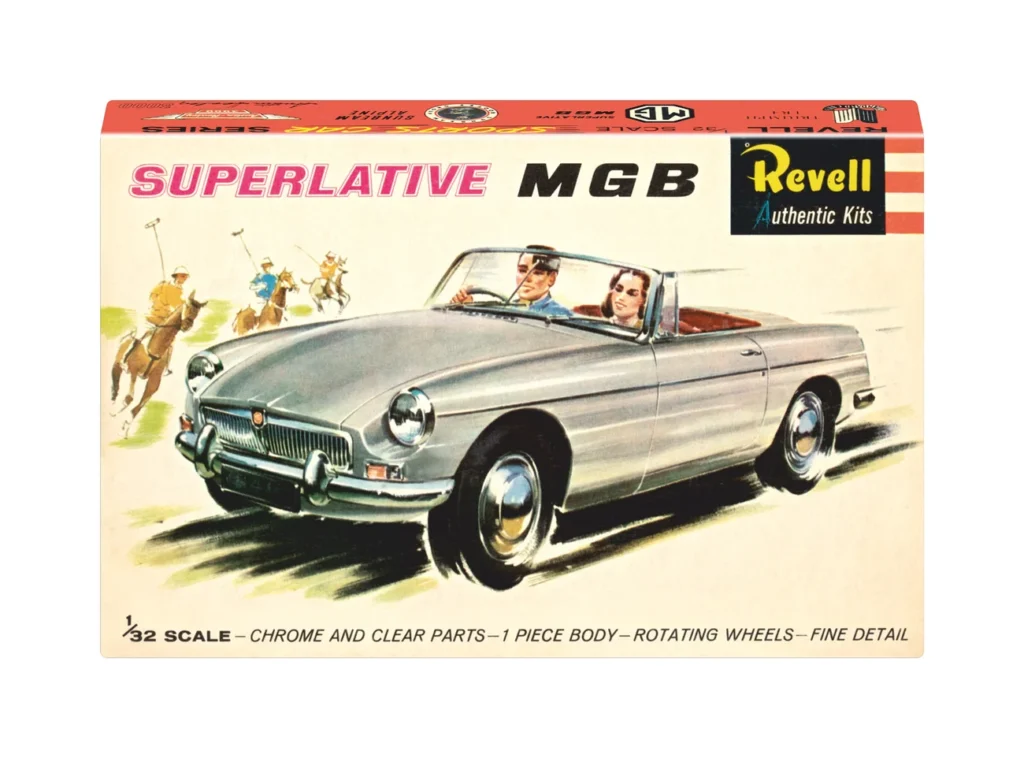 1962: a roadster without a frame
When thoughts turned in Abingdon near Oxford to a successor for the MGA, nobody suspected that it would become the most successful British sports car of all. Development ran under the works code EX205, Don Hayter was responsible for the shape, and in the autumn of 1962 the MGB stood in the dealerships. The decisive part sat beneath the bodywork: instead of a classic ladder frame, the car was given a unitary body, a first for an open MG. That made it lighter, more torsionally rigid and roomier inside, even though it was shorter than its predecessor.
On top of that came wind-up windows instead of side screens, a usable boot and a hood you could actually operate on your own. Traditionalists turned up their noses at the time and spoke of comforts that had no business in a real roadster. Customers saw it differently. The lines in Abingdon ran until December 1980, and together with the MGC and the MGB GT more than 500,000 vehicles were built. The open roadster alone accounted for around 400,000 of them, a large share of those for export to the USA.
Engineering without airs and graces
Under the long bonnet worked the familiar B Series engine from BMC, an inline four with 1.8 litres of displacement, a cast-iron block and around 95 hp. There was little that was modern about it, but everything about it was tough. The MGB took a little over eleven seconds to reach 100 kilometres per hour, and anyone reading those figures today quickly understands that this car was never about records. It was about the feeling of sitting low, looking out through a shallow windscreen, working at the big steering wheel and hearing the short gear lever click metallically into place.
One detail is remarkable, and not one you would expect of a sports car from the early sixties. The unitary structure was laid out with defined deformation zones right from the start, which is why the MGB is regularly named as one of the first production cars with a genuine crumple zone. Later came the requirements from North America: a third windscreen wiper, a padded dashboard that the workforce mockingly named the Abingdon Pillow after the factory’s home town, and from the mid-seventies those hefty plastic bumpers that earned the car the nickname rubber bumper among the fan community. Our kit shows you the car as it was first conceived, with chrome and a clean line.
From Sebring to Le Mans
The MGB was no fair-weather car, it had to prove itself in motorsport. Just a few months after the premiere the works sent three specially prepared cars to the twelve-hour race at Sebring, recognisable by the registrations 6 DBL, 7 DBL and 8 DBL. The debut went thoroughly wrong, with all the cars retiring with bearing failures. That same car, 7 DBL, then showed at Le Mans what the design was capable of. Paddy Hopkirk and Alan Hutcheson ran a special nose fairing in 1963, lost more than an hour through an excursion into the sand bank at the end of the Mulsanne Straight, and still finished twelfth overall. 1964 brought an eleventh place, and 1965 the last appearance of an MGB at the 24 Hours. At Sebring the model remained a presence for years, which makes it one of the longest-campaigned production cars in that race.
So when you are thinking about which paint scheme to go for while building, you have more choice than just British Racing Green. Iris Blue, Old English White and Tartan Red are part of this car’s history too, because three works-supported MGBs lined up at Sebring in 1964 in exactly those colours. Here is the kit to go with it: MGB Roadster in the shop.
Eighteen years and three series
The MGB stayed in the range almost unchanged for a remarkably long time. Mark I, Mark II and Mark III mark the stages of its development, and in between came a fully synchronised gearbox, a new rear axle, an alternator and many small changes for the American market. 1965 added the MGB GT, the fastback coupé styled with input from Pininfarina, 1967 the six-cylinder MGC, and the seventies the MGB GT V8. On 22 October 1980 the last open MGB left the factory in Abingdon, and with it ended not just a model range but a whole era of British sports cars. Only from 1992 to 1995 did the shape return once more as the MG RV8, although technically it was largely new.
The MGB on screen and in the classic car scene
Watch British films of the sixties and seventies and you will almost inevitably see an MGB drive through shot at some point, because it was the middle class sports car and therefore the perfect prop. The best known is the roadster from the 1972 thriller Sleuth, in which Michael Caine pulls up as Milo Tindle. That car still exists today, goes by the nickname Lulu in the scene and turns up regularly at club meetings. The story is a nice example of how closely film and car culture are interwoven in the case of the MGB.
Even without its cinema appearances the MGB has remained one of the most visible classics in Europe. The parts supply is regarded as exemplary, complete bodyshells were newly manufactured for a time, and there is at least one parked at the roadside on every classic car run. It is precisely this ubiquity that makes the model such a rewarding project, because whatever your question about paint shade, wheel or hood position, you will find a real-world reference within minutes.
 Our kit from 1964: model making of the swinging sixties
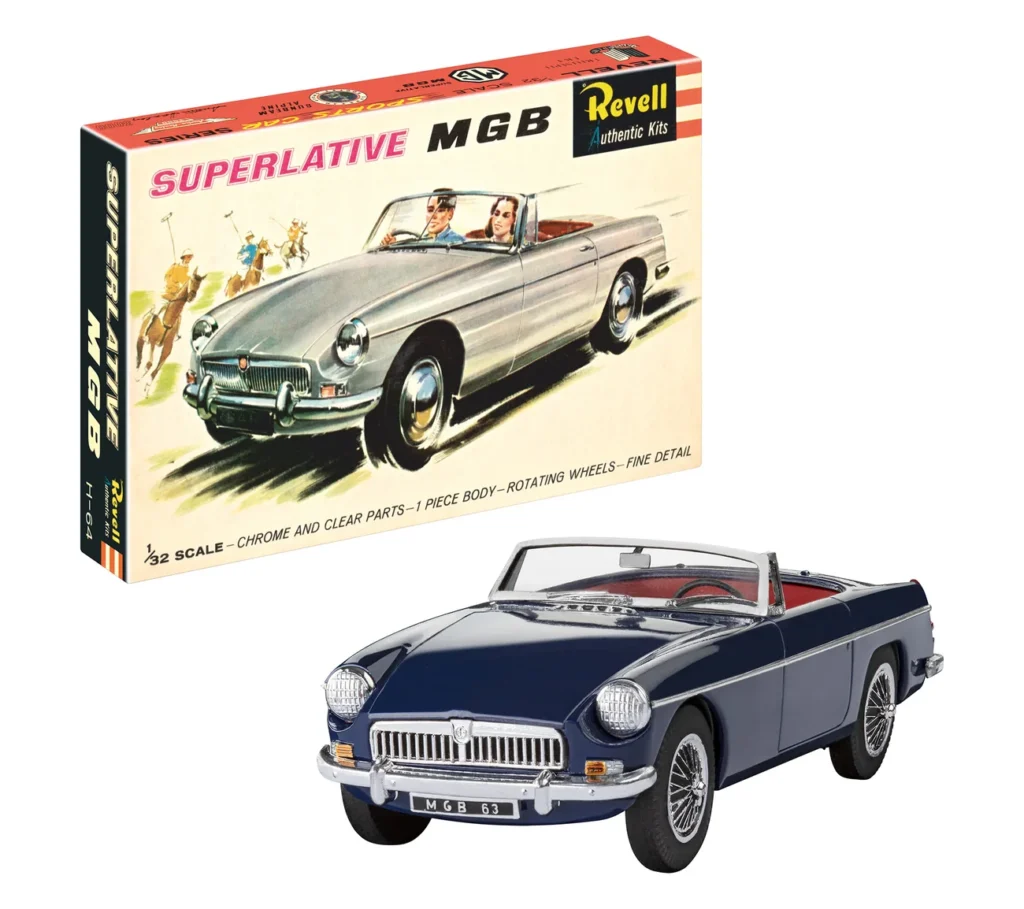
In our range this model ran back then under the name Superlative MGB, and the moulds of 1964 are exactly what you are now holding in your hands. 64 parts, a style of production without CAD design and without modern slide moulds, plus the box with the original artwork of the first release. The Level 5 rating seems surprising at first for a model 12.4 centimetres long, but it makes sense as soon as the first sprue is lying on the table. Historic tooling produces more flash, the fits are more generously toleranced, and body seams need attention.
Our advice from experience: dry-fit before glue comes into play, sand the parting seams carefully, and with the chrome parts go for careful deburring rather than vigorous sanding. If you want more, replace the trim strips with metal foil, run thin wire to suggest spokes and polish the body before the clear coat. The small scale rewards clean edges more than any amount of additional detail, and that is exactly where the appeal of a kit from our company’s early days lies.
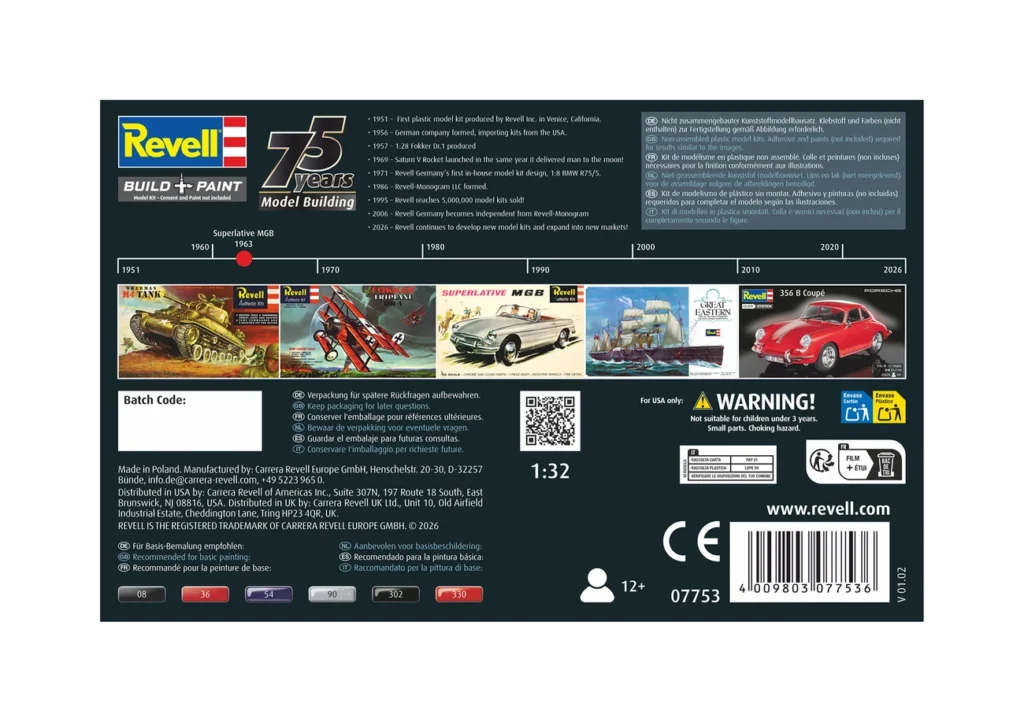
The package contains the unassembled plastic model kit from the historic moulds, illustrated multilingual assembly instructions and a decal sheet.
Secure your piece of history before the limited edition sells out: MGB Roadster now in the Revell shop.
Build inspiration
The great British YouTuber Freddie Dobbs shows you an MGB here in its natural habitat 🙂