
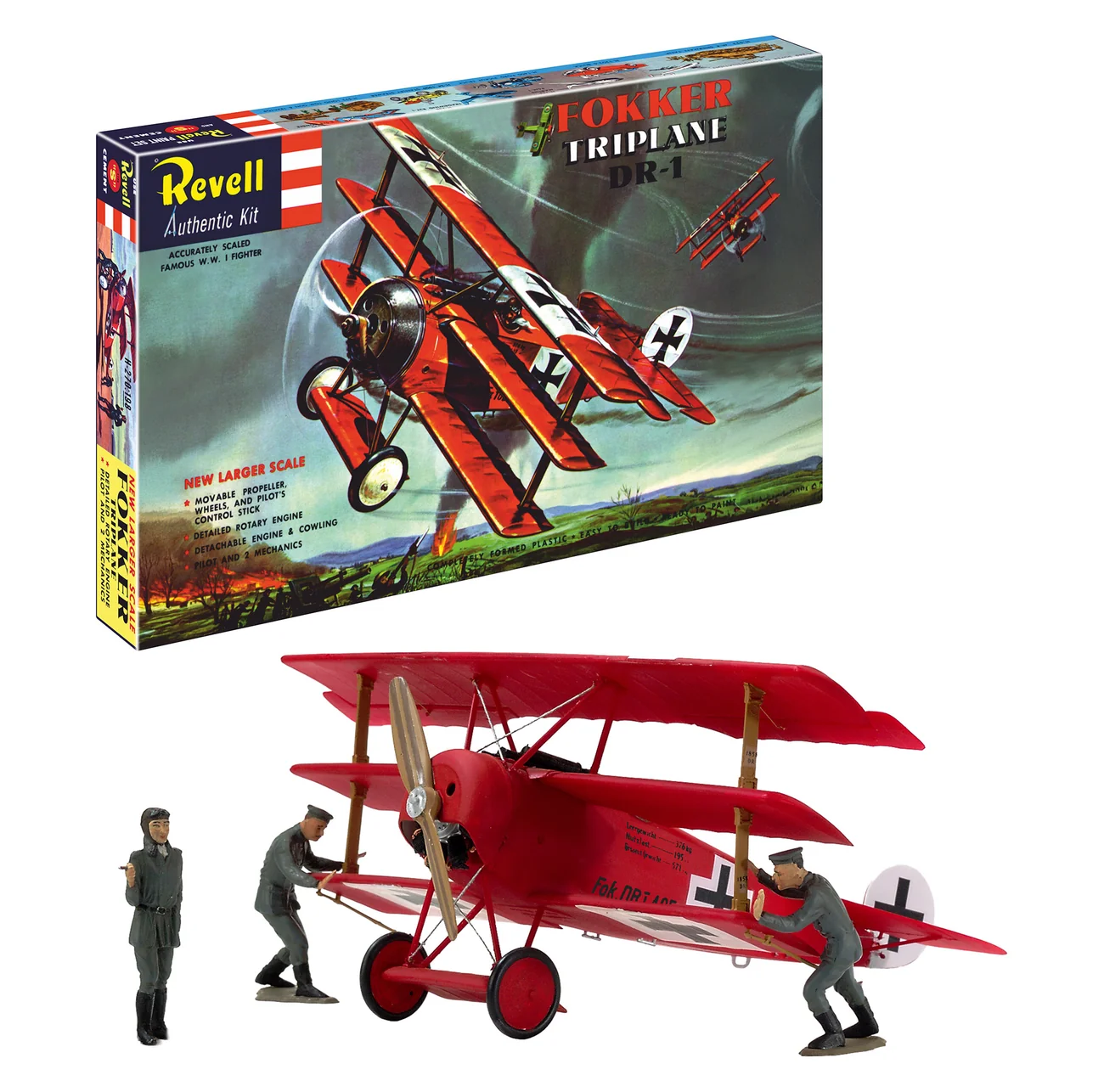
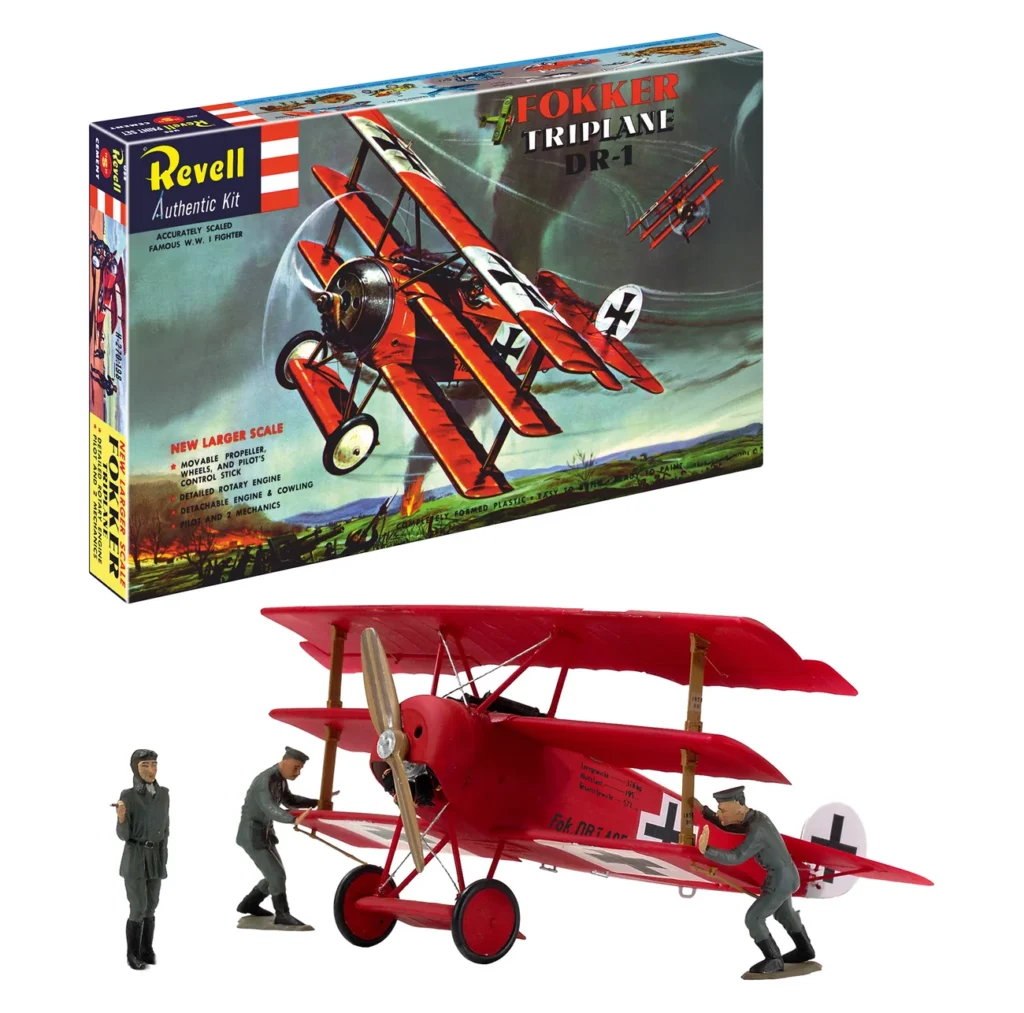
Some kits depict an aircraft, and some kits are a piece of history in their own right. Our Fokker Triplane DR.1 in 1:28 scale belongs firmly in the second category, because it comes out of tooling we put into service back in 1957. That means you are not only holding the most famous fighter of the First World War in your hands, but also one of the oldest aircraft models still in our range. As part of our new Vintage series, the triplane is now returning to the workbench in a strictly limited edition. You will find the kit right here in our shop: Fokker Triplane DR.1.
A triplane as the answer to the competition
The story of the Fokker Dr.I does not begin in Schwerin, but over the lines in Flanders. When the British Sopwith Triplane reached the front in the spring of 1917, German fighter pilots were astonished by an aircraft that was superior to theirs in the climb and in the turn. The answer came from designer Reinhold Platz, who ran the experimental workshop at Fokker. His design was not a copy of the Sopwith, but an independent construction with a steel-tube fuselage, fabric covering and three thick-section wings that largely did without bracing wires. The V.4 prototype became the pre-production F.I and finally the Dr.I, the designation standing simply for Dreidecker, or triplane.
The type never enjoyed mass-production success. Around 320 machines were built, and measured against the production figures of the Albatros fighters, the triplane remained a marginal phenomenon. Even so, no other aircraft shapes the image of the air war of 1917 and 1918 so strongly, and it is precisely this contradiction that makes the kit so appealing to us.
Three wings, a rotary engine and plenty of quirks
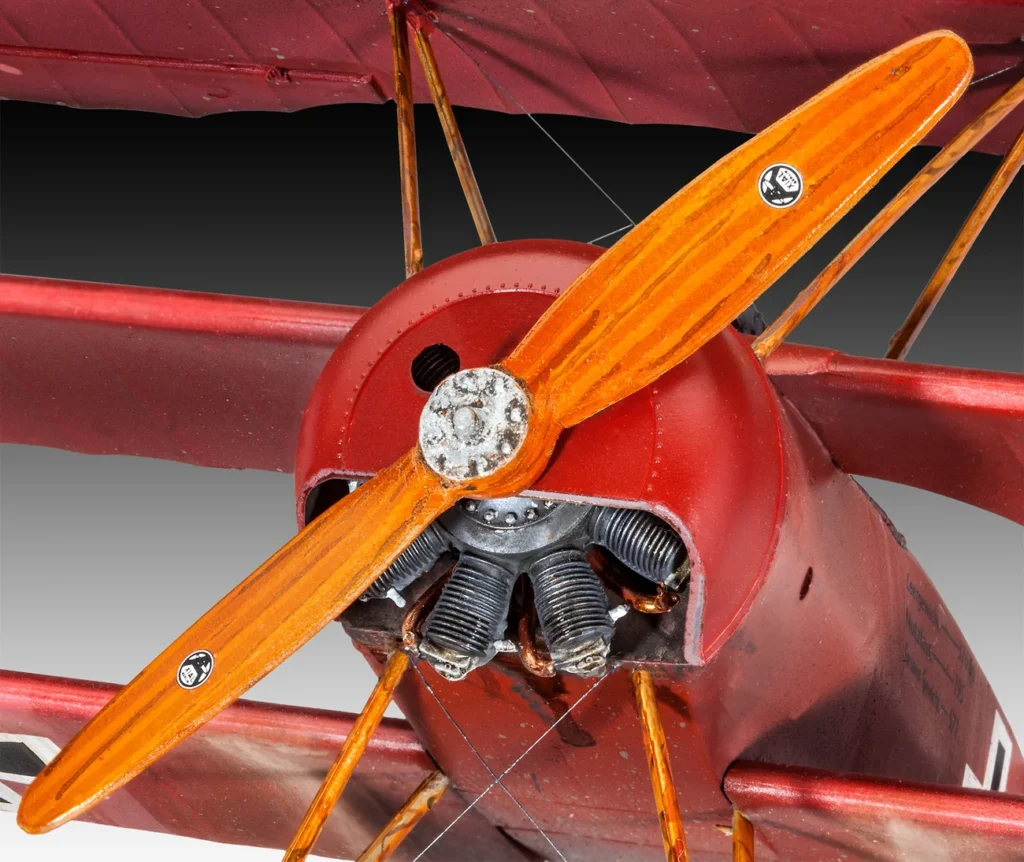
Anyone building the Dr.I should know just how idiosyncratic the original was. Power came from an Oberursel Ur.II rotary engine with 110 hp, a licence-built copy of the French Le Rhône 9J. In engines of this kind the entire cylinder assembly rotates together with the propeller, which produces an enormous gyroscopic effect. Right-hand turns therefore flew completely differently from left-hand turns, and engine speed could hardly be controlled with any finesse, which is why pilots briefly cut the engine on the landing approach using a blip switch. That is exactly where the characteristic stuttering sound of old rotary engines comes from.
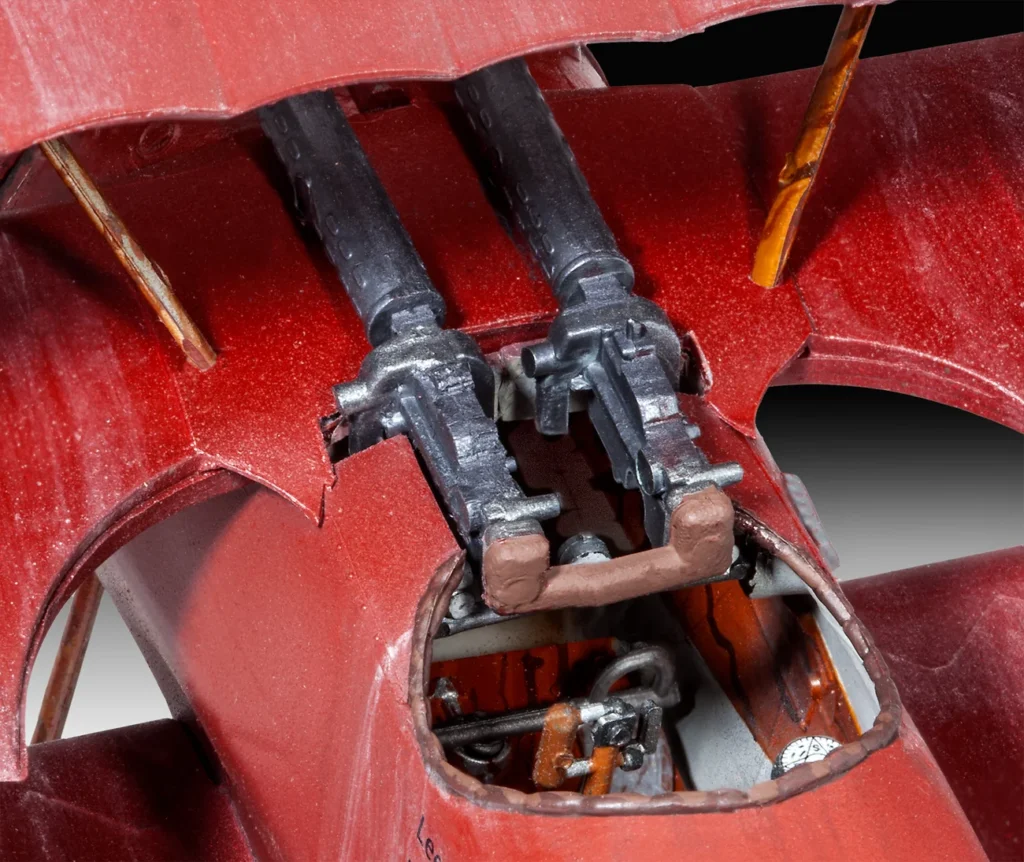
On paper the Dr.I was no high-flyer. Around 165 to 185 kilometres per hour was what it managed, because three wings generate not only lift but also plenty of drag. In return, the machine climbed spectacularly and turned in the tightest of spaces. Visibility forwards and downwards was so poor that experienced pilots flew in constant turns just to see anything at all. Two synchronised LMG 08/15 machine guns sat directly in front of the cockpit, and behind the pilot’s back there was nothing but plywood and fabric.
The type’s career also began with a setback. In the autumn of 1917 the upper wings failed on several machines, and among others the balloon specialist Heinrich Gontermann was killed. The fleet was grounded, spars and ribs were strengthened and production was reworked before the type was allowed back to the front at the end of 1917. That too is part of this aircraft’s story, and it explains why its actual operational service lasted only a few months.
Werner Voss and the most famous solo fight of the air war
Perhaps the most impressive episode belongs not to Richthofen, but to Werner Voss. The twenty-year-old commander of Jagdstaffel 10 flew the pre-production machine 103/17 and scored a whole series of aerial victories with it within a few weeks. On 23 September 1917 he ran into a flight of the British 56 Squadron over Flanders, led by James McCudden, and took on seven experienced opponents in their S.E.5as single-handed. The fight lasted around ten minutes, Voss hit almost every enemy machine and flew manoeuvres his opponents had thought impossible. In the end he was shot down and killed. McCudden later called him the bravest German airman he had ever seen fight, and that verdict from an opponent says more about the triplane’s reputation than any statistic.
Manfred von Richthofen and the 425/17
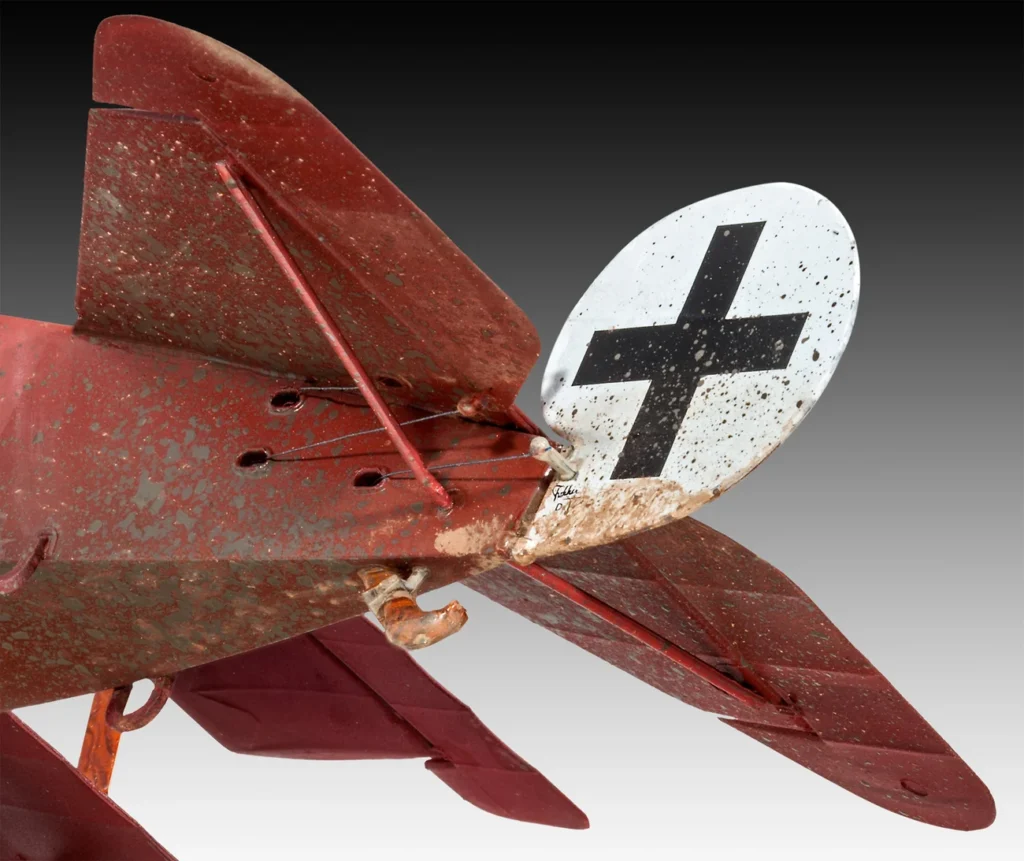
The man who made the aircraft immortal was, of course, Manfred von Richthofen. He was already flying the pre-production machine 102/17 at the beginning of September 1917 and had immediate success with it, he recommended re-equipping the fighter squadrons quickly, and he scored his last 17 aerial victories on the triplane. On 21 April 1918 he took off in the all-red Dr.I 425/17 for his final flight and was fatally hit by a single bullet over the Somme. Whether the Canadian pilot Roy Brown or Australian machine gunners on the ground fired the decisive shot is still disputed by historians today, and conclusive proof is missing. The fact that the death of the most successful fighter pilot of all, with 80 confirmed victories, happened in this of all aircraft finally cemented the myth. So if you want to paint yours in red, you are building the best-known aircraft of an entire era, and here is the kit to go with it: Fokker Triplane DR.1 in the shop.
Incidentally, the red paint was not one man’s quirk. Many machines in Richthofen’s fighter wing wore bright recognition colours, and the nickname Red Baron only really caught on after his death, above all on the Allied side.
Snoopy, cinema and console: the triplane in pop culture
Hardly any other aircraft has had a second life like this. The best-known case is probably a beagle, because since October 1965 Snoopy has been fighting the Red Baron in his triplane from the roof of his doghouse as a First World War flying ace in Charles Schulz’s Peanuts. The Royal Guardsmen turned that into a chart hit in 1966, and in their Christmas song the dog and the Baron even make peace. For many people this comic strip was their first and for a long time only contact with the aviation of the First World War, and in the 2015 feature film The Peanuts Movie the red triplane even chases around the Eiffel Tower.
Serious cinema has helped itself too. In The Blue Max from 1966 Richthofen appears as a supporting character, in 1971 Roger Corman devoted an entire film to the duel between Richthofen and Brown, and in 2008 The Red Baron told the story once again as a major German production. On top of that come books, comics and games, from the flight simulator Red Baron of 1990 through to Snoopy vs. the Red Baron on the PlayStation. So when you later put the model on the shelf, you are not just putting an aircraft there, but a pop culture icon.
Our kit from 1957: model making as a document of its time
Now for the second historical part of this set. The moulds date from 1957, and you can see it in the kit. 60 parts, surface detail in the style of the early years and a sprue created without any CAD design. Modelling forums still discuss to this day that the drawings used at the time were based on a captured machine, which is why individual details such as the ailerons are a better match for the early production aircraft. For us that is exactly the appeal, because this kit preserves not only the aircraft of 1917, but also the technical state of our own industry in 1957.
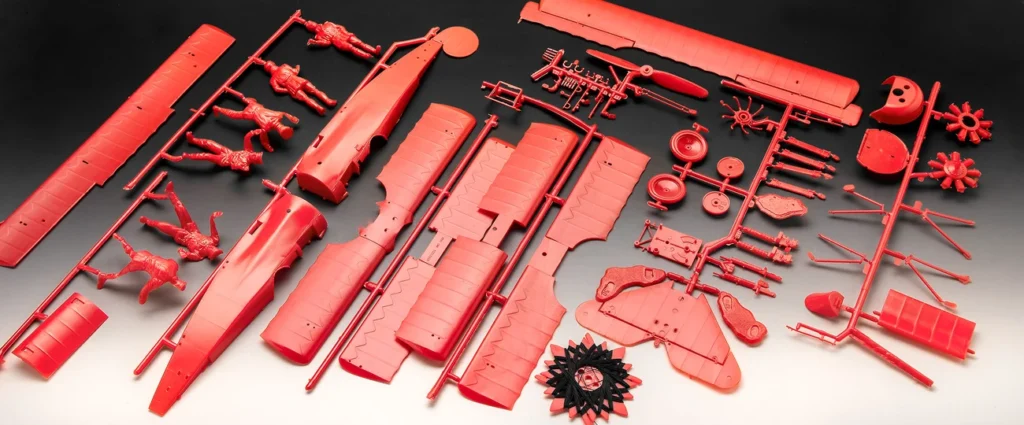
In practice that means: expect a certain amount of flash, dry-fit the parts before glue comes into play, and allow time for sanding the seams. The Level 4 rating is meant seriously. If you like, you can detail the spartan cockpit with plastic strip and wire, replace the rigging wires with nylon thread and give the fabric covering some depth with oil paints. At over 26 centimetres wingspan, the large scale offers plenty of surface for that, and it is precisely this scale that sets the model apart on the shelf from the usual kits in 1:72 and 1:48.
The package contains the unassembled plastic model kit from the historic moulds of 1957, illustrated multilingual assembly instructions and a decal sheet. The finished model will have a wingspan of 26 cm.
Since the edition is strictly limited, it pays to be quick: Fokker Triplane DR.1 now in the Revell shop.
Build inspiration
Here is a historical look at the triplane:
and here is some footage from an airshow