
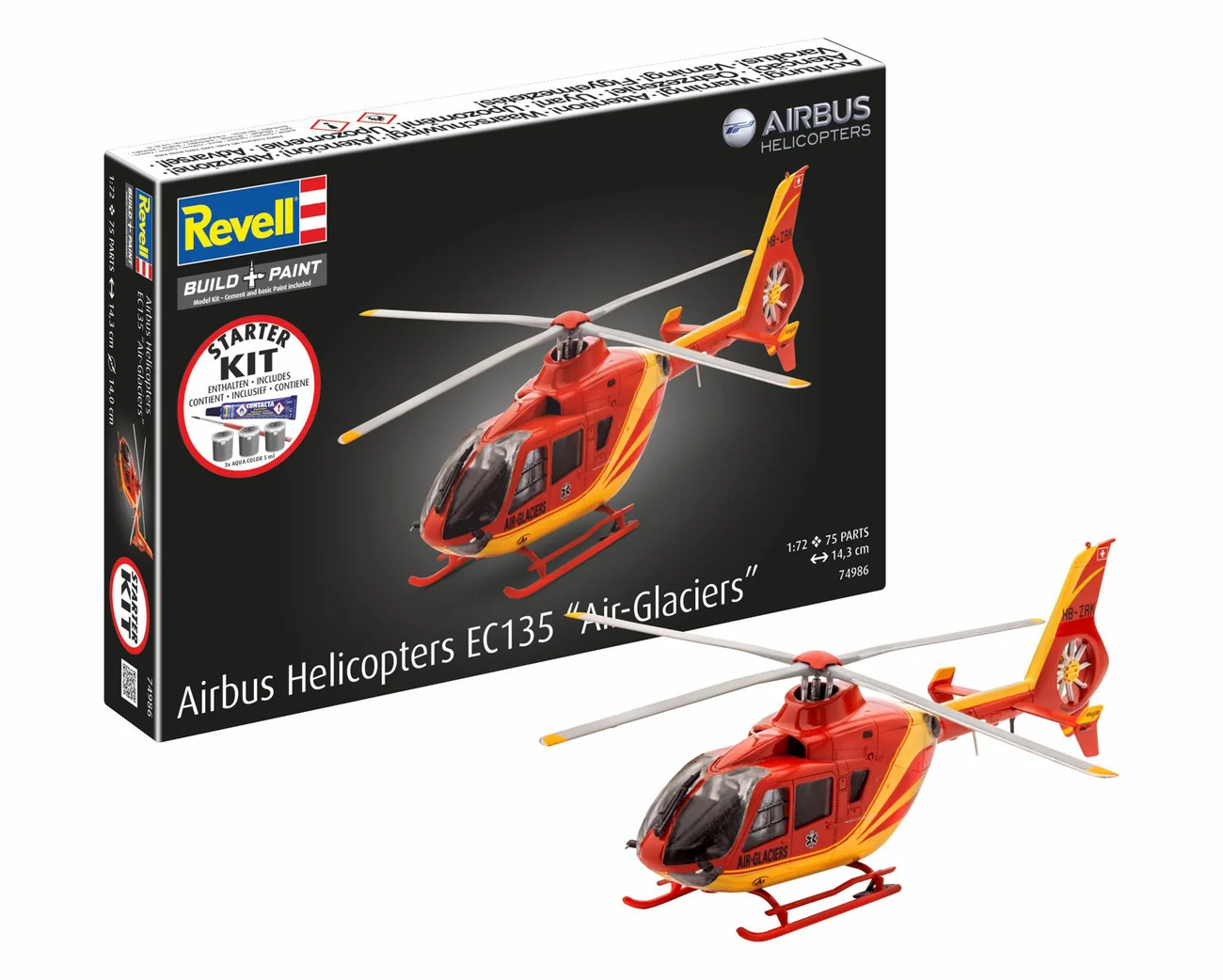
There are kits you build because the shape is beautiful. And there are kits you build because there is a story behind the original that you still want to keep telling after the last decal. Our Starter Kit of the Airbus Helicopters EC135 in the colors of Air-Glaciers clearly belongs to the second category. You are not building just any helicopter here, but one very specific machine with a biography of its own, operated by a company that helped invent mountain rescue in the Alps. If you want to get started right away, you will find the set here: Starter Kit Airbus Helicopters EC135 “Air-Glaciers” in the Revell shop.
From mountain guide to rescue pioneer: how Air-Glaciers came about
The story begins in 1963 with a tragedy. The mountain guide Bruno Bagnoud from Valais lost a friend after a fall, because the glacier pilot Hermann Geiger, who had been called to the scene, simply could not land with the machine he had at the time. Geiger then explained to Bagnoud what the problem was: a more powerful, turbine powered helicopter of the Alouette III type cost 1.5 million Swiss francs, and that money was not there. Bagnoud therefore borrowed 600,000 francs from a regional bank, the manufacturer Sud Aviation agreed to payment in installments, and in August 1965 the first Alouette III with the registration HB-XCB stood in Sion.
On 1 August 1965 Bagnoud, Hermann Geiger and Fernand Martignoni jointly founded Air-Glaciers. The beginning was hard and tragic at the same time. Geiger, internationally known as the glacier pilot and as the flying St. Bernard, died as early as August 1966 in a flying accident at Sion airfield, when his Piper collided with a landing glider during take off. Martignoni lost his life in 1982. Bagnoud went on to run the company alone for almost four decades, built up bases in Lauterbrunnen, Collombey, Leysin, Saanen, Gampel and La Chaux-de-Fonds and remained at the top until 2020. He died in October 2022 at the age of 87. In May 2025 Air-Glaciers celebrated its 60th birthday in Sion with around 7,000 visitors, and the very first Alouette III from 1965 is still there today.
So when you put this model in your display case, a piece of Swiss rescue history is standing there. Air rescue in the Alpine region as we know it today grew out of exactly this mixture of stubbornness, bank loans and personal loss.
From the BO 108 to the EC135: a German prototype becomes a global bestseller
The subject of our kit has a similarly headstrong background. In the 1980s Messerschmitt-Bölkow-Blohm in Ottobrunn developed the technology demonstrator BO 108, intended as the successor to the legendary BO 105. The first prototype flew on 17 October 1988, a second followed in June 1991. On board was technology that was new for helicopters at the time, among other things the first fully automatic digital engine control FADEC and a hingeless main rotor.
When MBB was absorbed into the newly founded Eurocopter group, the company brought the project along with it. And then what happened is the very thing modelers still recognize on this machine immediately: the French side of the group contributed the shrouded tail rotor, the Fenestron. Apparently this happened against considerable resistance from the engineers in Ottobrunn, who already had their BO 108 ready to fly and feared complications. The Fenestron prevailed nonetheless, and on 15 February 1994 the modified BO 108 A1 lifted off in Ottobrunn as the first machine of the new EC135 series.
In 1996 series production started up in Donauwörth, and the first production machine went to German air rescue. After that things went steeply uphill. In 2011 the thousandth EC135 rolled out of the hall, and by September 2020 around 1,400 units had been delivered to some 300 operators in 60 countries, with more than five million flight hours on the clock between them. Roughly half of them fly in Europe, and a very large share works in air rescue. Today the type continues under the designation H135. Along the way the airframe repeatedly served as a flying laboratory, for example as a research helicopter with fiber optic based flight controls or as the Bluecopter demonstrator for quieter and more economical rotor technology.
The Fenestron is the heart of the model
For the build it is worth understanding why this round hole in the vertical tail is so important. A classic tail rotor is a freely spinning blade at head height. In rescue operations on a meadow, a forecourt or a narrow ledge in the mountains, that is precisely the greatest risk for everyone approaching the machine. The shrouded Fenestron turns protected inside its housing, cannot injure bystanders and also takes no damage from brushing against undergrowth. On top of that comes the considerably lower noise level.
On the model, the Fenestron is the part on which your finished helicopter either wins or loses. If you fancy a little extra work, you can sand the inside of the duct smooth, thin the edge down very slightly and add detail around the rotor with Evergreen strip and stretched sprue.
HB-ZRK: the biography of a single machine
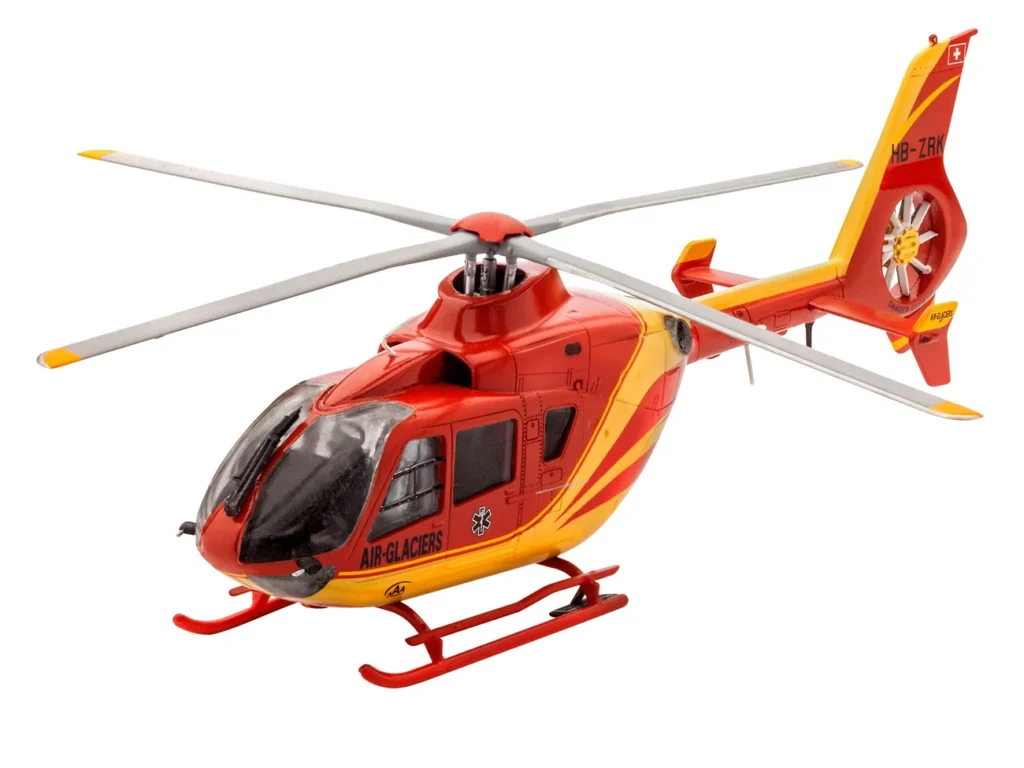
The decal sheet gives you not just any EC135, but HB-ZRK as it looked in 2015. And this machine has an astonishing career behind it. It was built in 1997 with the serial number 0027, in other words as a very early EC135 T1 from the first years of production. It spent its first life as D-HRHM in German air rescue, after which it flew as OE-XXR with an Austrian operator.
On 16 October 2014 it was entered on the Swiss register, a few days later it came into the country via Bern, and at the end of October 2014 it flew its first mission out of Lauterbrunnen. The background to this is very pragmatically Swiss, incidentally: a change in aviation regulations required twin engine helicopters in air rescue, and Air-Glaciers, which until then had mainly been operating single engine Lama and Alouette III helicopters, covered the requirement with used EC135s from Austria.
In Switzerland HB-ZRK was given a nickname that suits a small, tough machine in the high mountains wonderfully well: Asterix. The markings changed over the years, and around 2021 white titles and a rescue hoist were added. In 2024 it was replaced at Lauterbrunnen by a more modern EC135 T3 with better high altitude performance, modern navigation, night vision equipment and a searchlight. In May 2025 HB-ZRK was deleted from the Swiss register and has been flying in Austria again ever since. So you are building a state that no longer exists in this form, and that is exactly what makes the model exciting for a display case. You can get the kit for it here: Starter Kit EC135 “Air-Glaciers” in the Revell shop.
Lauterbrunnen, Piz Gloria and a touch of James Bond
The home base of our machine lies in the Lauterbrunnen valley, and therefore directly below one of the most famous film mountains in the world. Between October 1968 and May 1969 the James Bond film “On Her Majesty’s Secret Service” was shot on the Schilthorn, and the revolving restaurant has been called Piz Gloria ever since. For the helicopter attack in the film, Bell 204s belonging to Heliswiss were used at the time, and one of them additionally had to be chartered from Norway.
The connection to Air-Glaciers came later. In the Bond World 007 exhibition, which opened on the Schilthorn in 2013, there is a helicopter simulator, and its shell is the original airframe of a retired Alouette III of Air-Glaciers, which made its very last flight up to the summit. Anyone who sits down in that cockpit and flies the approach to Piz Gloria is sitting in a genuine piece of company history. For a diorama that is an appealing idea: an EC135 on approach to a rock plateau, with the wall of the Bernese Alps in the background.
The EC135 on television, in the cinema and in simulation
Hardly any modern helicopter is as present in German speaking countries as the EC135. In the Sat.1 action series “HeliCops”, the second EC135 prototype with the registration D-HECY even flew in front of the camera at first, partly flown by factory pilots and supplemented by computer animation. For the second season that machine was no longer available, and another EC135 took over the job. In the series “Die Rettungsflieger” the rescue helicopter is likewise an EC135, and in “Die Bergretter” too the type is part of the regular cast.
Behind the camera the EC135 is in action at least as often, namely as a camera platform with a stabilized Cineflex camera on a mount under the nose. Car chases that look as if they were filmed from just a few meters up are very often created exactly like this. And because prominence and practicality are not mutually exclusive, an EC135 carried Franz Beckenbauer from stadium to stadium during the 2006 football World Cup.
On screen the story continues. In Microsoft Flight Simulator the H135 by Hype Performance Group is one of the best known helicopter add ons of all, and the community has meanwhile built countless liveries for it, from air rescue and police through to Swiss operators. If you build the model and then fly the same machine virtually, you get a surprisingly complete overall picture of the equipment, the instrumentation and the visibility from the cockpit.
What awaits you on the workbench
Our 1:72 tooling of the EC135 has been with us since 2001 and has appeared over the years in a whole range of versions, from air rescue through civilian operators to the military EC635. The Air-Glaciers version benefits from this, because it also contains the sprue with the cargo hook, the external mirrors and further small parts. In total there are 75 parts, spread over several sprues plus a clear frame for the canopy and windows.
There are three things you should plan for right from the start. First the ballast weight. The assembly instructions call for weight in the nose, and there is a good reason for that, because otherwise the model will sit back on its tail. Space is tight, so it has proven worthwhile to distribute the weight, in other words some of it under the forward cabin floor and additionally fine lead shot in the instrument console. Anyone who only notices this after closing up the fuselage will be annoyed for a long time.
Second the glazing. The large, strongly curved windscreen is the most demanding spot on the kit. Dry fit it, sand carefully, work with as little glue as possible and use a canopy glue that does not fog. If you mask the glazing cleanly before painting, you will save yourself a great deal of rework afterwards.
Third the markings. The red and yellow Air-Glaciers paint scheme is the actual reason why this kit is rated Level 4. You should plan the color demarcations, mask cleanly and give the decals time to settle over the curves.
If you want to display the cabin open, you can quickly upgrade the rescue equipment included in the kit with belts made from lead foil and a few handles made from wire. After that the movable main rotor makes sure the finished model does not look static.
The kit at a glance
The set is designed so that you can start straight away, because Aqua Color base paints, a brush and the Revell Contacta plastic tube glue are already included. You do not need a stop at the hobby shop in between, which also makes this set interesting as a gift for getting started in modeling.
The scale is 1:72, the age recommendation is 12 years, there are 75 individual parts to build, and the finished helicopter measures around 14 centimeters. The kit includes a detailed cockpit with instrument panel, a worked out interior, the precisely reproduced Fenestron tail rotor, the movable main rotor and the decal set for HB-ZRK from the year 2015.
This is what you will find in the box:
- Plastic model kit, not assembled
- Illustrated, multilingual assembly instructions
- Authentic decal set for Air-Glaciers, HB-ZRK
- Brush
- Base paints from the Revell Aqua Color range
- Glue, Revell Contacta plastic tube glue
Conclusion: small model, big story
Fourteen centimeters of plastic, 75 parts, a weekend of work. And yet at the end there is a model on the shelf that tells of a mountain guide who borrowed money in 1963, of a helicopter whose shrouded tail rotor was pushed through against internal resistance, and of a single machine that started out in Germany, went on flying in Austria, saved lives above the Lauterbrunnen valley for eleven years and is on the move in Austria again today. That is exactly why we build models.
Start your rescue mission and get the set here: Starter Kit Airbus Helicopters EC135 “Air-Glaciers”.
Inspiration for your build
Here you can see some footage of HB-ZRK in action