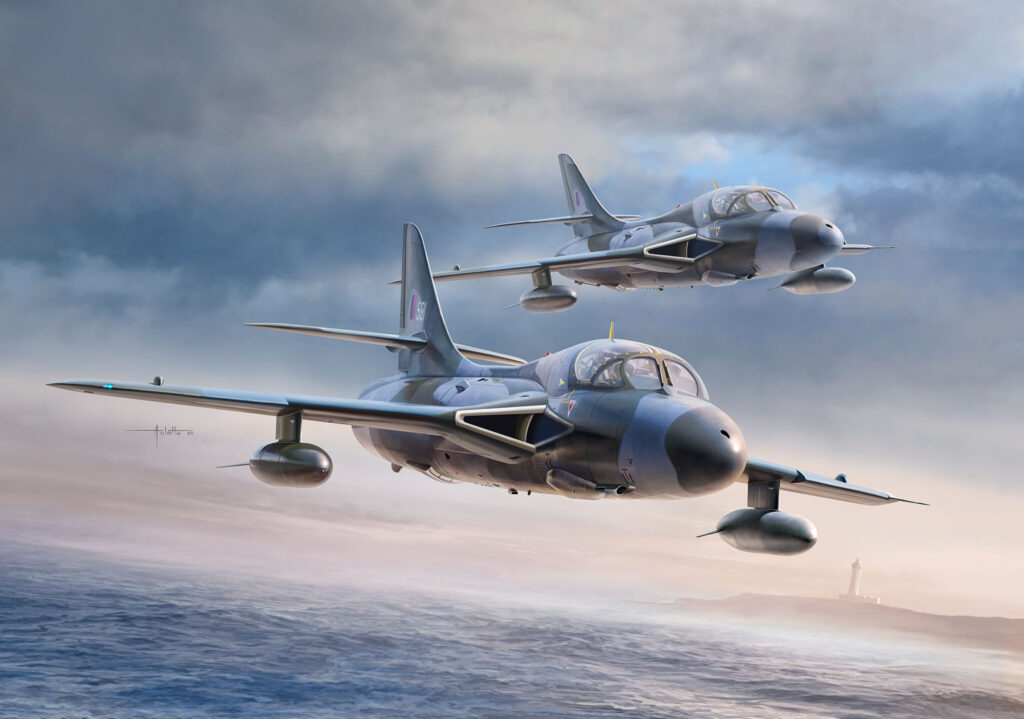
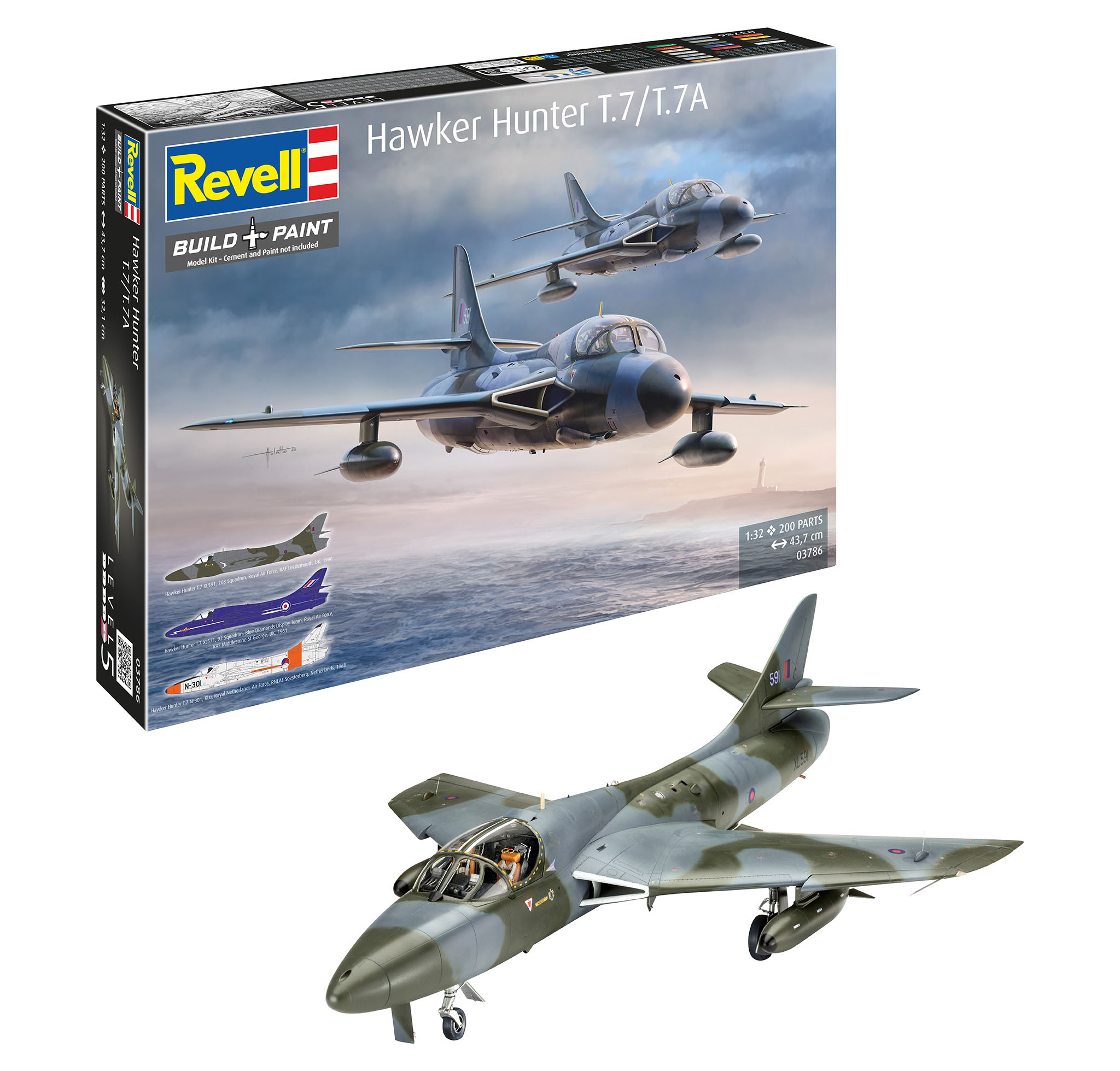
There are aircraft you recognise instantly, and there are aircraft you like instantly. The Hawker Hunter is one of those rare machines that manages both. Sydney Camm’s sleek swept-wing jet from the early 1950s is still regarded as one of the most beautiful combat aircraft ever built in Britain. But while the single-seat fighter grabbed the headlines, it was an entirely different version that taught Hunter pilots how to fly it in the first place: the two-seat T.7. That is exactly the trainer we are now bringing to your workbench in the big 1:32 scale.
View the Hawker Hunter T.7/T.7A in the Revell Shop
Why the Hunter needed a two-seater
To understand why the T.7 mattered so much, you have to go back to the beginning for a moment. By the end of the 1940s the RAF had a problem. Its first jets, the Gloster Meteor and the de Havilland Vampire, were no longer a match for the new generation of Soviet types with their straight wings. Hawker answered with the P.1067 project, a cleanly drawn swept-wing aircraft built around the then new Rolls-Royce Avon engine. Neville Duke took the prototype up on its maiden flight on 20 July 1951, and in 1953 a modified Hunter set an absolute world speed record. Almost 2,000 machines were built in total, serving with more than twenty air forces.
For young pilots, however, moving from a Meteor or a Vampire onto this considerably faster and considerably more demanding aircraft was an enormous leap. An ejection seat and a manual were not enough. What was needed was a trainer that felt exactly like the real thing, because it was the real thing, simply with a second seat and a second set of controls.
Side by side instead of in tandem: a decision made by the instructors
Hawker began work on a two-seat variant in 1953, initially as a private venture. Two concepts were on the drawing board. A tandem version would have been easier to build and aerodynamically cleaner. A version with side-by-side seating was more complicated, because it required a completely new and wider forward fuselage.
In the end the decision was not made by the designers but by the instructors. The Central Flying School and the Day Fighter Leaders’ School came out clearly in favour of the side-by-side arrangement, because it allowed the instructor to show the student directly which lever to operate and when, how a target is sighted and what matters in instrument flying. Specification T.157D was issued in 1954 and Hawker built a prototype. That single decision is the reason your T.7 gets that unmistakable wide nose, which sets it apart from any single-seat Hunter at a glance.
The hump that solved a flight problem
The prototype XJ615 flew for the first time on 8 July 1955, and it was immediately apparent that the new canopy was seriously disturbing the aerodynamics. From around Mach 0.84 the airflow began to turn unstable, and at Mach 0.88 the aircraft started to snake and pitch. On the single-seater the fairing behind the canopy is short and narrow and ends almost at the wing root. For the T.7 that did not work.
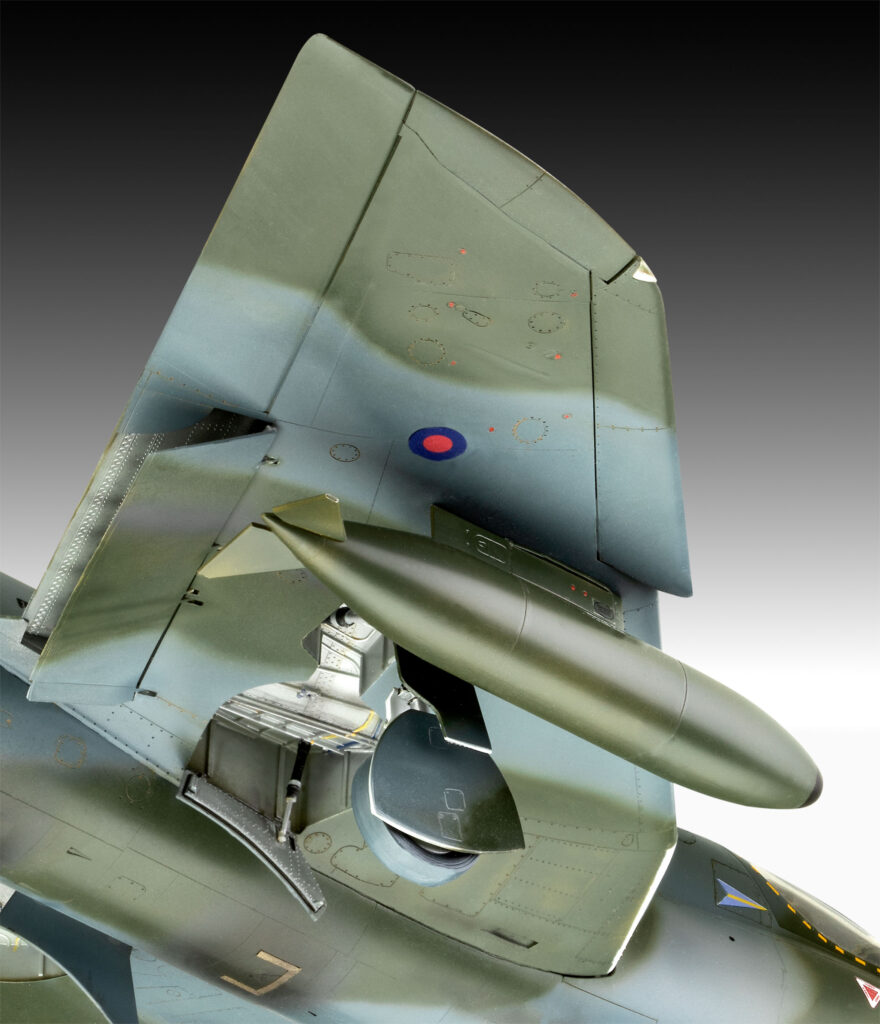
Hawker went on to test more than twenty different versions of this fairing until the solution was found: a far larger, hump-backed spine that extends more than halfway along the fuselage. That put an end to the snaking and pitching. So what many modellers take for a purely stylistic feature is in fact the visible result of a genuine flight test problem. Build the T.7 and you are building a piece of solved aerodynamics along with it.
The armament was adjusted along the way as well. The prototype initially carried two 30 mm ADEN cannon, while only one remained on production aircraft. That is another detail you can pay attention to when painting, because the asymmetric arrangement stands out as soon as the finished model is on the shelf.
From the 1955 maiden flight into everyday RAF service
The original order covered 55 aircraft, which were to be built at Blackpool. Following the British defence cuts of 1957 there was spare capacity at the Kingston plant, so production moved there. 45 T.7s were built for the RAF, the first of them flying on 11 October 1957. The remaining ten airframes went to the Admiralty and became the first T.8s for the Royal Navy. Six further aircraft were created by converting existing F.4s.
From 1958 the T.7 went to 229 Operational Conversion Unit at Chivenor, and after that it was issued in small numbers to practically every Hunter unit, in Britain as well as with the 2nd Tactical Air Force in Germany. Many squadrons kept a single example for conversion work, instrument rating checks and everyday continuation training. In 1967 4 Flying Training School at Valley on Anglesey was added, where the T.7 was used in advanced pilot training. That era only came to an end with the introduction of the BAe Hawk.
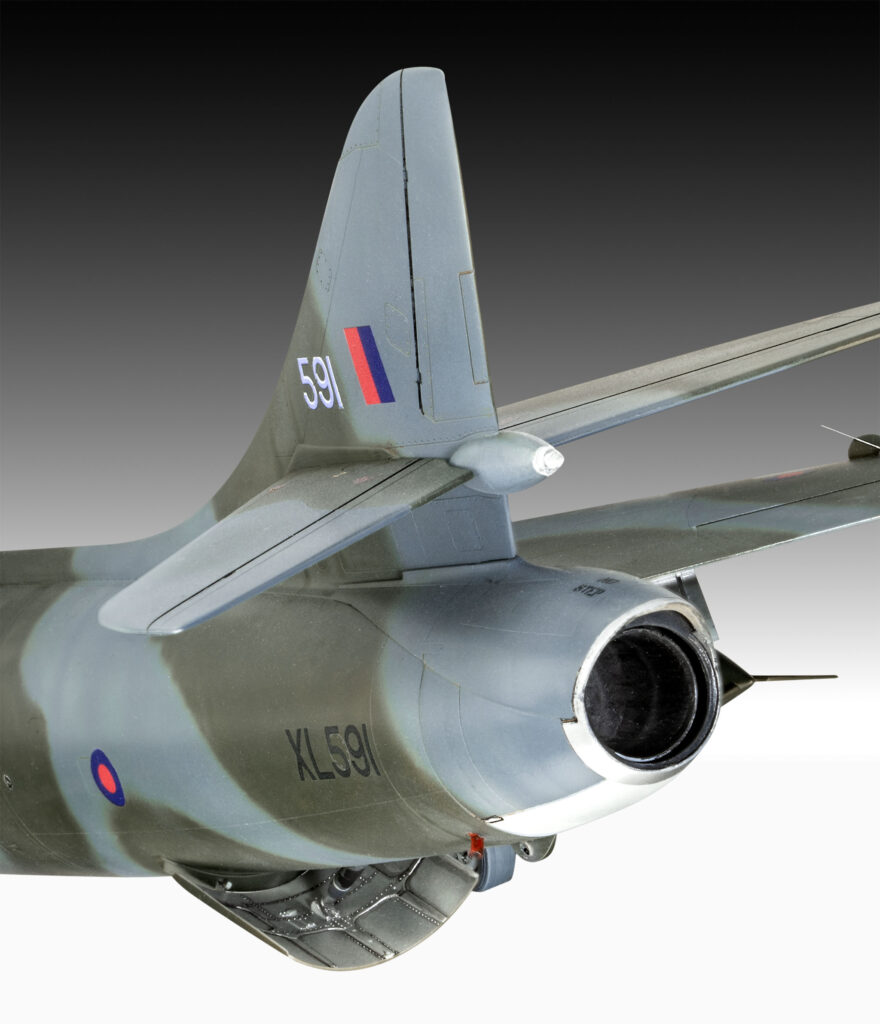
The T.7A writes a chapter of its own. On these aircraft part of the instrumentation was replaced with Buccaneer instruments, together with the Integrated Flight Instrumentation System. They were used to train prospective Buccaneer crews at Lossiemouth before they moved on to the heavy low-level striker. A training jet that prepared pilots for a completely different aircraft is an unusual role even by the standards of aviation history.
To the Hawker Hunter T.7/T.7A kit in 1:32
The T.7 with the Koninklijke Luchtmacht
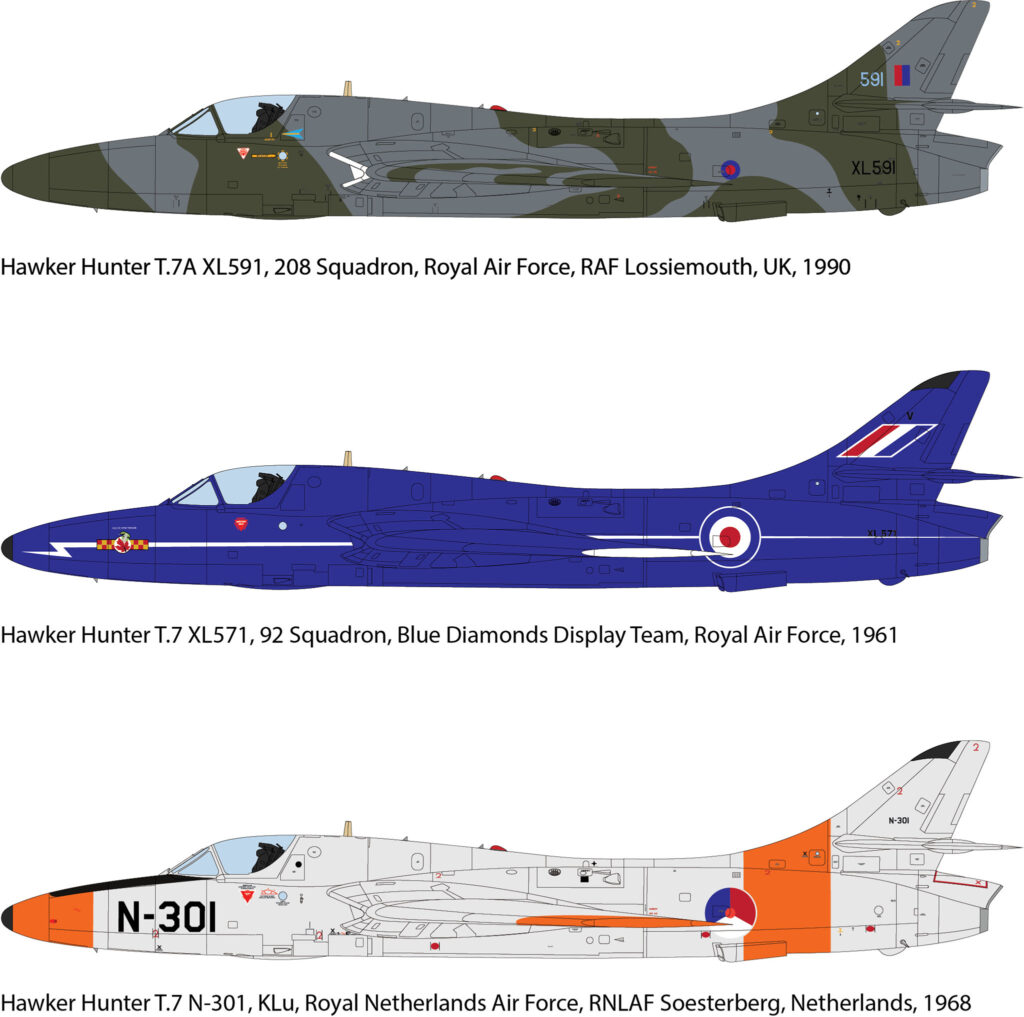
The Royal Netherlands Air Force ordered twenty T.7s directly from England, delivered in 1958 and 1959. They carried the serials N-301 to N-320 and flew with 322, 323, 324, 325, 326 and 327 Squadron as well as with the Jachtvliegschool, operating from Soesterberg, Leeuwarden and Twenthe. 324 Squadron took on the task of converting every Dutch Hunter pilot from the Gloster Meteor onto the Hunter.
325 Squadron was the last operator. On 27 August 1968 it ferried two aircraft back to England, which brought the story of the T.7 in Dutch service to an end. Two examples had already begun a second life in 1964, however, when the Nationaal Lucht- en Ruimtevaartlaboratorium bought them for research purposes. One of them remained in use until 1980, and N-312 flew with various nose sections over the course of its career. Anyone who hears a Hunter in aluminium with dayglo panels thunder overhead in the Netherlands today is witnessing the work of the Dutch Hawker Hunter Foundation at Leeuwarden, which deliberately keeps that colour scheme alive.
Forty minutes from London to Paris
The finest anecdote surrounding the T.7 comes from the summer of 1959. To mark the fiftieth anniversary of Louis Blériot’s Channel crossing, the Daily Mail announced a race between Marble Arch in London and the Arc de Triomphe in Paris. More than 10,000 pounds in prize money was on offer, and within a few weeks well over a hundred attempts were made using anything that moved: motorcycles, cars, helicopters, speedboats, amphibians.
The winner was Squadron Leader Charles Maughan of the RAF with a time of 40 minutes and 44 seconds. His chain of legs consisted of a police motorcycle to the Thames at Chelsea, a Bristol Sycamore helicopter to Biggin Hill, a two-seat Hunter to Villacoublay, another helicopter to Issy and a final motorcycle dash to the Arc de Triomphe. So the fastest man in the race was sitting in a training aircraft of all things. A second seat made it possible to take a navigator along, allowing the pilot to concentrate fully on the clock.
Black Arrows, Blue Diamonds and a bridge in London
The Hunter also defined the golden age of British formation aerobatic teams. The jet-black aircraft of 111 Squadron, known as the Black Arrows, flew a loop with 22 Hunters in a single formation at Farnborough in 1958. That record still stands today. When the squadron re-equipped with the Lightning, 92 Squadron took over with sixteen brightly blue Hunters as the Blue Diamonds. A surviving T.7 at the Yorkshire Air Museum wears exactly that blue and commemorates the team’s lead aircraft.
And then there is 5 April 1968. Annoyed that no formation flight over London had been planned for the fiftieth birthday of the RAF, Flight Lieutenant Alan Pollock broke away from his formation, circled the Houses of Parliament three times and then flew his Hunter FGA.9 through the span of Tower Bridge. He was the first person ever to do so in a jet. He was spared a court martial, but his RAF career ended nonetheless. Hardly any other story captures so well the emotions this aircraft has stirred up.
On screen the Hunter had its strongest appearance early on. The British feature film High Flight from 1957 follows flying cadets through their training at Cranwell, and in the final third the stage belongs to the Hunter formations. For a kit that tells the story of precisely those training years, that is a fitting connection. Later the aircraft became mainly the subject of documentaries, such as the 2014 production The Hawker Hunter or the episode of the series Air Warriors from 2023, which covers Pollock’s flight through Tower Bridge among other things. Anyone who wants to see the Hunter in motion today is most likely to find it at European airshows in the hands of private operators and foundations.
What this means for your workbench
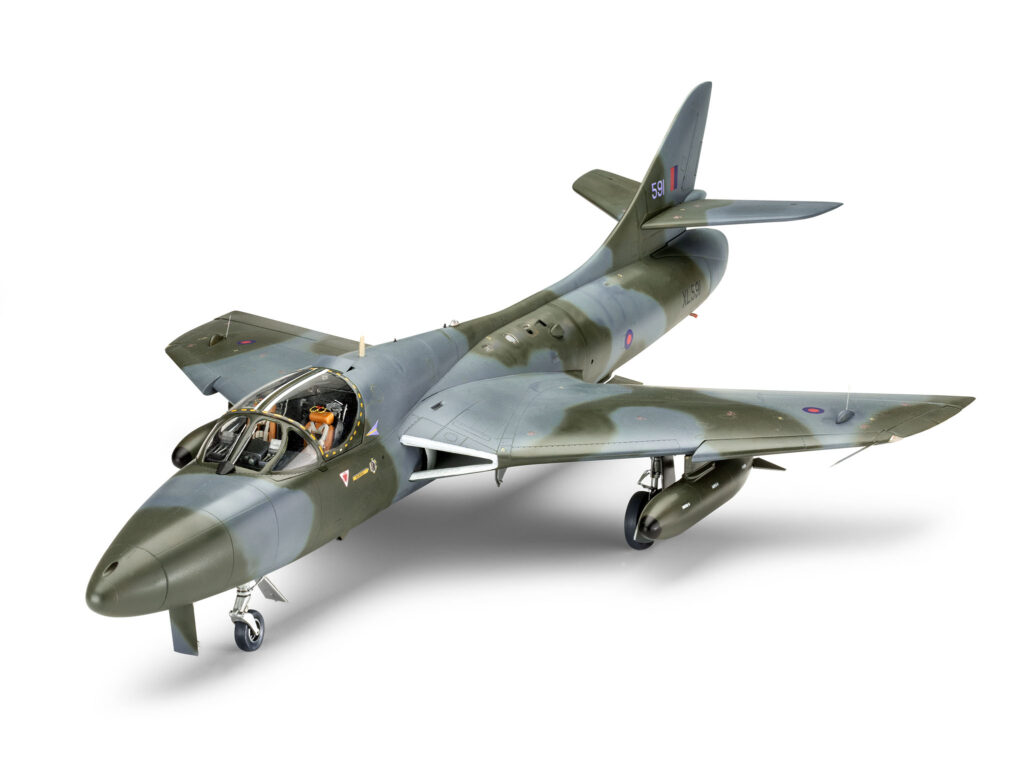
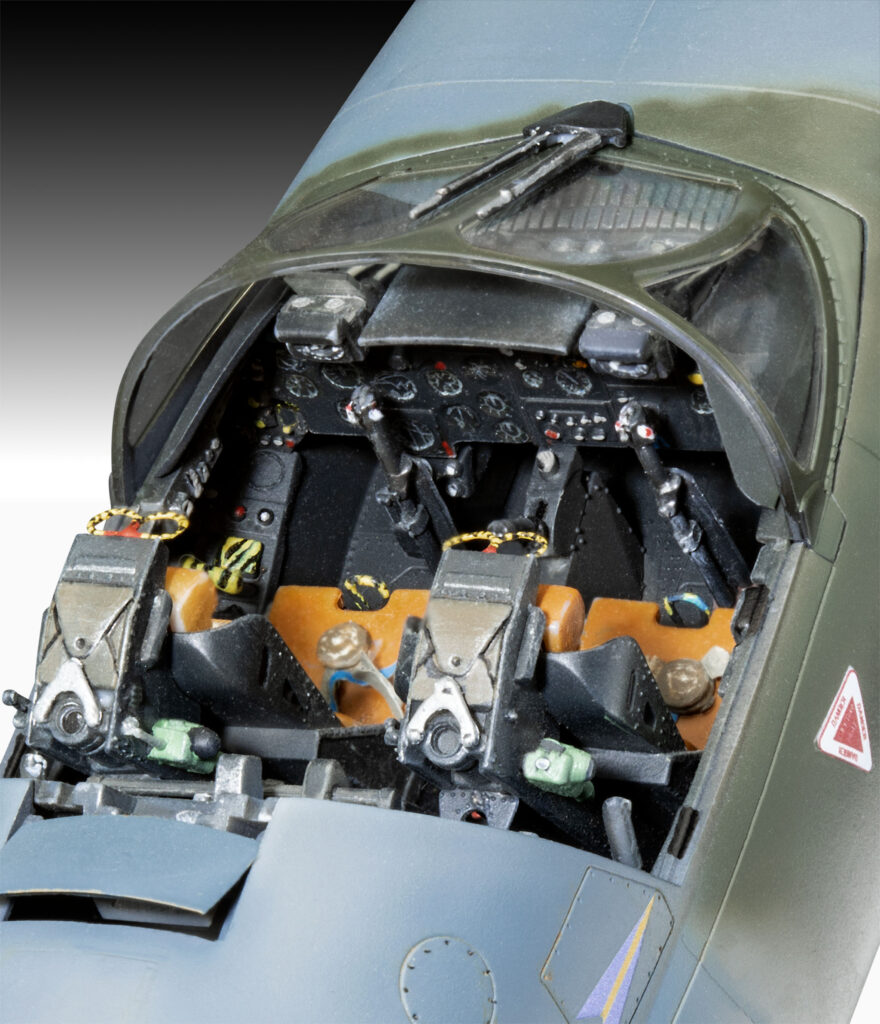
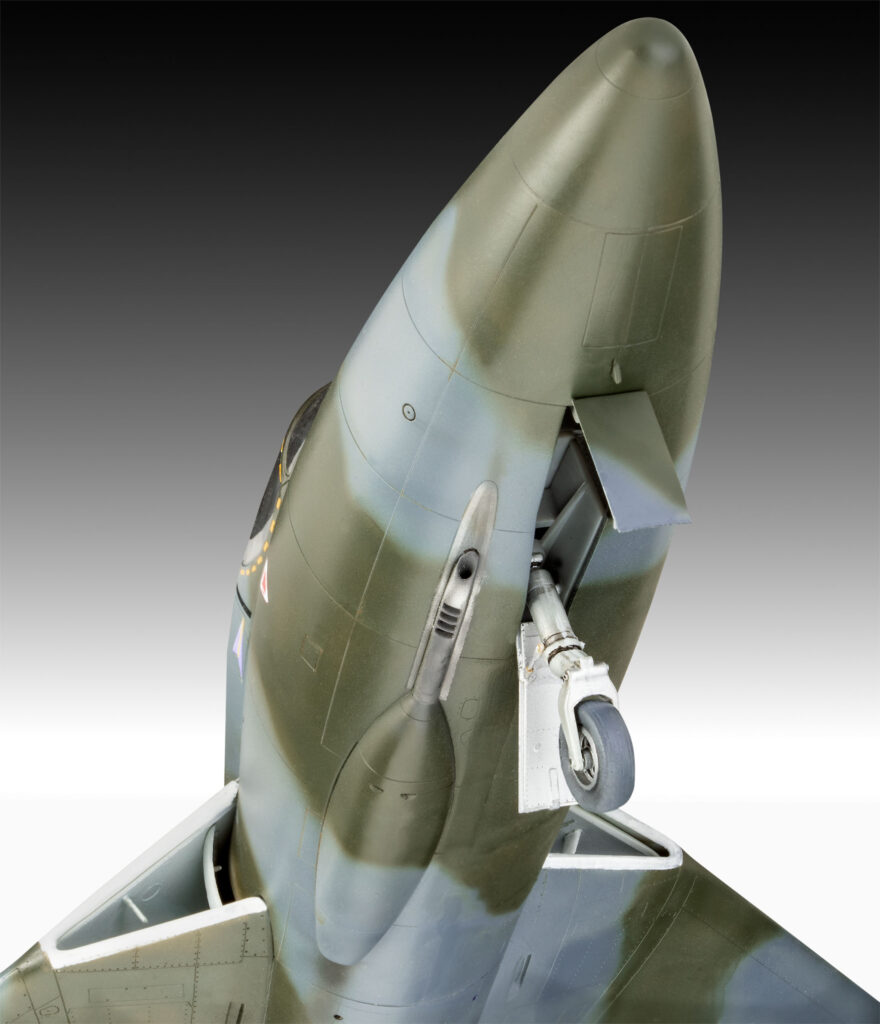
For us the T.7 was a long-standing gap in the range, and we have realised it using state of the art 3D scanning technology. The completely new forward fuselage with its authentic two-seat configuration is the centrepiece, because this is exactly where the character of this aircraft lies. The highly detailed twin cockpit with precise instrument panels and realistic seats comes into its own beneath crystal clear glazing, which makes a real difference in 1:32 in particular. The surface detail was likewise taken from the original by scan.
The well thought out breakdown of the parts ensures smooth assembly and allows for straightforward base painting before you move on to detailing and finish. The decal sheet covers aircraft of the RAF as well as of the Royal Netherlands Air Force, so you have the choice between a British training jet and a machine from Leeuwarden or Twenthe.
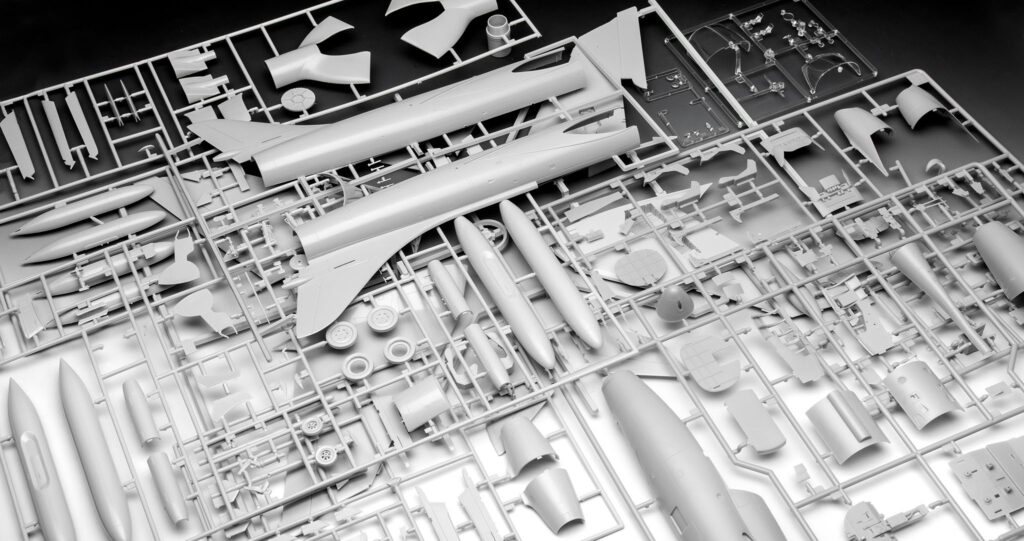
The kit in numbers
The Hawker Hunter T.7/T.7A is released in 1:32 scale and consists of 185 individual parts. It is recommended from 13 years and up. In the box you will find the plastic model kit, multilingual illustrated assembly instructions with paint references and a high quality decal sheet for several versions. The item number is 037869090.
An aircraft that trained an entire generation of RAF pilots, a race winner between two capital cities and a witness to what were arguably the most elegant years of British aviation. Bring this piece of history to your workbench.
Order the Hawker Hunter T.7/T.7A now in the Revell Shop