
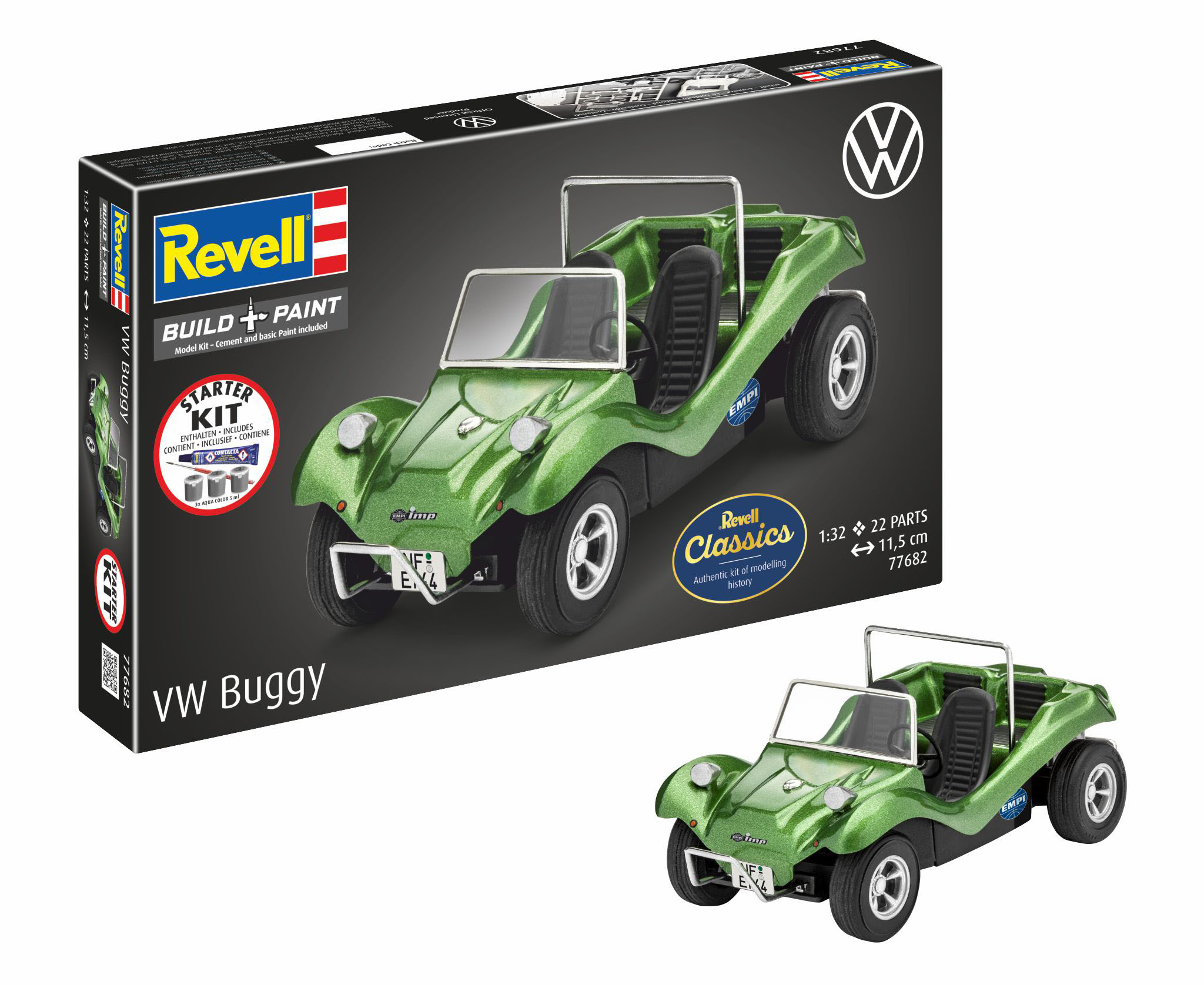
There are vehicles you have to explain, and there are vehicles that trigger a feeling right away. The VW Buggy clearly belongs to the second group. No roof, no doors, fat tyres, a boxer engine in the rear, and behind it a story that begins in a Californian garage and runs through the desert of Baja California all the way into German cinemas and children’s rooms. With our Starter Kit VW Buggy you bring exactly this attitude to life on your workbench in 1:32 scale, and in a format that lends itself perfectly to being a summer project.
Before you reach for the side cutters, it is worth taking a look at the original. Because whoever knows what they are actually building, builds differently. And with the Buggy, the source material is considerably more exciting than the simple silhouette would suggest.
A surfer, a garage, and an idea made of fibreglass
The story begins in the early 1960s in Newport Beach, California. Bruce Meyers was a surfer, artist, and boat builder, and therefore thoroughly familiar with glass-fibre-reinforced plastic. On the beach at Pismo Beach he watched the sand vehicles common at the time, converted Model A and Model T roadsters that were mockingly called water pumpers because of their water-cooled engines. Heavy, crude, inelegant. Meyers was thinking in a different direction.
In 1964 he completed a car in his garage that would later go down in history as Old Red. A hand-laid fibreglass body, set onto the floor pan of a used VW Beetle, together with drivetrain, axles, and engine from the Volkswagen parts bin. Light, agile, dirt cheap to run, and on sand superior to any heavy off-road vehicle. Meyers supposedly reckoned at the time with perhaps twenty examples, just enough for him and his friends to reach the remote coves in Baja with their surfboards.
There turned out to be a few more.
Why the Beetle of all things was the perfect basis
For model makers this technical point is particularly interesting, because it explains the proportions of the vehicle. The Beetle did not have a self-supporting body, but rather a central tube frame with a floor pan onto which the so-called little house was merely bolted. So you could remove the body without the chassis losing its structure. That is exactly what made the Beetle the dream of every small-series manufacturer.
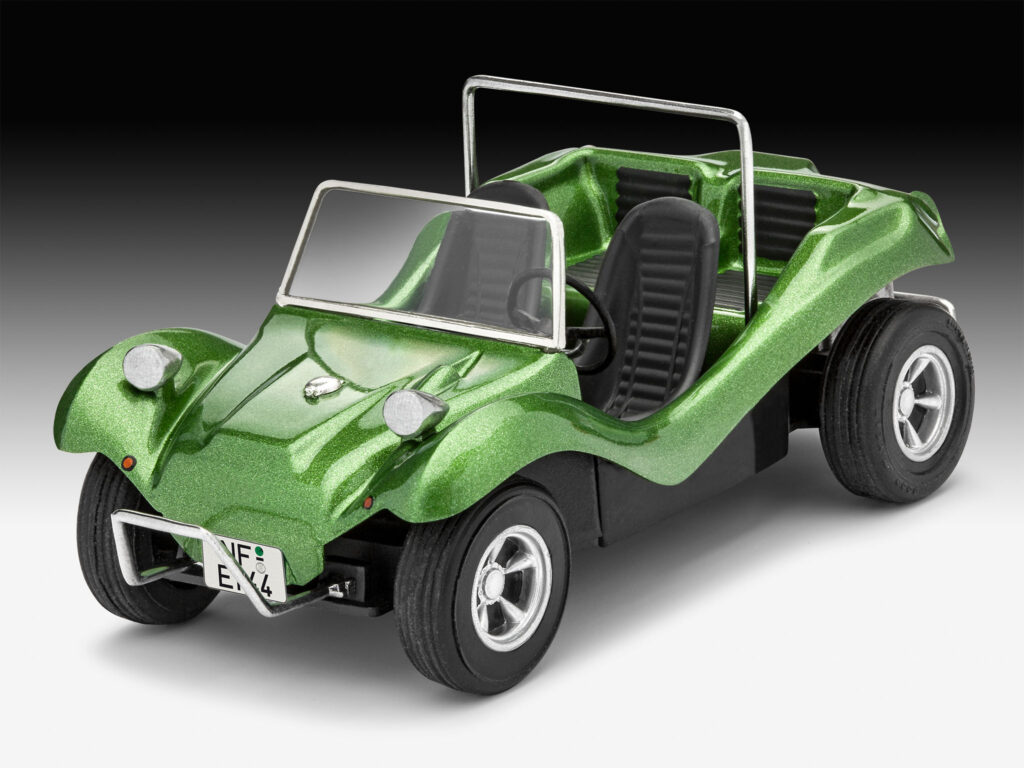
The recipe was as simple as could be. Take a used Beetle, strip it of its sheet-metal shell, shorten the floor pan by thirty to forty centimetres depending on the desired build, weld the remaining pieces back together, and pull a light plastic tub over the top. At the rear came the widest possible rims and correspondingly fat tyres, so that traction on loose ground was right. A top was hardly a concern; most Buggies had at best a makeshift fabric cover to button on. You will see exactly this construction reflected in our model too, from the short wheelbase to the free-standing wheels and the exposed boxer engine in the rear.
Buggy beats motorcycle: the record run that founded a racing series
The real breakthrough came not on the beach, but in the desert. In April 1967 Bruce Meyers and his friend Ted Mangels set out with Old Red to beat the fastest time between La Paz and Tijuana, which until then had been held by motorcycles. They took 34 hours and 45 minutes and were thus more than five hours under the existing record. A journalist travelling along made sure the news went around the world.
Out of this single run there soon emerged the National Off-Road Racing Association, and with it, in the autumn of 1967, the first Mexican 1000, the forefather of today’s Baja 1000. This first professional desert race was won, of all things, once again by a Buggy. Vic Wilson and Ted Mangels arrived first in La Paz after 27 hours and 38 minutes, ahead of motorcycles, Ford Broncos, and everything else that had gathered at the bullring in Tijuana. Of 68 teams that started, only 31 reached the finish.
Whoever keeps that in mind afterwards looks at their finished model with different eyes. This is not a mere beach toy, but a vehicle that brought an entire motorsport discipline into being.
The price of success
For Meyers, the fame had a bitter downside. The orders far exceeded what his company could produce, and the idea was easy to copy. Within a very short time, dozens of manufacturers were offering similar bodies, among them big names of the American mail-order business. Meyers took it to court, but lost, because his prototype had already been out in public before the patent application. With that, the design was effectively public property.
In 1971 B. F. Meyers & Co. gave up. Of the estimated 250,000 to 300,000 Buggies built worldwide, only a few thousand actually came from his production. Bruce Meyers himself never made big money with his invention, but he did shape an entire genre.
So if you are wondering which original our kit is exactly modelled on, the honest answer is: the type, not a single licence. The Buggy is a class of vehicle, not one single model, and that is what makes it so wonderfully free to paint. You can take a look at the kit here and then decide whether your example should look more like a Californian beach or a dusty desert trail.
 How the Buggy came to Germany
The German chapter of this story tends to get overlooked, but it is particularly appealing to us. In 1969 the editorial team of the magazine Gute Fahrt commissioned Karmann in Osnabrück to build the prototype of its own Buggy on a shortened Beetle chassis. The biggest hurdle was not the technology, but the road approval. The plastic tub had to be designed so that it would pass the TÜV, and indeed the TÜV Rheinland found only minor things to complain about in the end.
From 1971 you could buy the result as the Karmann GF, with GF standing simply for Gute Fahrt. Karmann supplied both kits and finished vehicles until 1974, powered by 1.3 and 1.5 litre boxer engines with around 44 hp at a kerb weight of about 640 kilograms. The kit cost around 3,000 Marks, whereas the turnkey car cost 8,800 Marks and was thus more expensive than a Beetle convertible. In parallel, a Göttingen VW wholesaler managed to make the Imp Buggy imported from the USA road-legal.
Original Karmann GFs are correspondingly rare today and, in good condition, change hands in the five-figure range. A model in 1:32 is a considerably more relaxed way of putting one in your display cabinet.
Cinema, television, and an earworm you will recognise instantly
Hardly any type of vehicle has dug itself so deeply into pop culture. Steve McQueen and Faye Dunaway chased over the beach in a Buggy in 1968 in The Thomas Crown Affair, underscored by Windmills of Your Mind. Elvis Presley sat behind the wheel of a Buggy in the same year in Live a Little, Love a Little. And for German-speaking audiences there is in any case another appearance that stands out: in Watch Out, We’re Mad a red beach Buggy with a yellow top plays a leading role, and the title song by Oliver Onions is called simply Dune Buggy. Whoever has heard it once will definitely not get it out of their head while building.
Even in the children’s room the Buggy was present. The shape served, among other things, as the model for the classic Darda toy cars. So there is a whole generation that knew the Buggy first as a slot-track speedster and only later as a real car.
From the beach to the present
The story did not end in 1971. In 1999 Bruce Meyers revived his brand, in 2020 he sold it at the age of 94, a few months before his death in February 2021. The brand still exists today and continues to offer the Buggy as a kit, now even as a fully electric variant.
Volkswagen itself has also taken up the idea once more. At the 2019 Geneva Motor Show, the ID. Buggy stood as a concept based on the modular electric toolkit, without a roof, without doors, with a removable body. The thinking behind it was exactly the same as fifty years earlier: an open platform on which small manufacturers too can build something of their own. The concept did not go into series production, but it does show how enduring the idea is.
Why the set is an ideal summer project
This is exactly where our kit comes in. With 22 individual parts in 1:32 scale, the Buggy is pleasantly manageable. You are not sitting for weeks over a fuselage, but have a visible result in front of you after one or two cosy evenings or a rainy summer afternoon. For anyone looking for something light between two big projects, this is ideal.
As a Starter Kit, everything you need to get started is included. Alongside the parts there are the most important base colours, a fine brush, and model cement with a needle applicator, plus decals and an illustrated instruction sheet. All you should add is a pair of side cutters or a hobby knife to cleanly detach the parts from the sprue.
On the question of whether the set is suitable for building together with children, let us be quite frank: yes, from around ten years of age and with you at the table. We have rated the Buggy as Level 3, because it has to be glued and painted. This is not a snap-together kit that falls together on its own. But that is precisely where the appeal lies, because children experience for the first time that a model comes into being through their own care. It is best if you take over detaching the parts and metering the glue, while the youngsters see to the paint and decals. The Buggy forgives a lot here, because hardly any surface is hidden and mistakes are barely noticeable.
A tip on the colour scheme: the historical originals were almost never understated. Bold shades of green, sunshine yellow, turquoise, and bright red, gladly with metallic and glitter too, suit the character of the vehicle far better than any muted tone. Whoever wants to build a desert version then works with a little light dust in the wheel arches and along the lower body edges. And because the engine sits exposed in the rear, it is worth spending a little time here on a clean separation of metal and aluminium tones. That is the spot everyone looks at first in the display cabinet.
You can find the Starter Kit VW Buggy here in our shop.
A model that comes into being in just a few hours, but gathers fifty years of automotive history on the shelf. You will hardly fit more summer into so little space.