
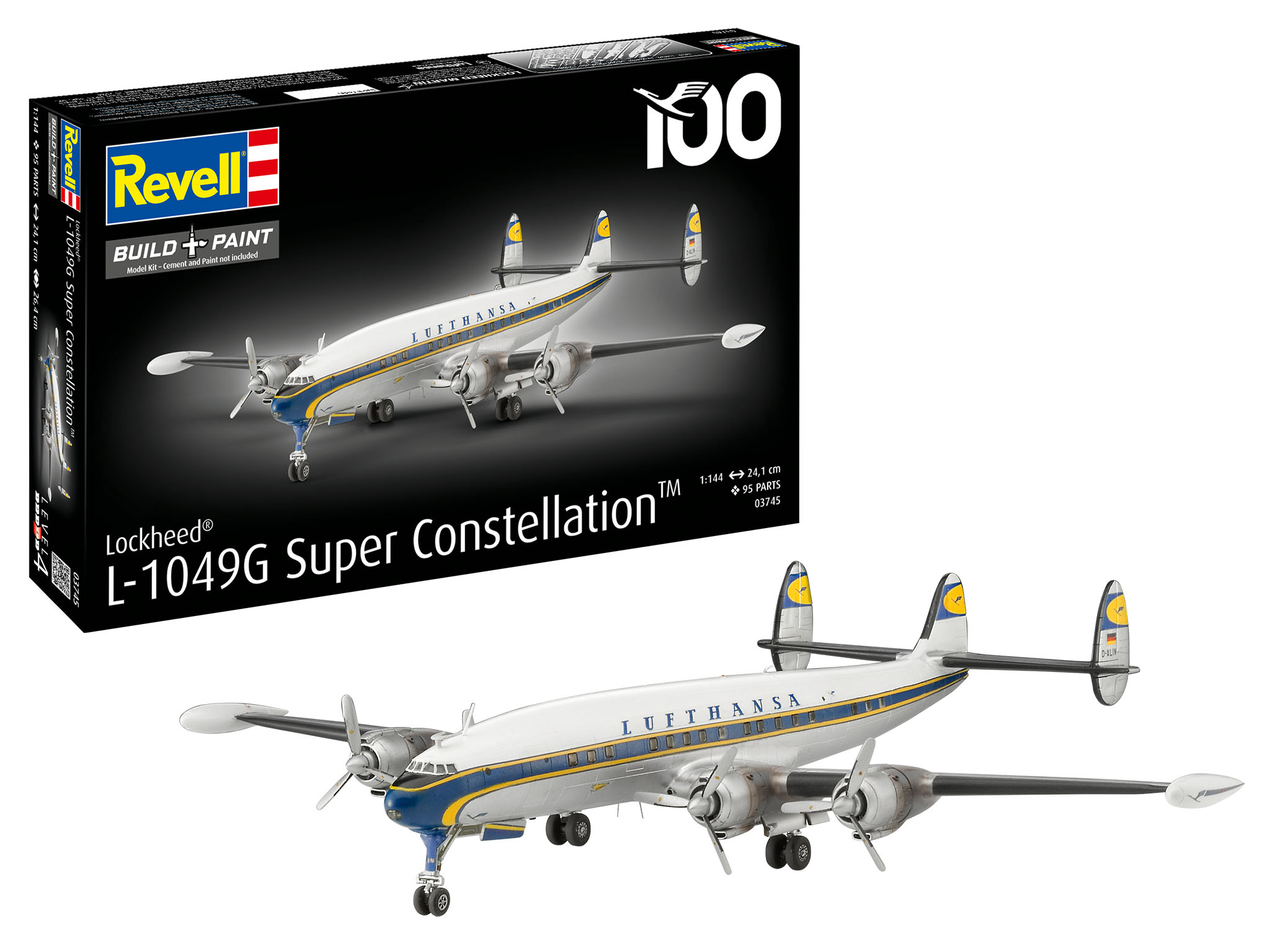
For many aviation enthusiasts, the Lockheed L‑1049G Super Constellation (Revell Shop Link) is not just an aircraft but a symbol of the golden age of civil aviation. Its elegant, rounded nose, slender wings and distinctive tail fins have made it one of the most photogenic aircraft ever to go into series production. The Super Constellation ties in seamlessly with the legendary “Connie” L‑049 and continues the line of Lockheed piston‑propeller airliners into the 1950s. For us as modellers, it is particularly exciting because it puts in our hands an aircraft that embodied luxury and comfort at the highest level.
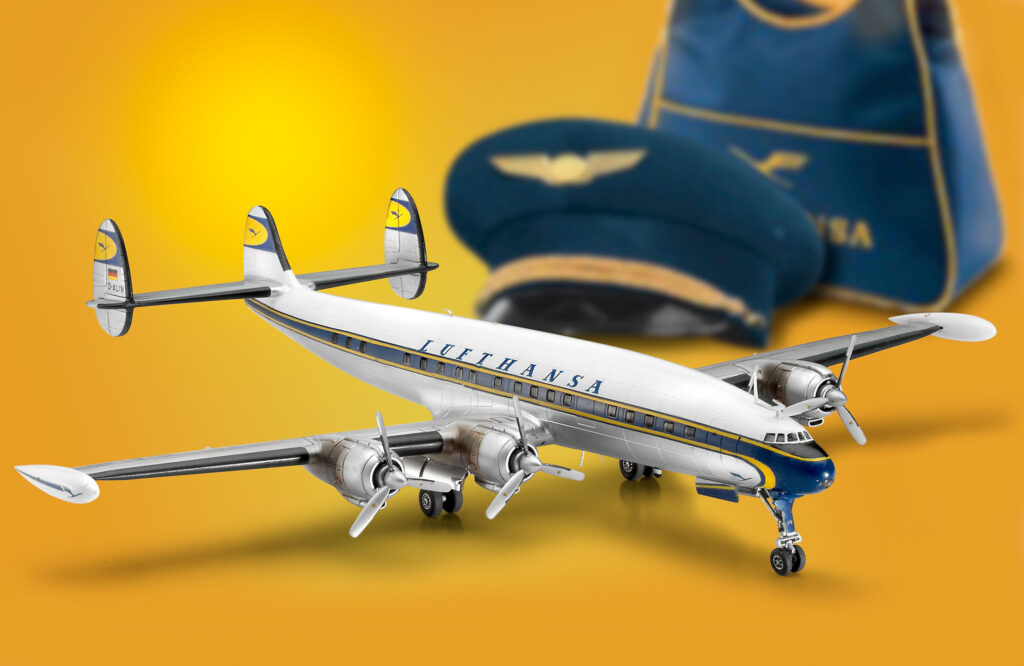
For Lufthansa, the Super Constellation marked the start of long‑haul operations in post‑war Germany. The first L‑1049Gs were delivered in 1955, including the famous “D‑ALEM”, with which the airline opened its transatlantic service on the Düsseldorf–Shannon–New York route. The Super Constellation was therefore also a political and economic statement: Lufthansa was back on the world stage. Every time you build this Lockheed L‑1049G today, you bring a piece of this history into your room or onto your display.
The Super Constellation at Lufthansa – flying with 50s flair
The eight L‑1049Gs that Lufthansa operated in the 1950s, together with the later L‑1649A Super Star Constellations, formed the core of the new airline’s first long‑haul fleet. At the time, the Super Constellation was an aircraft that carried passengers on Atlantic routes in a way you now only see in films or historical photos. The cabins were relatively spacious, the engines sounded deep and full, and the aircraft appeared noticeably more “human” than the later jet‑powered machines.
For us as modellers, this is particularly appealing because with the Revell kit you can capture precisely this era: the early 1950s Lufthansa livery, which you can recreate directly on the model. The Super Constellation was not just a workhorse, but also an image carrier. At that time, flying on an aircraft of this size was still perceived as a special way of travelling, and therefore particular attention was paid to elegant lines and a clean, distinctive paint scheme. The current retro livery of the preserved Super Constellations in Munich and Hermeskeil picks up this legacy again, and for many modellers the Revell kit is the perfect starting point for building such an aircraft with a long‑term perspective.
The “Connie” kit
Our model is currently unique. This makes the Lockheed L‑1049G Super Constellation Lufthansa variant in 1:144 scale one of the few, but very authentic mainstream kits of this iconic aircraft. Depending on your painting ideas, you can not only build it as a Lufthansa version, but also imagine it in the colours of TWA, Eastern or other airlines.
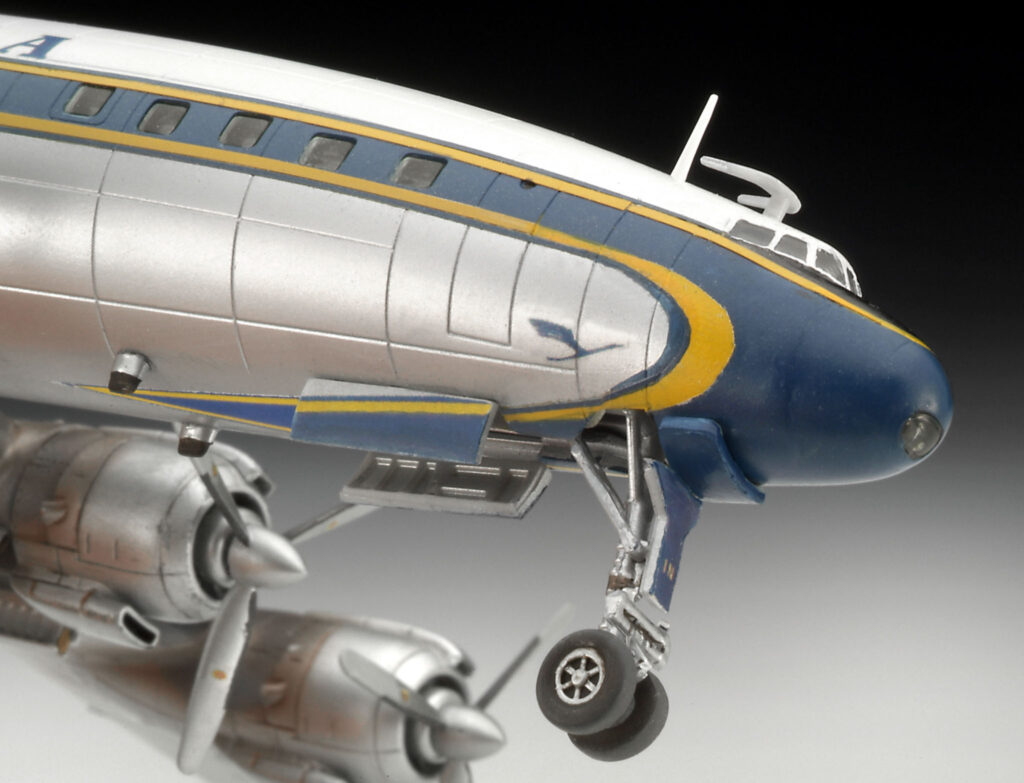
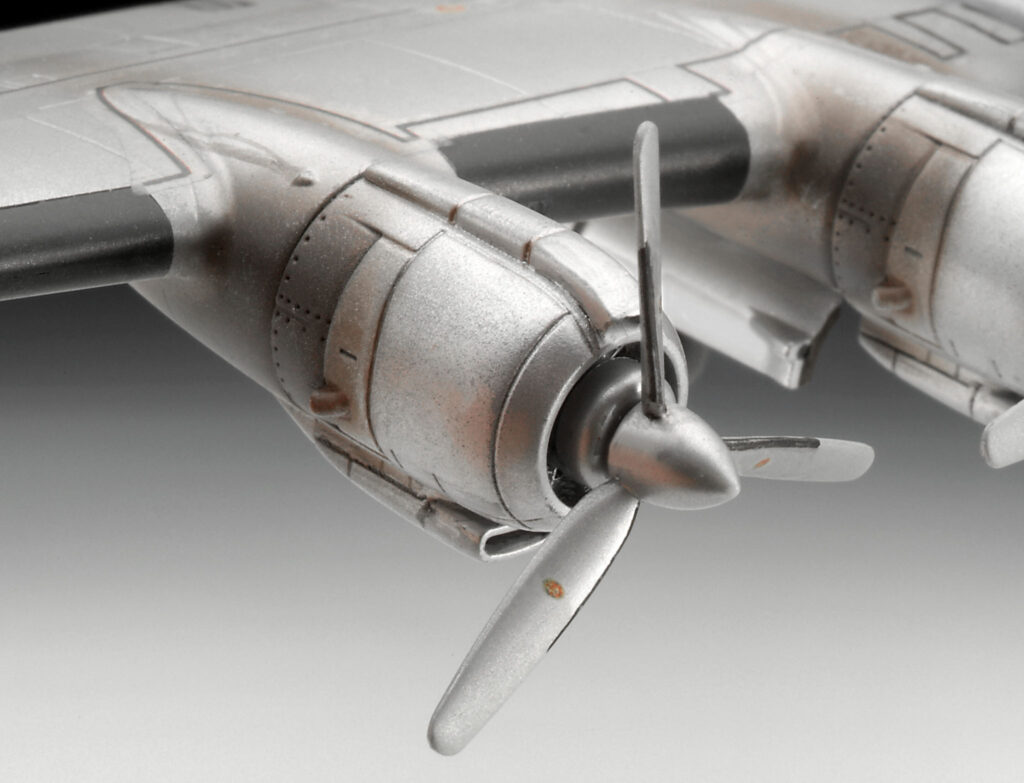
The shapes are flowing and rounded as on the original, and the contours of the wings and fuselage perfectly match the typical Lockheed silhouette. Particularly impressive is how the individual parts work together as a whole: the fuselage with its clean lines, the open windows in the correct openings, the detailed engine nacelles and the separately attached wing tips with their characteristic tip tanks. For the scale, the recessed panel lines are clearly defined but not overdone, so that after painting you get a calm, clean surface finish without every single groove getting in your way.
The kit on the workbench – 95 parts, Level 4
The kit comes with 95 individual parts and is classified as a Level‑4 model, which indicates that it is primarily intended for advanced modellers. You should already have some experience with aircraft kits in this scale, particularly in handling thin wing root joints, small struts and the careful assembly of tail units and wings. At the same time, the building instructions are structured so that you do not miss anything important, even if you do not have every reference on your desk.
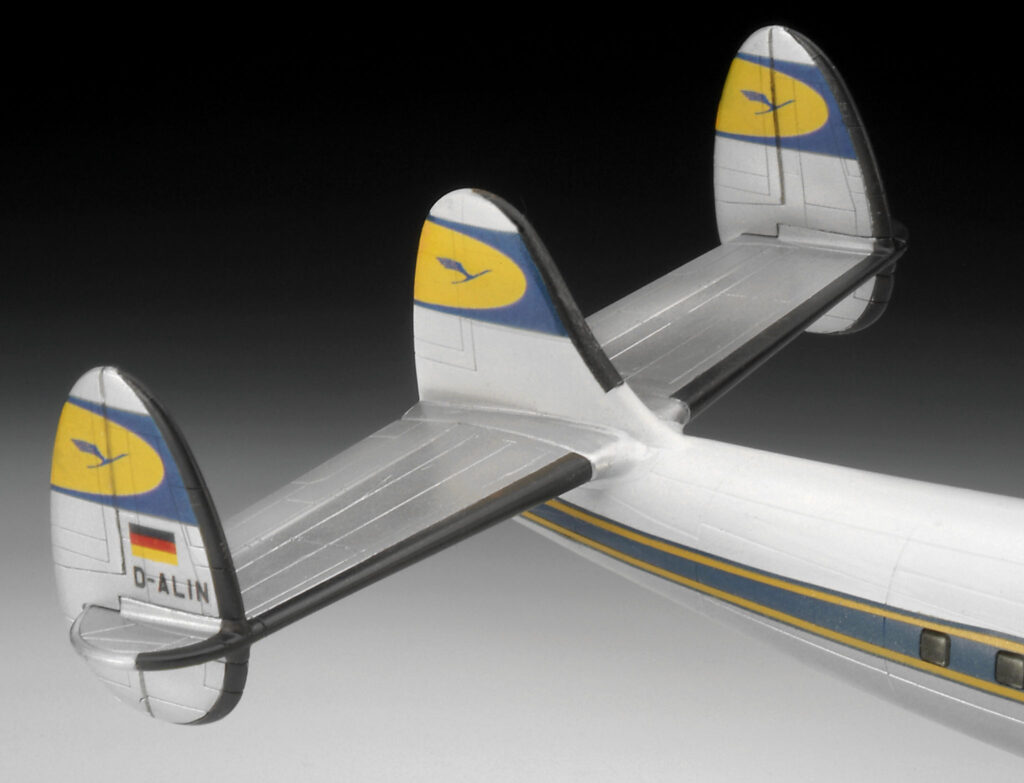
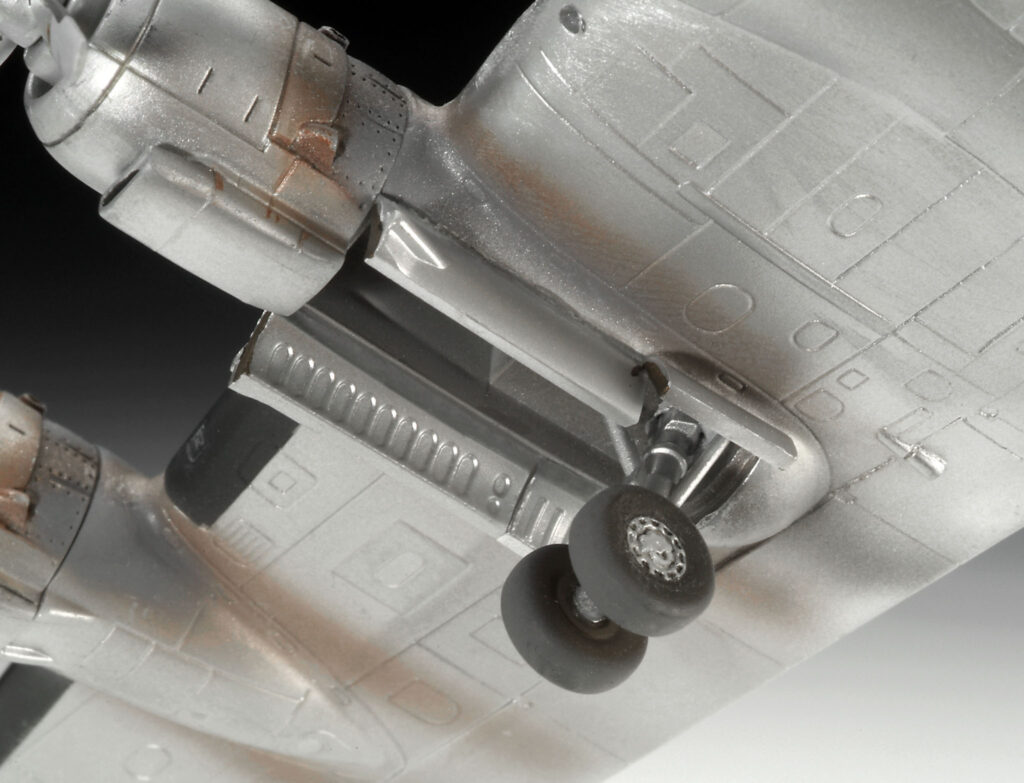
The construction of the kit follows a clear layout: two fuselage halves with pre‑opened window apertures, a matching cockpit section that you can optionally install, as well as the usual tail and wing elements. The wing tips and the auxiliary fuel tanks are separate parts, so you could theoretically also build a version without tip tanks, even though Revell’s presentation of the kit is based on the full tip tank configuration of the Super G version. In addition, there are the detailed radial engines and the landing gear legs, which are surprisingly delicate for 1:144 scale.
Where you should take your time
As with many aircraft kits, this one also benefits from a bit of “tuning” on your part. Depending on your particular moulding, the mating edges on fuselage and wings may require some filling or sanding work. The engine nacelles and the joint between wings and tip tanks are also areas where you should carefully check the fit before you start painting. If you like working on fine details, you can focus nicely on the landing gear struts, tail units and engine cooling air intakes without making the model look overloaded.
Correct alignment of the wings and tail fins is particularly important in 1:144 scale. The Super Constellation is a low, wide‑spanning aircraft, and even slight angular deviations stand out quickly with this kind of shape. However, the building instructions show clearly how the individual parts fit together and how much weight you need to place in the forward fuselage so that the aircraft does not sit on its tail. The “Difficulty Level 4” classification is therefore quite justified, but it means less “impossible” and more “for people who are aware of the details”.
The Super Constellation is not only a technical but also a cultural witness of its time. It has appeared in many documentaries and films about the post‑war era, often as a silent backdrop, sometimes as a symbol of status, wealth or escape. In numerous reports about the early Lufthansa or the development of international air traffic, it repeatedly makes an appearance, usually in the colours of TWA or Lufthansa. For modellers, this is interesting because with a model like this you can easily imagine a scene from a film or documentary.
The Constellation and Super Constellation are also popular as a backdrop in historical novels or aviation stories. They symbolise the era when long‑haul flights were still journeys with a special flair, with salad bowls, cocktails and stylish uniforms. If you are interested in these kinds of stories, building the Revell kit gives your model an additional narrative layer: you are recreating not just an aircraft, but an entire atmosphere.
Marienhof, series and retro aircraft – the Super Constellation today
In Germany, the Super Constellation is best known to the public through the preserved museum examples, such as the D‑ALIN at the aviation exhibition centre in Hermeskeil or the D‑ALEM in the visitors’ park at Munich Airport. These aircraft have been finished in retro Lufthansa liveries and now function like living airfield sculptures that transport visitors back to the 1950s.
For modellers, this is particularly appealing because with the Revell kit you can directly reference an aircraft that you may have visited in real life. The livery that you apply using the included decals is indeed an interpretation of the early Lufthansa scheme, but it stands firmly in the tradition of precisely these retro examples. If you like, you can further adjust the details to reference photos and thus build a version that closely follows the museum‑restored Super Constellations in the open air.
For a truly convincing look of the Super Constellation, it is worth paying attention to a few select but effective details. For example, on the wing surfaces and especially the tip tanks, you can emphasise panel lines or subtle shadowing along the joints so that the overall surface does not look too smooth. The engine nacelles and the propeller blades are also ideal areas for careful priming and subtle colour gradations.
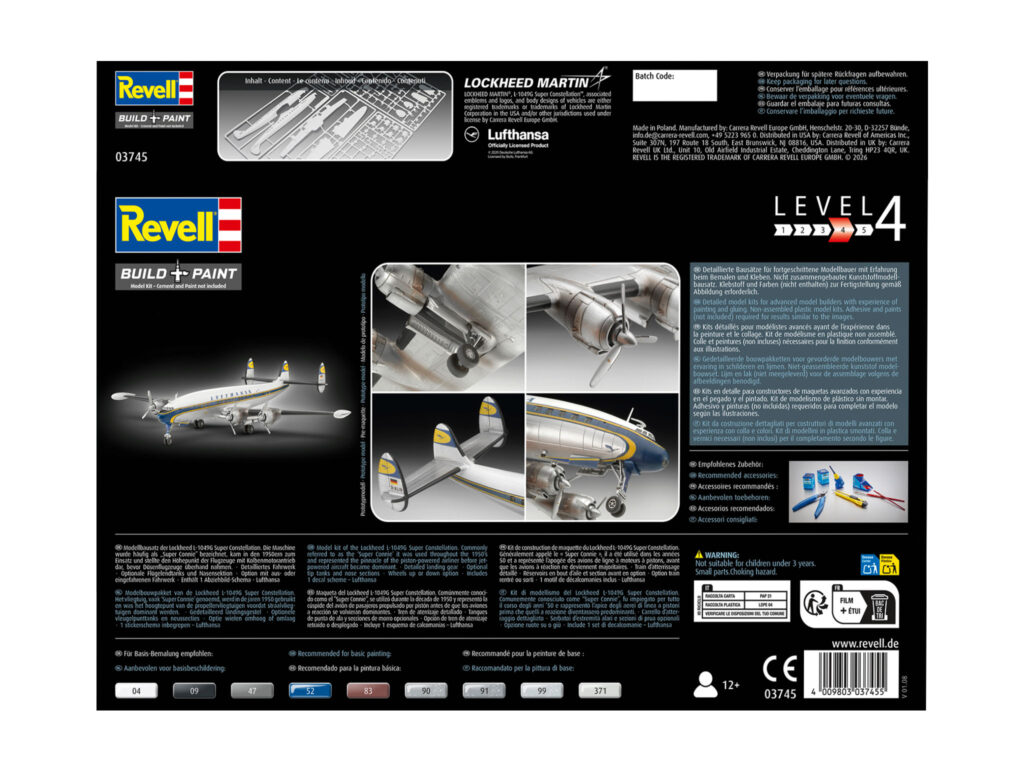
The window rows are already pre‑cut open in the Revell kit, which is a big plus because it eliminates masking work at least for the main passenger windows. If you want to add even finer details, you can place minimal structure inside the cockpit opening or use tiny masking dots to suggest instrument panels and round gauges. The decals are well printed, as is typical for 1:144; in particular, the small markings and stencils on the wings and fuselage can be applied without major problems.
Technical key data of the Super Constellation L‑1049G
The Lockheed L‑1049G Super Constellation was a technical step forward compared to the original Constellation. The fuselage was lengthened by about five metres compared with the L‑749, allowing for more passengers and payload. The basic wing layout remained unchanged, but the engines were more powerful. The L‑1049G used Wright R‑3350 Turbo‑Compound engines, each delivering around 3,200 hp. These engines used turbo‑compound technology, where power‑recovery turbines extract additional energy from the exhaust flow.
With a wingspan of about 38 metres and a length of just over 35 metres, the Super Constellation was not a particularly short aircraft, but it was relatively slim and agile for a long‑haul airliner. Its maximum speed was about 600 km/h, with a cruising speed of around 550 km/h. In addition, it had a range of over 8,000 kilometres, which was an enormous achievement for the 1950s and allowed Lufthansa to launch transatlantic services from Germany with the Super Constellation without having to rely constantly on intermediate stops.
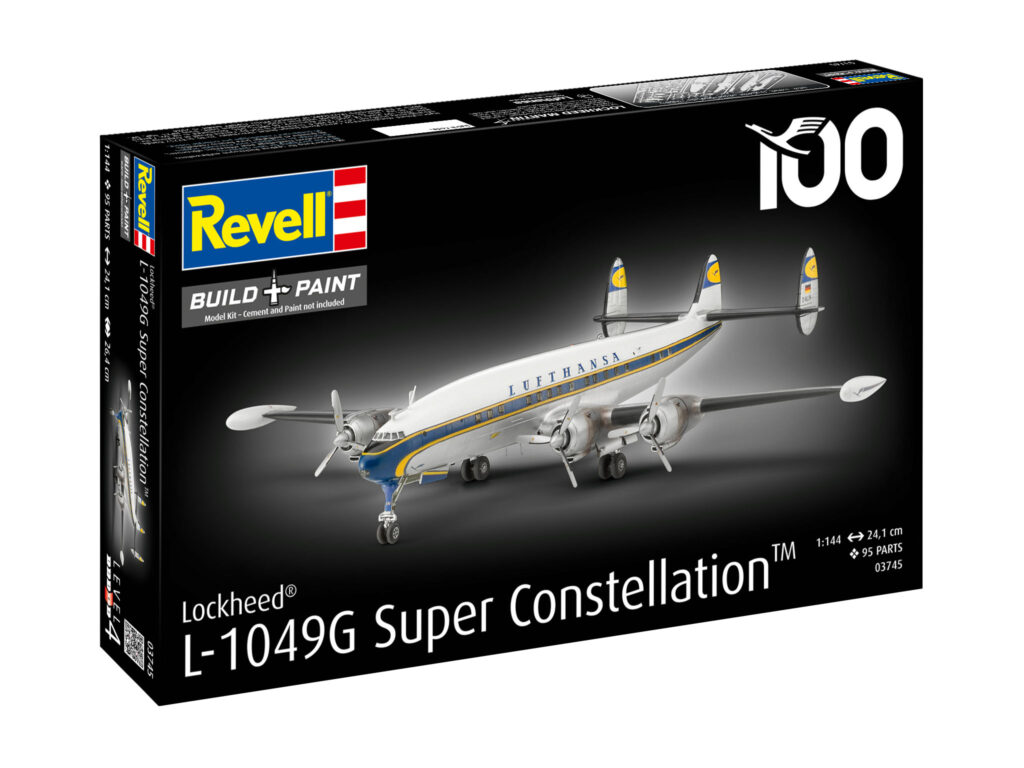
The Revell component within the theme of 1950s civil aviation is deliberately compact and precise. The Super Constellation L‑1049G Lufthansa is not just a “vintage reissue”, but a model updated in spirit and design to meet today’s expectations while still closely following the historic original airframe. For modellers, this means that with a single kit you gain access to an aircraft that, in other scales, is sometimes only available as a rare vacuform or resin kit or not at all.
For your workshop, this aircraft is a beautiful addition if you have already worked on jet airliners such as the Boeing 707 or similar modern machines. The Super Constellation provides a counterpoint: it comes with piston engines, clearly visible mechanical systems on the engines and wings, and a more classic tail unit design. If you ever plan a scene with different types of aircraft, this Revell kit allows you to build a bridge between the last major propeller airliners and the early jet aircraft.
For us as modellers, the Lockheed L‑1049G Super Constellation Lufthansa is a kind of time machine. It combines technical details, historical relevance and an appearance that is simply enjoyable to build and even more enjoyable to display. With the Revell kit in 1:144 scale, you get a tool that is suitable both for hands‑on work at the bench and for engaging with the history of Lufthansa. Whether you build the aircraft as a classic sales display or as part of a larger diorama is entirely up to you.
Inspiration for the build
Lockheed L-1049G Super Constellation – walk around & inside – Flugausstellung Hermeskeil 2016
Lufthansa Lockheed Super Constellation L-1049 G
Simulator Lufthansa | Lockheed L-1049G ” Super Constellation “| Die Königin der Lüfte | Simulator , Simulation
VHS-Rip Deutsche Lufthansa Lockheed L-1649A Starliner Promo Film 1958, GER